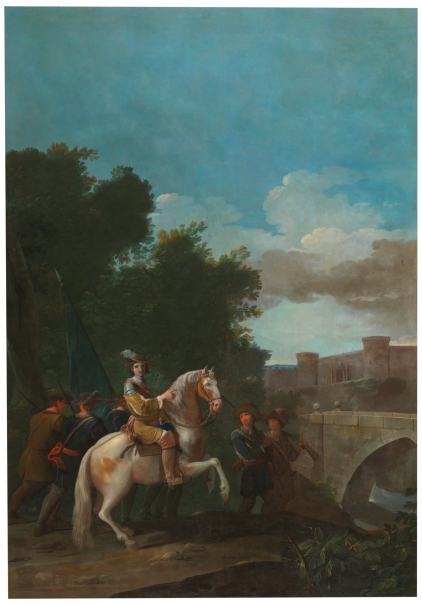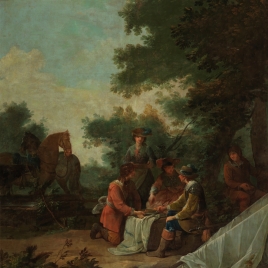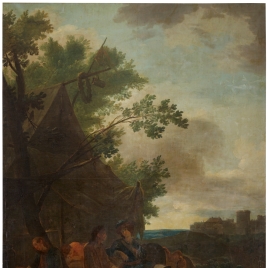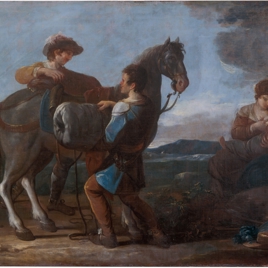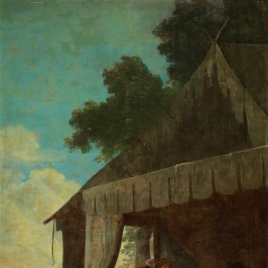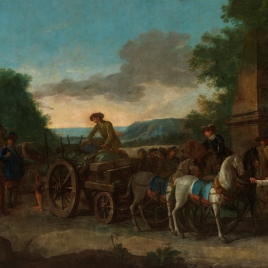
An officer on horseback and four foot-soldiers
1776 - 1778. Oil on canvas.Not on display
This work is part of the series of tapestry cartoons executed for the Royal Tapestry Factory of Santa Bárbara in Madrid, between 1750-1800.
Antonio González Velázquez (1723–1794) started working on these works in 1765, during the reign of Charles III, King of Spain (1759–1788). According to the existing documents, he produced 71 pieces for tapestries bound for different spaces in the Royal Sites, even though the production of some of them was later called off.
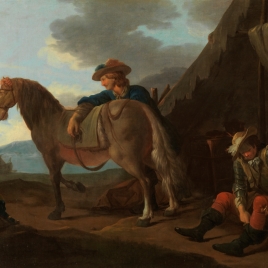
This work is the result of a 1776 commission that lasted until 1778. It belongs to a subseries consisting of 17 scenes of a military nature that include gallantry scenes between soldiers and ladies, bivouacs, convoys, and other encampment subjects. They were inspired by the paintings of Philips Wouwerman (Haarlem, 1619–1668), an 18th-century Dutch painter, according to the tastes of the time. They were intended for the decoration of the Silverware Room in the King’s Apartment, within the new extension of El Pardo Palace in the outskirts of Madrid.
That group of works met different fates. It was transported from the holdings of the Royal Factory to the Tapestry Department of the Royal Palace in Madrid, and then to the Casino del Príncipe, from which it was ultimately and officially transferred to the Museo del Prado in 1870. For unknown reasons, this work – back then with inventory number 5688 – disappeared on an uncertain date during those years and ended up on the international art market many years later. The antiquities dealer Eufemio Díez Monsalve acquired it, from whom the Museum eventually purchased it.
Museo Nacional del Prado, Memoria de actividades 2010, Madrid, Museo Nacional del Prado, 2011, p.22-23