formularioRDF
The itinerary <em>TITULORECORRIDO</em> has been successfully created. Now you can add in works from the Collection browser
<em>TITULOOBRA</em> added to <em>TITULORECORRIDO</em> itinerary

Close Continuar a ficha de la obra Continuar a ficha de la obra
18-02-2026
Francesco Albani

Bologna, 1578 - Bologna, 1660

Francesco Albani See author's file

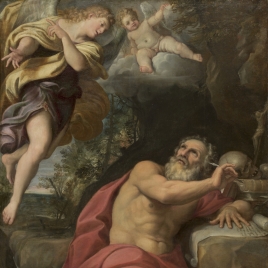
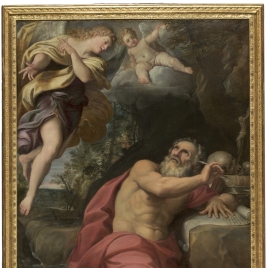
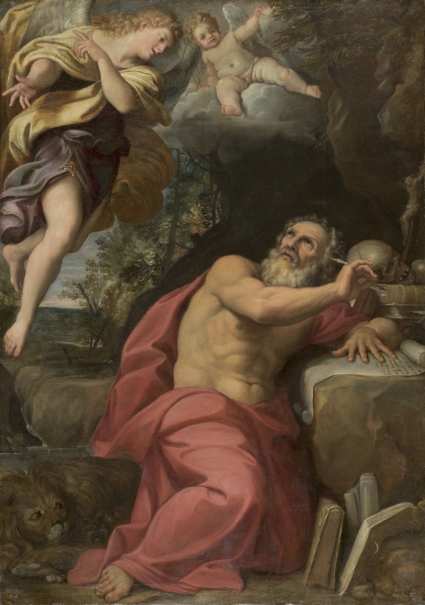
Apparition of the Angels to Saint Jerome

1602 - 1603. Oil on canvas.
Room 004

This painting entered the royal collection during the reign of Charles IV, King of Spain. In his inventory of the Casita del Principe (Cottage of the Prince) in El Escorial, it is registered as a work by Lucio Massari. This attribution also appears in the inventory of Ferdinand VII, King of Spain, in Palacio Real Nuevo, where it was located in 1814. However, in the Real Museo’s inventory of 1857, the painting is already associated with Domenichino. This association follows the proposal of Pedro de Madrazo filed in the museum catalogues that he wrote from 1843 onwards and was subsequently maintained in the institution’s publications until 1996.

The first researchers to study this painting debated between its attribution to Domenichino’s catalogue (Voss, 1924) and that of Annibale Carracci (Mahon, 1960). The first author to associate the work with Francesco Albani was Posner, also in 1960. This was an opinion that generated practically unanimous consensus among later specialists. However, it was Pérez Sanchez (1965) who, contrary to this belief, reaffirmed its historical attribution to Massari from the inventory of Charles IV. Nonetheless, the attribution to Albani has been consolidated mainly through the works of Cavalli (1962), Borea (1965), and especially Puglisi (1999) and Benati (1981, 1983 and 2022), who have provided solid arguments in favour of including this painting as part of the artist’s early phase.

This attribution is based on the painting’s evident formal similarity to other early works by Albani, including Resurrected Christ appears before the Virgin, produced for the oratory of San Colombano (around 1597–98), the Assumption of the Virgin for that of San Domenico (around 1600–01), and the Nativity of the Virgin for the church of Santa Maria della Pietà or of the Piombo (around 1600), now in the Pinacoteca Capitolinea. With these early works, the Prado’s painting shares the same angelic typology and a similar taste for Annibale Carracci’s classicism. This is exemplified by the treatment of the muscles, forms inspired by Rafael and some of Correggio’s softness, and sfumato of the contours. Based on these facts, Puglisi (1999) and Benati (2022) consider the Madrid work to have been produced shortly after these paintings, at the beginning of the artist’s Roman period around 1602–03.

Albani based the general distribution of the scene and the figures on a print by Agostino Carracci who, in turn, drew inspiration from a composition by Tintoretto dated 1588. As a reference for the lion, he looked to a drawing by Agostino that is now preserved in Windsor Castle. In considering Albani’s creative process, we should take into account a preparatory drawing that includes the same theme and identical placement of the figures (Milan, Civiche Raccolte, inv. C728-5874) and that was executed in pencil and watercolour with white highlights.

Finally, documentary evidence proves the existence of up to three replicas of this composition, which are currently lost. However, these are testimony of how well the work was received in Italian circles. One of the latter is documented in the Palazzo Campeggi in Bologna (around 1769), and two others in the Costaguti collection (1712) and the Sacchetti collection (1726) in Rome (Information updated by the Department of Italian and French Painting up to 1800 on 8 April 2022).
Multimedia

Technical data

Imagen del carrusel
Imagen del carrusel
Inventory number
P000130
Author
Francesco Albani
Title
Apparition of the Angels to Saint Jerome
Date
1602 - 1603
Technique
Oil
Support
Canvas
Dimension
Height: 184 cm; Width: 129 cm
Provenance
Royal Collection (acquired by Charles IV, King of Spain?; Casita del Príncipe (Cottage of the Prince), El Escorial, Madrid; Palacio Real, Madrid, first room of the new construction, 1814–18, no. 206).

Bibliography +

Madrazo, Pedro de, Catálogo de los cuadros del Real Museo de Pintura y Escultura de S.M redactado con arreglo a las indicaciones del Director actual del este Real Establecimiento, Oficina de Aguado, Impresor de Cámara, Madrid, 1843, pp. 130, nº 630.

Voss, Hermann, Die Malerei des Barock in Rom, Propylaen Verlag, Berlín, 1924, pp. 198, 509.

Mahon, Denis, Italian art and Britain, Winter Exhibition, Royal Academy of Arts, Londres, 1960, pp. 156.

Posner, Donald, Annibale Carracci and his School: The Paintings of the Herrera Chapel, Arte antica e moderna, 12, 1960, pp. 411, nº 66.

Cavalli, Gian Carlo, L'ideale classico del Seicento in Italia e la pittura di paesaggio, Edizioni Alfa, Bolonia, 1962, pp. 97.

Pérez Sánchez, Alfonso E., Algunos pintores italianos del siglo XVII en el Museo del Prado, Archivo Español de Arte, XXXV, 1962, pp. 54.

Pérez Sánchez, Alfonso E., Pintura italiana del S. XVII en España, Universidad Fundación Valdecilla, Madrid, 1965, pp. 165, 166.

Borea, Evelina, Domenichino, Edizioni per il Club del Libro, Milán, 1965, pp. 193.

Sánchez Cantón, Francisco Javier, Museo del Prado. Catálogo de las pinturas, Museo del Prado, Madrid, 1972, pp. 174.

Benati, Daniele, Qualche osservazione sulla attività giovanile di Francesco Albani, Paragone. Arte, 32, 381, 1981, pp. 52, lám. 38.

Puglisi, Catherine R., Early works by Francesco Albani, Paragone. Arte, 32, 381, 1981, pp. 26-47.

Benati, Daniele, Albani, Francesco, Allgemeines Künstlerlexikon: die Bildenden Künstler aller Zeiten und Völker, E. A. Seemann, Leipzig, 1983, pp. 766.

Museo Nacional del Prado, Catálogo de las pinturas, Museo del Prado, Madrid, 1985, pp. 183-184.

Museo Nacional del Prado, Museo del Prado. Inventario general de pinturas (I) La Colección Real, Museo del Prado, Espasa Calpe, Madrid, 1990, pp. nº 630.

Museo Nacional del Prado, Catálogo de las pinturas, Ministerio de Educación y Cultura, Madrid, 1996, pp. 93-94, nº 130.

Réau, Louis, Iconografía del arte cristiano, Serbal, Barcelona, 1997, pp. 134.

Puglisi, Catherine R., Francesco Albani, Yale University Press, New Haven, 1999, pp. 101-102, nº 18, fig. 36.

Benati, Daniele, Annibale Carracci y los «boloñeses» en Roma, En: Andrés Úbeda de los Cobos (dir), Annibale Carracci: los frescos de la capilla Herrera en Roma, Museo Nacional del Prado, Madrid, 2022, pp. 55, fig. 20.

Other inventories +

Inv. Fernando VII, Palacio Nuevo, 1814-1818. Núm. 206.
Primera pieza de la obra nueva [...] {21324} 206 / Dos varas y media de alto dos menos cuarta de ancho, San Jerónimo en el desierto con dos Angeles y el leon = Lucio Masaci

Museo Real de Pinturas a la muerte de Fernando VII, 1834. Núm. 206.
DEPÓSITO GRANDE / ESCUELA ITALIANA [...] Depósito de entresuelo / Dos cientos seis. San Gerónimo escribiendo y el Angel, figuras de cuerpo entero / / Lº / 2.100

Catálogo Museo del Prado, 1854-1858. Núm. 630.

Inv. Real Museo, 1857. Núm. 630.
Dominiquino (Dominico Zampieri, llamado el) / 630. San geronimo escribiendo en el desierto. / Irrumpe los trabajos del santo la aparicion de dos angeles. A sus pies se ve un leon. / Alto 6 pies, 7 pulg; ancho 4 pies, 7 pulg, 6 lin.

Catálogo Museo del Prado, 1872-1907. Núm. 147.

Catálogo Museo del Prado, 1910. Núm. 130.

Catálogo Museo del Prado, 1996. Núm. 130.

Inscriptions +

Trazo de carboncillo en forma de "C"
Frame, back, upper bar

206.
Inscribed in white. Front, lower left corner

Marco arreglado / G
Scrap of paper. Frame, back, left side bar

San Jeronimo
Inscribed. Frame, back, lower bar

Cartela moldurada: 130 / DOMENICHO ZAMPIERI / IL DOMENICHINO / (1581-1641) / SAN JERONIMO
Frame, front, lower bar

De la hoja
Inscribed with chalk. Back, right side

No 85 Sn Geronimo / escriviendo
Scrap of paper. Frame, back, left side bar

No 85 Sn Geronimo/ Escriviendo
Scrap of paper. Stretcher, left side bar, at center

Marco arreglado. G.
Scrap of paper. Stretcher, left side bar

630.
Inscribed in orange. Front, lower left corner

P.e N.ro S.or [Príncipe Nuestro Señor]
Inscribed in pen and ink. Back, central area

M.N.PRADO 00130
On metallic tablet. Frame, back, upper bar

Location +

Room 004 (On Display)

Expuesto
Update date: 18-02-2026 | Registry created on 02-12-2015

Visor 360

Drag with the cursor to rotate the piece

Other works by Francesco Albani

Print on demand

Print artworks available in our catalogue in high quality and your preferred size and finish.

Image archive

Request artworks available in our catalogue in digital format.

Up