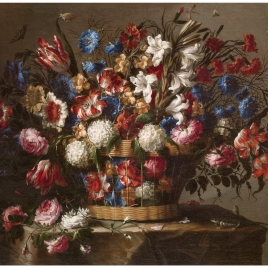
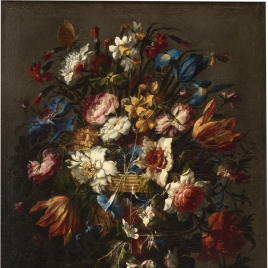
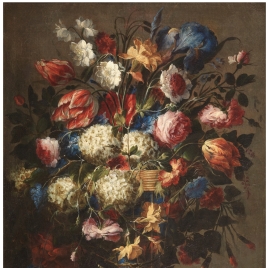
Basket of Flowers
Ca. 1670. Oil on canvas.Room 018
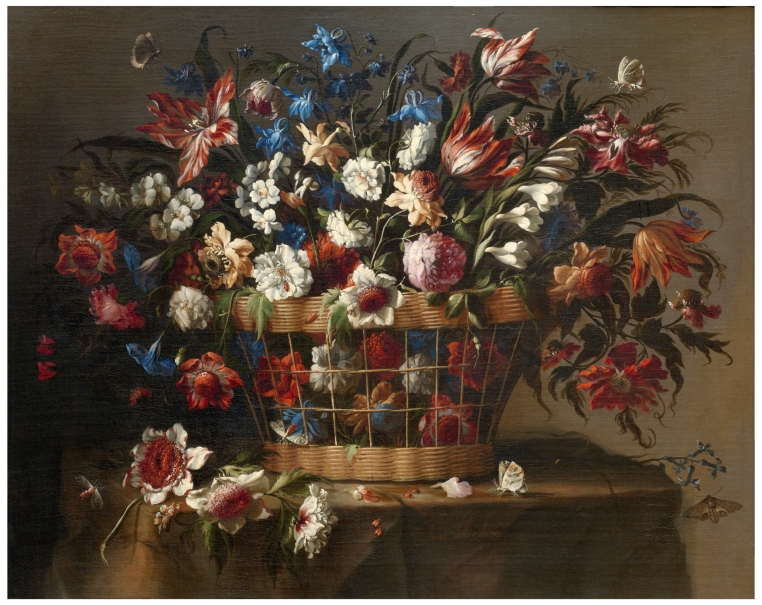
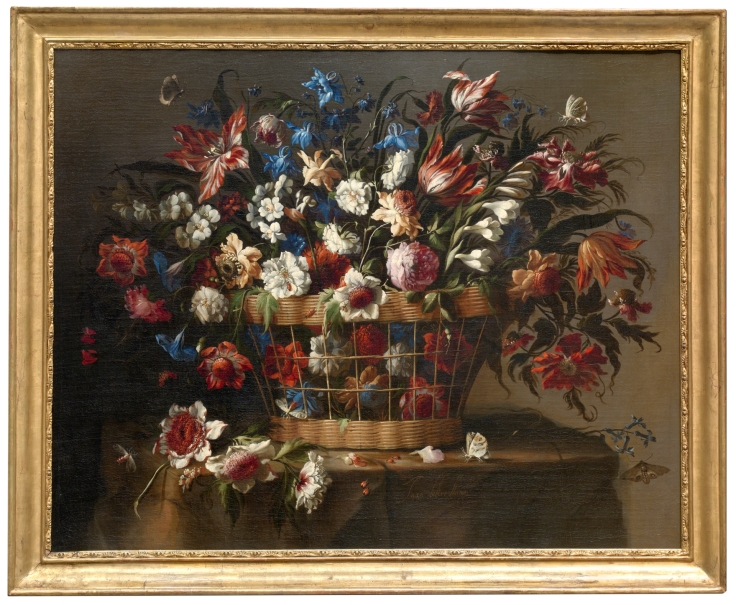
Throughout his career, Juan de Arellano executed flower pieces of a horizontal format that represent bouquets in open weave wicker baskets. During the last decade of his career, he painted a number of these works on a large scale that constitute the apogee of his flower pieces of this type. The basket motif also appears in a number of other flower paintings from the period, such as Antonio Ponce´s The Month of May (Private Collection), a picture which may be indebted to a prototype by Juan van der Hamen. In this picture, the flowers in the basket are depicted in a looser, more unruly manner than the formally arranged bouquet in a vase. Indeed, the iconography of the basket of flowers may differ from other forms of presentation in that these are to be imagined as recently gathered from a garden, as they have been in Tomas Hiepes´s painting of a Girl Making Posies in a Garden (Private Collection). In the works of both Arellano and Ponce their freshness is evoked by their heaving, undulating vitality, that is such as to have pushed out a number of the blooms from the basket. The butterflies that have been attracted to the arrangement in Arellano´s painting also serve to underline the vernal beauty of the flowers.
Despite the apparently natural appearance of the flowers, their arrangement conforms to Arellano´s habitual compositional practice, in terms of the disposition of the blooms and their chromatic harmony. The painter from Santorcaz has, if anything, increased the illusionistic three-dimensionality of the arrangement in this late work. He has carefully articulated the perspective of the flowers, turning these into pictorial depth towards the extremities of the composition and reinforcing the illusion of volume in the composition by dramatically counterpointing the strongly lit flowers at the left of the basket against the dark background, while silhouetting those at the right-hand side of the basket against a luminous ground. In fact, Arellano´s style changed little during the last twenty years of his career. However, the flowers in this painting are the product of many years of experience in this field and are modelled with considerable fluency and freshness of touch. The Spanish painter´s confident, rhythmic brushwork is responsible for endowing the blooms, leaves and stems with the sense of dynamic, pulsating life that was always one of the most compelling qualities of his art. Although the insects present in the picture might remind the viewer of the Flemish flower pieces that Arellano had emulated as a young artist, these are relatively broadly painted and his work shows little of the microscopic detail for which Northern specialists were so admired. Arellano´s flower piece rather exudes a decorative splendour that is one of his abiding artistic qualities. It is likely that this painting had a pendant pair or formed a part of an even larger ensemble of paintings and would have produced a spectacular impression as decoration in the richly appointed interior of a 17th century collector (Text drawn from Cherry, P.: Spanish Flower Painting in the Golden Age, Museo Nacional del Prado, 2002, p. 104).