formularioRDF
The itinerary <em>TITULORECORRIDO</em> has been successfully created. Now you can add in works from the Collection browser
<em>TITULOOBRA</em> added to <em>TITULORECORRIDO</em> itinerary

Close Continuar a ficha de la obra Continuar a ficha de la obra
17-02-2026
Pasquale Chiesa

Génova, 1630 - (¿?), 1654

See author's file

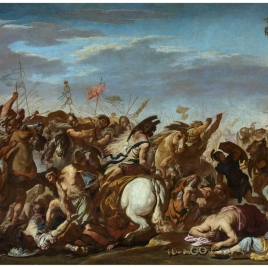
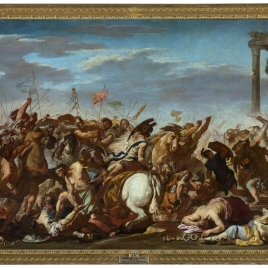
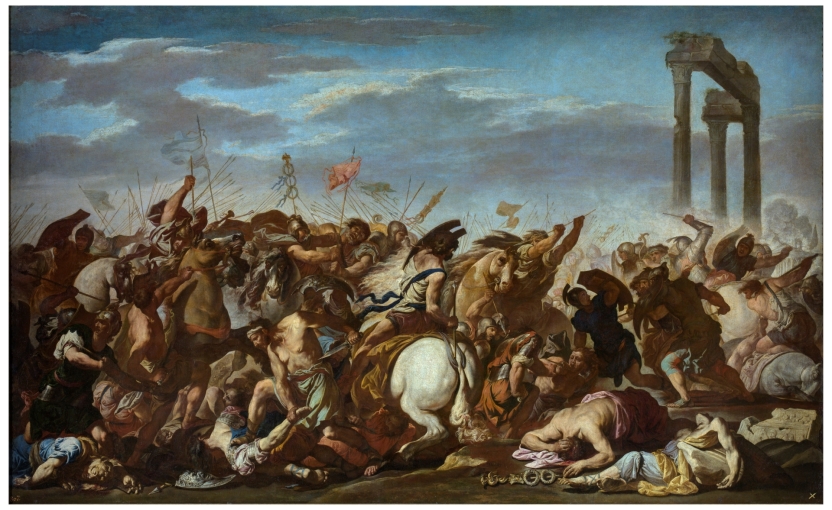
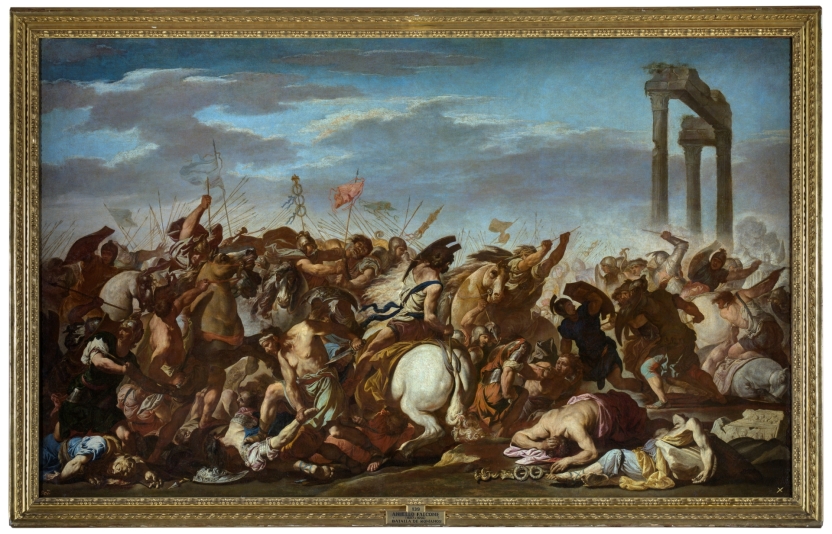
Battle

1650 - 1654. Oil on canvas.
Not on display

The Battle is a work well-known to specialists in 17th-century Neapolitan painting, largely because it was included in the original catalogue of the 1985 exhibition in Madrid on the subject. On that occasion, Pérez Sánchez attributed the work to Aniello Falcone, the name traditionally associated with the canvas. In 1857, it was included in an inventory as a work presumed to have been from early in Falcone’s career and closely linked to traditional examples of its genre stemming from Antonio Tempesta’s Room of Constantine in the Vatican, as Martín Soria had already pointed out. The attribution to Falcone was supported by an unsuitable comparison with The Battle in the Louvre, dated 1631, making it one of the cornerstones of the Neapolitan painter’s corpus. It replaced an older – and not entirely unsubstantiated – attribution to Salvator Rosa, who had been associated with the painting from its first appearance in the 1746 inventory of the collections of Philip V, King of Spain. The heroic and classical dimension of the composition is starkly different from Falcone’s realism. Moreover, the grandiloquence of the work evokes the ancient world and is undoubtedly more aligned with the Roman origins of The Battle, of which Rosa was a decisive interpreter from the mid-17th century onwards.

Nonetheless, even the aspects of Rosa’s work do not seem to fully corroborate attributing the painting (which is not even mentioned in monographs on the Neapolitan-born artist). The overtly brutal naturalism of the depiction, which evokes late Ribera – albeit with the help of some Roman examples in the style of Mattia Preti and Giacinto Brandi – is more reminiscent of Pasquale Chiesa, a little-known artist of Genovese origin. He was mainly active in Rome and the recovery of his works has been undertaken by Eduard Safarik and Andrea Giovanni De Marchi drawing from a large group of works executed around the mid-17th century and kept ab antiquo in the Doria Pamphilj collection in Rome.

While the formative elements of the style of ‘Pasquale Genovese’ – born around 1630 and died prematurely in 1654 – had already been highlighted by some sources (‘a disciple of Salvator Rosa and [...] a very great imitator of the Spagnoletto’, as Sebastiano Resta recalled in a letter), recent studies – particularly those of De Marchi – have insisted above all on the Neapolitan influence on Chiesa’s painting. Although no evidence of direct contact with the Parthenopean circle has been found, it is certain that most of the artist’s works, including the Prado canvas, featured, or still feature, Neapolitan labels. This is exemplified in the Martyrdom of Saint Andrew in the Palazzo Barberini in Rome, previously attributed to Onofrio Palumbo (as well as to Rosa), or, among those not yet formally recognised, in Christ among the Doctors in the Temple in the John and Mable Ringling Museum of Art in Sarasota, formerly attributed to Andrea Vaccaro. Another example is The Incredulity of Saint Thomas in the Kunsthistorisches Museum in Vienna, which was doubtfully attributed to Paolo Finoglio.

The light setting of The Battle must surely be surprising when compared to the sombre dimensions more typical of Chiesa’s creations. Nevertheless, evidence of the attribution of the canvas to Chiesa includes the similarity between the techniques of the banners and the drapery in The Incredulity of Saint Thomas, or the unnatural anatomies of the combatants, emboldened by the plebeian vigour that constitutes the artist’s unmistakable, expressive style.

Porzio, Giuseppe, Algunas puntualizaciones sobre la pintura italiana del siglo XVII en el Prado: Giuseppe di Guido y Pasquale Chiesa. Boletín del Museo del Prado, 2019-2021, p.85-90 [87-89 f.2]
Technical data

Imagen del carrusel
Imagen del carrusel
Inventory number
P000139
Author
Pasquale Chiesa
Title
Battle
Date
1650 - 1654
Technique
Oil
Support
Canvas
Dimension
Height: 133 cm; Width: 215.00002 cm
Provenance
Royal Collection (Felipe V, Palacio de La Granja de San Ildefonso, Segovia, 1727; La Granja, 1746, nº 401; Palacio de Aranjuez, Madrid, pieza de música, 1794, nº 401; Aranjuez, Consejo de Estado, 1818, nº 401).

Bibliography +

Allgemeines Künstlerlexikon : die bildenden Künstler aller Z, Saur, 1915, pp. 217.

Pérez Sánchez, Alfonso E., Pintura italiana del S. XVII en España, Universidad Fundación Valdecilla, Madrid, 1965, pp. 388.

Pérez Sánchez, Alfonso E., Pintura italiana del siglo XVII. Exposición conmemorativa del ciento cincuenta aniversario de la fundación del Museo del Prado, Ministerio de Educación y Ciencia, Madrid, 1970, pp. 234.

Sánchez Cantón, Francisco Javier, Museo del Prado. Catálogo de las pinturas, Museo del Prado, Madrid, 1972.

Pérez Sánchez, Alfonso E, Pintura napolitana. De Caravaggio a Giordano, Museo del Prado, Ministerio de Cultura, Madrid, 1985, pp. 126/ lám.36.

Museo Nacional del Prado, Catálogo de las pinturas, Museo del Prado, Madrid, 1985, pp. 218.

Museo Nacional del Prado, Museo del Prado: inventario general de pinturas (I) La Colección Real, Museo del Prado, Espasa Calpe, Madrid, 1990, pp. nº807.

Aterido Fernández, Ángel; Martínez Cuesta, Juan; Pérez Preciado, José Juan, Colecciones de pinturas de Felipe V e Isabel Farnesio. Inventarios Reales, II, Fundación de Apoyo de la Historia del Arte Hispánico, Madrid, 2004, pp. 394.

Luna, Juan José, Guerra y pintura en las colecciones del Museo del Prado. Siglo XVI a Goya, Arte en tiempos de guerra, Jornadas de Arte, Madrid, 2009.

Porzio, Giuseppe, Algunas puntualizaciones sobre la pintura italiana del siglo XVII en el Prado: Giuseppe di Guido y Pasquale Chiesa, Boletín del Museo del Prado, XXXVII, 2019-2021, pp. 85-90 [87-89 f.2].

Spinosa, Nicola, Aniello Falcone: e i pittori della sua cerchia (1625-1656), SilvanaEditoriale,, 2023, pp. 135 nº60.

Other inventories +

Inv. Felipe V, La Granja, 1746. Núm. 401.
Una Batalla origl en Lienzo, de mano de Salvador Rossa, donde ày distintas Figuras de à pie, y à Cauallo, con los estandartes e insignias qe acostumbraban los antiguos Romanos, puestas en el uno las quatro sigtes letras S.P.Q.R. Tiene quatro tercias, y diez dedos de alto; dos varas, y media de ancho. Marcos dorados como el antecte...1

Inv. Testamentaría Carlos III, Aranjuez, 1794. Núm. 401.
Pieza de musica [...] {201} 401 / Siete pies y tres quartos de largo y quatro y tres quartos de alto Batalla co varias figuras y un Estandarte Con Ynsignias de las que usaban los Romanos. Salbador rosa ... 12000

Inv. Fernando VII, Aranjuez, 1814-1818. Núm. 401.
Consejo de Estado [...] {20962} 401 / Dos varas y media largo vara y tercia alto, batalla de romanos y ruinas = Rosa

Catálogo Museo del Prado, 1854-1858. Núm. 807.

Inv. Real Museo, 1857. Núm. 807.
Falcone (Aniello) / 807. Una batalla. / Choque entre caballería e infantería, donde por todas partes reina la confusión, el encono y el espanto. / Alto 4 pies, 9 pulg; ancho 7 pies, 8 pulg, 6 lin.

Catálogo Museo del Prado, 1872-1907. Núm. 156.

Catálogo Museo del Prado, 1910. Núm. 139.

Catálogo Museo del Prado, 1942-1996. Núm. 139.

Inscriptions +

807
Inscribed in orange. Front, lower left corner

X
Cross of Burgundy or Cross of Saint Andrew, collection’s mark belonged to King Felipe V. Front, lower right corner

Displayed objects +

Trompet: Trompeta natural de la que se ve únicamente la campana, sin que se haya detallado el resto del instrumento, que surge al fondo de la escena, en el lado izquierdo, entre los combatientes en el campo de batalla. Posiblemente se hace referencia a una trompeta natural recta. Detrás se perfila la campana de otro aerófono de metal, pero queda menos preciso (Proyecto de Iconografía Musical, U.C.M.)

Update date: 17-02-2026 | Registry created on 02-12-2015

Visor 360

Drag with the cursor to rotate the piece

Print on demand

Print artworks available in our catalogue in high quality and your preferred size and finish.

Image archive

Request artworks available in our catalogue in digital format.

Up