Cervantes and his models
1887. Oil on canvas.On display elsewhere
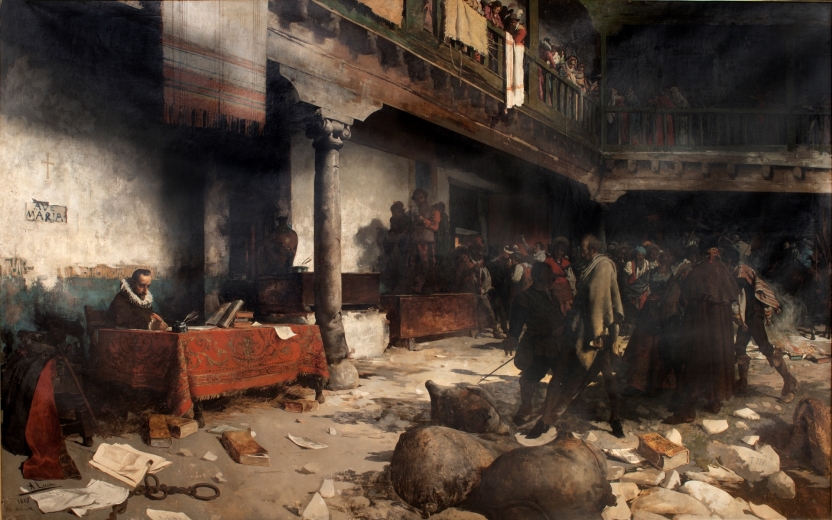
This is probably one of the most ambitious canvases in terms of conception and size among those painted by Angel Lizcano throughout his production. The artist mainly devoted his works to the trivial, small genre scenes of the time with which the painter had to earn a living throughout his life, a creative life which passed without its merit being duly recognised within the artistic circles of his time. However, this monumental painting was awarded a second-place medal at the 1887 National Exhibition. Its success resides in the artist´s joyous idea of an imagined scene bringing together the characters of the main novels inspired by Cervantes, realised in a tumultuous gathering before the illustrious Spanish writer´s eyes. Thus, this work pays homage to the author’s fruitful daydreaming and was conceived as a tribute, celebrating his writing. In the spacious courtyard of La Posada de la Sangre in Toledo, Miguel de Cervantes appears seated behind a large table covered with a sophisticated tablecloth, while writing in a sombre and melancholic attitude. In front of him are a motley group of characters and various objects from the inn which, according to the title of the painting, would have inspired Cervantes (known as ‘el Manco de Lepanto’) when creating the main characters in his most well-known works. The neglected and battered figure of Don Quixote, wrapped in a threadbare blanket, and his squire Sancho clearly stand out among the others. Don Quixote is also alluded to in the books of chivalry scattered on the floor, among them the Amadis de Gaula, lying on the floor in the foreground among the wineskins, conceived by the heated imagination of Don Quixote as a reckless giant. In the background, amidst the riotous uproar of a brawl, a smoking pyre on which several books of chivalry are being burned can be glimpsed. The rowdy spectacle is being contemplated by a crowd on the upper gallery of the inn. In the foreground, next to the writer´s table, his knight´s clothes, hat, cloak, sword and shackles, probably alluding to his five-year captivity in Algeria, are visible on a chair.
This painting is one of the most original of the allegories of Don Quixote painted by Spanish painters over the past hundred years. Unlike all the others, this work places the main characters of the timeless novel in a time prior to the literary creation itself. In other words, as beings and objects seen in reality by Cervantes in his everyday life and later transformed by his imagination into the main characters of his novel, spun by the ink of his pen in different episodes of the adventures of the Ingenious Hidalgo. Perhaps for this reason, Lizcano weights the work toward realism, the different elements that make up the composition depicted with the best of his pictorial mastery. The artist patiently indulges in the faithful and meticulous description of the courtyard of the inn in Toledo, both in its architecture and in the rustic austerity of its walls, as well as in the wineskins, the books, the parchments and the stones in the foreground, all of them contributing to the disorderly appearance of the scene. This allowed Lizcano to demonstrate his skills in reproducing the scene’s different surfaces, which seem to be almost within reach. However, as is only logical, the group of characters is the focus of the artist´s attention and bear witness to Lizcano´s speciality in capturing common people, whom he depicts with a special realist intent in this work. The artist achieves his end by consistently accentuating the most picturesque features of their humble condition, particularly evident in the ragged and neglected character wrapped in the blanket and who, according to Lizcano, would have served Cervantes as a model for Caballero de la Triste Figura (the Knight of the Sad Figure in Spanish, another name for which Don Quixote is known).
Nonetheless, in a first reading of the canvas, although the focus of attention is on this group of characters, the entire painting is executed in the artist´s most exquisite pictorial language, both in the neatness of his rigorous drawing and in the use of a chromatic range which, while reduced, remains rich in nuance. Both aspects are combined with a special skill in the use of chiaroscuro, an aspect that exhibits Lizcano´s fundamental vocation as an illustrator. Thus, in the second half of the composition are moments of equally excellent workmanship and similar pictorial accomplishment, such as the group of people in the background hurrying out of the doorway, the characters leaning out of the first-floor corridor, and the whitewashed walls of the courtyard, among which a frieze of Arabic tiles can be seen.
Such a large-scale composition must have required special preparation on Lizcano´s part. Indeed, a preparatory sketch of the painting exists. Although it is extremely faithful to the final canvas in all its elements, the sketch is significantly different since it presents Cervantes as a very old man, thus emphasising the dreamlike character of the scene before his eyes.
El mundo literario en la pintura del siglo XIX del Museo del Prado, Madrid, Centro Nacional de Exposiciones y Promoción Artística, 1994, p.132