formularioRDF
The itinerary <em>TITULORECORRIDO</em> has been successfully created. Now you can add in works from the Collection browser
<em>TITULOOBRA</em> added to <em>TITULORECORRIDO</em> itinerary

Close Continuar a ficha de la obra Continuar a ficha de la obra
17-02-2026
Andrea Vaccaro

Naples, 1604 - Naples, 1670

See author's file

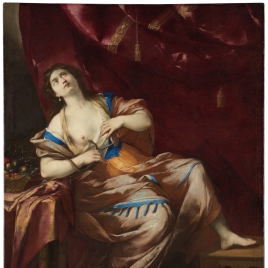
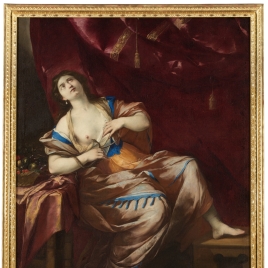
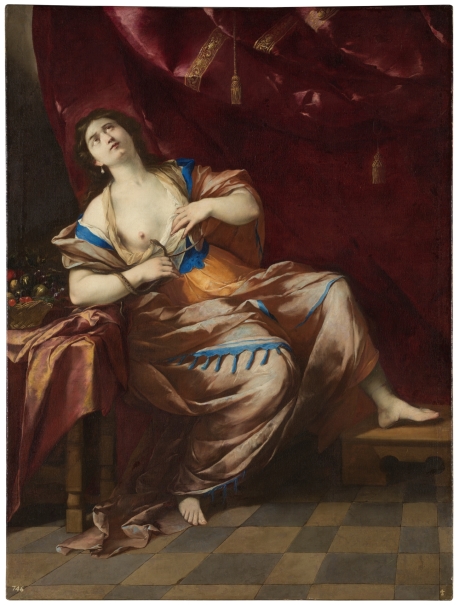
Cleopatra killing herself

XVII century. Oil on canvas.
On display elsewhere

In Parallel Lives, Plutarch describes the end of the life of Cleopatra, the last queen of Egypt. Married to Mark Antony, who had taken control of the eastern part of Roman territory as part of the Second Triumvirate (43–38 BCE), she posed a political threat to the Empire for Octavian. He reported to the Senate that this union would pose a risk, as he thought that Mark Antony would play a submissive role to Cleopatra. Her ambitions would compromise the territorial integrity, which would lead them to engage in a battle from which Octavian would emerge victorious. After her husband’s death, and to avoid being displayed in Rome as a war trophy, Cleopatra decided to take her own life with the poison of an asp. Both the courage and noble pride she displayed in this episode, along with the myth of her beauty, made her become an exempla virtutis in a process analogous to that of other historical heroines, such as Judith and Lucretia. In addition to the similar way of putting an end to their lives, both Lucretia and Cleopatra have in common that they were the protagonists of stories linked to a relevant political event for Rome, since with the fall of Cleopatra and Mark Antony, Egypt would lose its independence and become a Roman province.

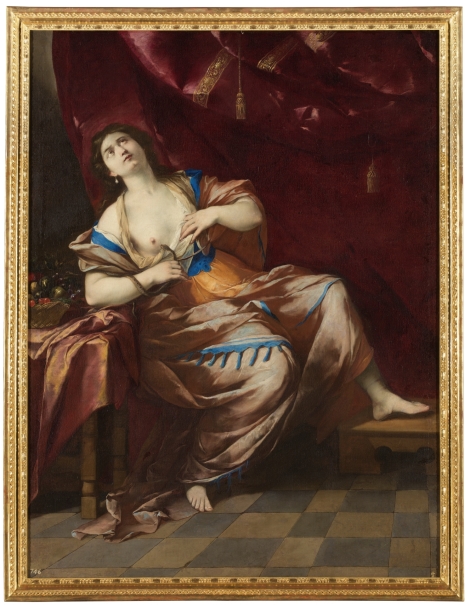
Cleopatra’s death would be widely disseminated in literary and artistic works as a reflection of those virtues, and representations of it were commonly found in European collections in the Modern Era. Although sources do not provide any specific detail on her suicide, an erotic image of the semi-naked sovereign letting herself be bitten by the snake – which is usually located on her breast and biting close to the nipple, as in this painting – has been disseminated. With the decorum imposed after the Council of Trent, artists resorted to this type of episode in order to depict nudes without being censored. These scenes were also largely demanded by collectors. There are no records on whether the tragic event took place in her tomb or in the palace, yet the most popular versions place her in a drawing room, surrounded by draperies and other objects that indicate the luxury associated with her status as queen. This painting, attributed to Andrea Vaccaro, reveals the elements common to this iconography, including the basket of fruit and the ostentatious attire and jewels that adorn her. The painter depicted Cleopatra in a highly theatrical pose, leaning back in a chair with one arm resting on the table and one foot on a footstool. She opens her dress with one hand and with the other she brings the asp close to her skin. The drama is emphasised by the position of her head, staring towards infinity, and the containment of any feelings, thus emphasising her pride. Conversely, the eroticism is heightened in this painting, since her feet are exposed and the shape of her legs is hinted at beneath her weighty attire.

This composition is reminiscent of those created by artists of the Bolognese school in the first half of the 17th century. However, its style places its creation in the workshop of a Neapolitan painter. The blend of both characteristics has led to the attribution of this canvas to Andrea Vaccaro since at least 1746, when it was first registered in the palace of La Granja from the collection of Isabella Farnese. There, at the end of that century, it was seen by both Antonio Ponz and Antonio Conca, who agreed to attribute it to that artist. It survived until the 20th century without its authorship being questioned by critics, when Pérez Sánchez pointed out that this canvas might be closer to the style of Francesco Guarino (1611–1654). Xavier de Salas, as per H. Voss, also doubted this and, as a result, in the 1972 and 1990 catalogues of the Museo del Prado’s paintings it appears with an uncertain attribution to Vaccaro. Nevertheless, it is currently once again considered to be by this Neapolitan painter with great certainty.

Japón, Rafael, 'Andrea Vaccaro. Cleopatra dándose muerte' En: El factor Prado: los depósitos del Museo Nacional del Prado., Museo de Bellas Artes de Asturias,, 2022, p.58-61 nº 10
Technical data

Imagen del carrusel
Imagen del carrusel

Related artworks

Inventory number
P000473
Author
Andrea Vaccaro
Title
Cleopatra killing herself
Date
XVII century
Technique
Oil
Support
Canvas
Dimension
Width: 152 cm; Height: 202 cm
Provenance
Royal Collection (Isabella Farnese Collection, Royal Palace of La Granja de San Ildefonso, Segovia, pieza donde se decía misa antiguamente, 1746, n. 746; La Granja Palace, pieza tercera de azulejos, 1766, n. 746; La Granja Palace, tercera pieza de azulejos, 1774, n. 746; Royal Palace of Aranjuez, Madrid, pieza de cenar, 1794, n. 740; Aranjuez Palace, sala de corte del rey, 1818, n. 746).

Bibliography +

Inventario General de las Pinturas, Alhajas y Muebles que existen en el Real Palacio de San Ildefonso. 1774, [s.n], Madrid, 1744, pp. 90, nº 17602 (746).

Inventario Palacio del Real Sitio de S. Ildefonso. La Granja. 1746. Inventario Gral. de Pinturas, Muebles y otras alhajas de la Reina Ntra. Sra. que tiene en el Palacio del Real Sitio de S. Ildefonso, VII, [s.n], Madrid, 1746, pp. 64, nº 746.

Pérez Sánchez, Alfonso E., Pintura italiana del S. XVII en España, Universidad Fundación Valdecilla, Madrid, 1965, pp. 469-470.

Sánchez Cantón, Francisco Javier, Museo del Prado. Catálogo de las pinturas, Museo del Prado, Madrid, 1972.

Museo Nacional del Prado, Catálogo de las pinturas, Museo del Prado, Madrid, 1985, pp. 721.

Museo Nacional del Prado, Museo del Prado: inventario general de pinturas (I) La Colección Real, Museo del Prado, Espasa Calpe, Madrid, 1990, pp. 202.

Noticias. Nuevos depósitos. Oviedo. Museo de Bellas Artes, Boletín del Museo del Prado, 11, 1990, pp. 116.

Aterido Fernández, Ángel; Martínez Cuesta, Juan; Pérez Preciado, José Juan, Colecciones de pinturas de Felipe V e Isabel Farnesio. Inventarios Reales, II, Fundación de Apoyo de la Historia del Arte Hispánico, Madrid, 2004, pp. 483.

Tuck-Scala, Anna Kiyomi, Andrea Vaccaro (Naples, 1604-1670). His documented life and art, Paparo, Pozzuoli, 2012, pp. 179.

Japón, Rafael, 'Andrea Vaccaro. Cleopatra dándose muerte' En: El factor Prado: los depósitos del Museo Nacional del Prado., Museo de Bellas Artes de Asturias,, 2022, pp. 58-61 nº 10.

Other inventories +

Inv. Isabel Farnesio, La Granja, 1746. Núm. 746.
745-746 / Otras dos Pinturas en Lienzo, la una de maº de Jph. Rivera, qe representa la Caridad Romana. Y la otra de Bacharo, qe significa Cleopatra, que arrima el Aspid al pecho. Tienen à siete pies, y tres dedos de alto; y cinco, y uno de ancho. Marcos dorados lisos ... 2

Inv. Testamentaría Isabel Farnesio, La Granja, 1766. Núm. 746.
Pieza tercera de Azulejos [...] 743 / Ôtro [quadro] de ocho pies de alto, por seis de ancho, marco dorado liso, representa Cleopatra de cuerpo entero, de mano del Abate Bacaro, vale tres mil y trescientos rrs

Inv. Carlos III, La Granja, 1774. Núm. 746.
{17602} 746 - Pintura de ocho pies de alto por seis de ancho Cleopatra de cuerpo entero de mano de el Abate = Bacaro = en la tercera pieza de azulejos ... 3300

Inv. Testamentaría Carlos III, Aranjuez, 1794. Núm. 740.
Pieza de Cenar [...] [41] 740 / Cinco pies y 6 dedos de largo y siete y dos dedos de alto. Cleopatra que se aplica el Aspid al pecho. Bacaro ... 2500

Inv. Fernando VII, Aranjuez, 1814-1818. Núm. 746.
Sala de Corte del Rey [...] {20656} 746 / Cleopatra que se aplica el aspid al pecho cinco pies y seis dedos de largo siete y dos dedos de alto = Bacaro

Catálogo Museo del Prado, 1854-1858. Núm. 718.

Inv. Real Museo, 1857. Núm. 718.
Vaccaro. / 718. Cleopatra. / Se da la muerte aplicandose un aspid al pecho. Tiene manto tornasolado de color morado y lila, guarnecido de fleco azul. En el fondo hay una cortina carmesi formando pabellon. (C.L.) / Alto 7 pies, 2 pulg; ancho 5 pies, 5 pulg.

Catálogo Museo del Prado, 1872-1907. Núm. 518a.

Catálogo Museo del Prado, 1910. Núm. 473.

Catálogo Museo del Prado, 1942-1996. Núm. 473.

Catálogo Museo del Prado, 1985. Núm. 473.

Inscriptions +

746
Painted. Front, lower left area

Billalba
Inscribed in pencil. Frame, back, upper bar

Billalba 746
Inscribed in pencil. Frame, back, lower bar

Billalba
Inscribed in pencil. Frame, back, right side bar

N.o / 746
Handwritten label. Frame, back, upper bar

Billalba 746
Inscribed in pencil. Frame, back, left side bar

7 p.es y 6 ps
Inscribed in pencil. Frame, back, right side bar

n,o / 436
Inscribed in pencil. Stretcher, central crossbeam, on the left

718 [etiqueta con orla azul y borde dentado; manuscrita a tinta]
Inscribed in pen and ink. Frame, back, upper bar

?
Fleur-de-lys , used as a collection’s mark belonged to Queen Isabella Farnese. Front, lower right corner

746
Inscribed in pencil. Frame, back, right side bar

Gomez y Conpa
Inscribed in pencil. Frame, back, lower bar

Exhibitions +

Las hijas del Nilo: mujer y poder en el antiguo Egipto
Madrid
09.06.2022 - 31.12.2022

Location +

Oviedo - Museo de Bellas Artes de Asturias (Deposit)

Update date: 17-02-2026 | Registry created on 28-04-2015

Visor 360

Drag with the cursor to rotate the piece

Other works by Andrea Vaccaro

Print on demand

Print artworks available in our catalogue in high quality and your preferred size and finish.

Image archive

Request artworks available in our catalogue in digital format.

Up