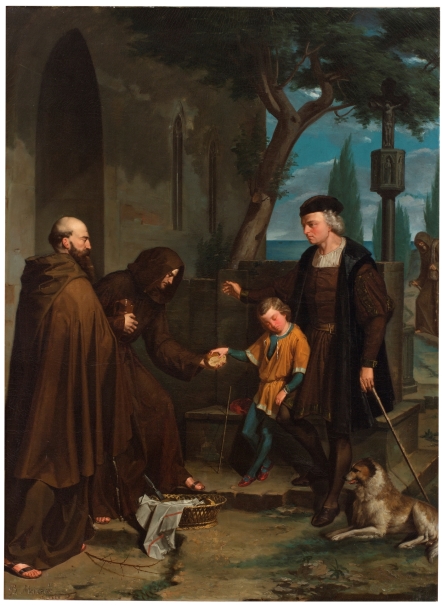
Columbus at the gates of the convent of Santa María de la Rábida, begging bread and water for his son
1858. Oil on canvas.On display elsewhere
This painting was submitted to the 1858 National Exhibition of Fine Arts. It was Mercadé´s first success in these competitions, as it was awarded a second-class honourable mention. The plot of the painting was further explained by the following text in the catalogue: ‘While he was receiving this humble refreshment, the guardian of the convent, Friar Juan Pérez de Marchena, happened to pass by. Then, he noticed the man´s presence with admiration, struck up a conversation with him and soon found out about the peculiarities of his life’.
The canvas depicts the arrival of the admiral and his son Diego at the gates of the monastery of La Rábida, where the monks presented them with a humble snack to ease the fatigue of their taxing journey. Depicted in his usual iconography, Columbus is stationed at the entrance to the convent. He is indicating with the gesture of his hand the request for food for his fainting son, who takes refuge in his lap. His staff and basket are abandoned on the stone bench before which he is leaning, while they are attended to by two monks.
This work is clear evidence of Mercadé´s youthful training in the purest Catalan Nazarenesque style of those years, despite the fact that it was executed in Madrid, the city where the painter lived for several years. It is also one of the most singular examples of the artist´s production and of all the historical painting of the time, which was still subject to the strictest academic purism. The spirit of the composition, resolved with extreme technical neatness and exquisitely finished in all its details, the sheer prominence of the figures and the reproduction of the qualities of the different surfaces, corresponds to the purest Nazarene aesthetic. However, at the same time, this painting reveals delightful details of a reticent realism, such as the little dog that has accompanied the travellers on their journey or the basket of food with the cloth and knife, conceived with the immediacy of a true still life.
The unusual small format of the painting is noteworthy, perhaps indicating Mercadé´s initial intention of using it as a preparatory sketch for a larger painting. Nonetheless, despite its small size, the vigorous monumentality with which the figures are conceived and their attitudes resolved with a restrained solemnity lends the scene the transcendent dignity required by the category of the genre.