Crucifixion
Late XV century. Oil on panel.Not on display
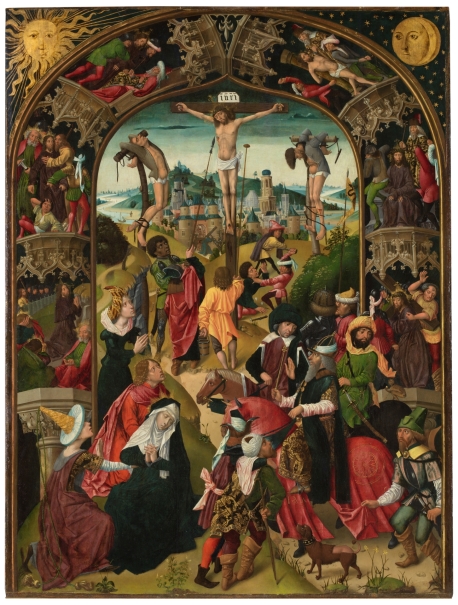
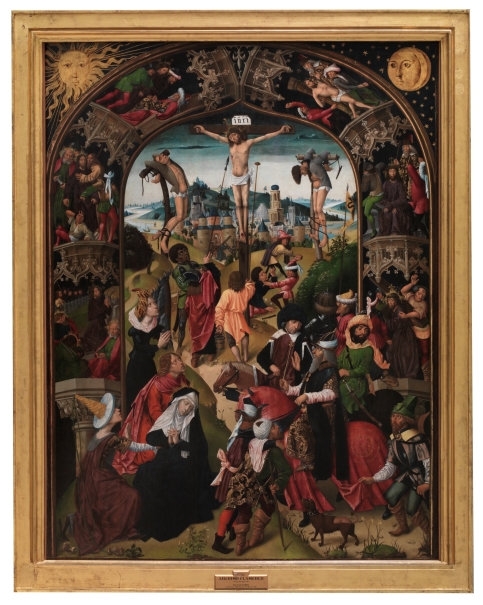
This panel represents The Crucifixion and features all the customary iconographical elements taken from either the scriptures or from subsequent tradition: the two thieves whose suffering contrasts with the dignity shown by Christ on the cross; Mary fainting at the foot of the cross, sustained by Saint John; Longinus poking the spear into Christ’s side to check if he is dead; the executioner who is still intent on tormenting Jesus by giving him a sponge soaked in vinegar to drink; the soldiers gambling for his clothes by playing dice; and the simultaneous appearance of the Sun and the Moon, a reminder that day resembled night during the crucifixion. The woman behind Saint John gazing at Christ should be interpreted as the Magdalen on account of her arresting – albeit fashionable – clothing. The other one in the foreground, who could be Mary Salome or Mary Cleophas, is dressed in imaginative, eye-catching garments – notably her headdress, an invention combining two different ones.
Despite the apparently orthodox iconography, there are many details that deviate from tradition, resulting in a painting that provides an account of the religious event peppered with details that range from curious or unusual to downright ambiguous. For example, it is not clear which of the two figures that thrust the spear into Christ’s side should be identified with the Roman centurion Longinus.
The composition denotes the evident influence of the work by Van der Weyden. The idea of placing a live scene beneath an architectural portal decorated with Gothic tracery whose archivolts display secondary scenes, similar to a church entrance, was used by Rogier in a few paintings. Furthermore, a few aspects denote a certain compositional ambition on the part of the anonymous artist. There are attempts to progress towards achieving a correct perspective by seeking to capture depth. In addition, the abovementioned similarities are very vague and may stem from the use of a common Rogieresque source rather than from a direct connection with one of those masters. Lastly, the presence of certain details reminiscent of artists operating outside Brussels and the circle of Rogier open up new interpretative possibilities.
Pérez Preciado, José Juan, Fifteenth-century netherlandish painting at the Museo Nacional del Prado. Catalogue raisonné, Madrid, Museo Nacional del Prado, 2024, p.59-63 nº.3