Dauphiné
Ca. 1864. Oil on paper attached to cardboard.Not on display
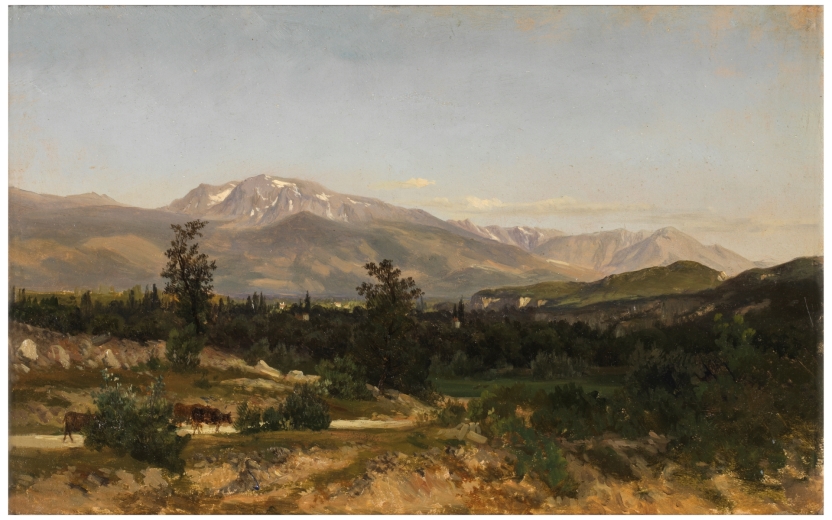
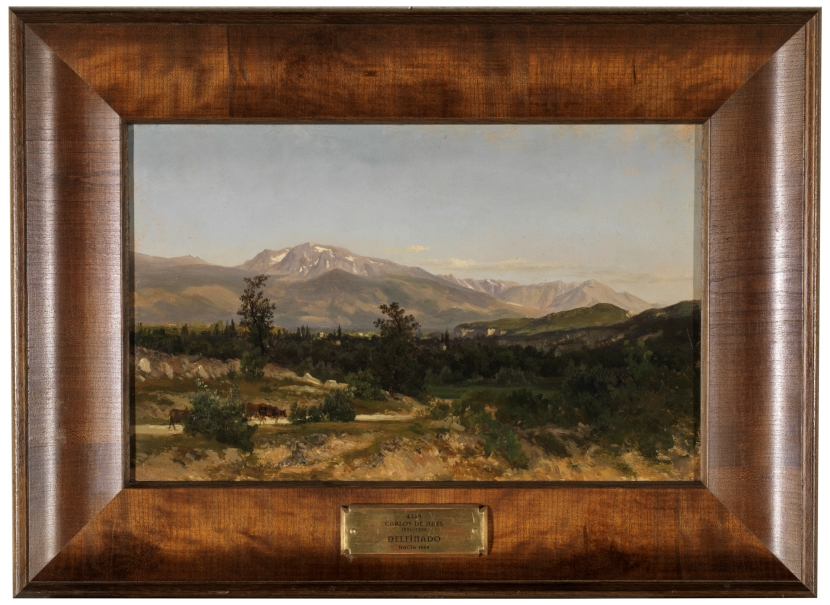
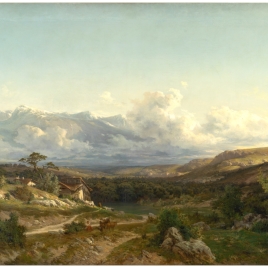
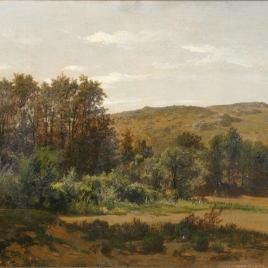
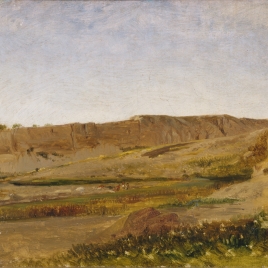
To the left, bordered by bushes and shrubs, there is a path lined with several cows leading to the bottom of the valley, where a village settlement can be glimpsed amidst the woodland. The composition ends with the lofty heights of the mountain range that runs through the Dauphiné. Patches of snow cover its peaks and fade into the brightness of a clear sky dotted with a few clouds.
The similarity it shares with the composition of the "Landscape in the Dauphinoise" (P06538) leads us to think of this study as the basis for the final painting with larger dimensions. This illustrates that in many cases, Haes´s realism involved certain Romantic traits that were particularly prevalent in his compositions until the mid-1970s. They were mostly based on real life with the painter adding components typical of a country setting to these types of compositions. For example, animals, villagers, or rural buildings should not be absent as typical features and, to a certain extent as bucolic details that humanise the landscape. Although the focus is closer and the viewpoint lower, the place where the path marks and defines the outline of the left-hand side of the mountain also reflects the bushes and rocks that form it. In this case, the valley is hidden by a wooded area that in both paintings gives way to some hills to the left and to the right. These hills advance the great mountainous structure, whose peaks are marked by permanent snowfields. It is more than likely, given Haes´s habit of storing everything he painted directly in situ in his studio, that this small study was the only real basis of inspiration for his final painting.
Gutiérrez Márquez, Ana., Carlos de Haes en el Museo del Prado, 1826-1898 : catálogo razonado, Madrid, Museo Nacional del Prado, 2002, p.314