Desdemona
1887. Oil on canvas.On display elsewhere
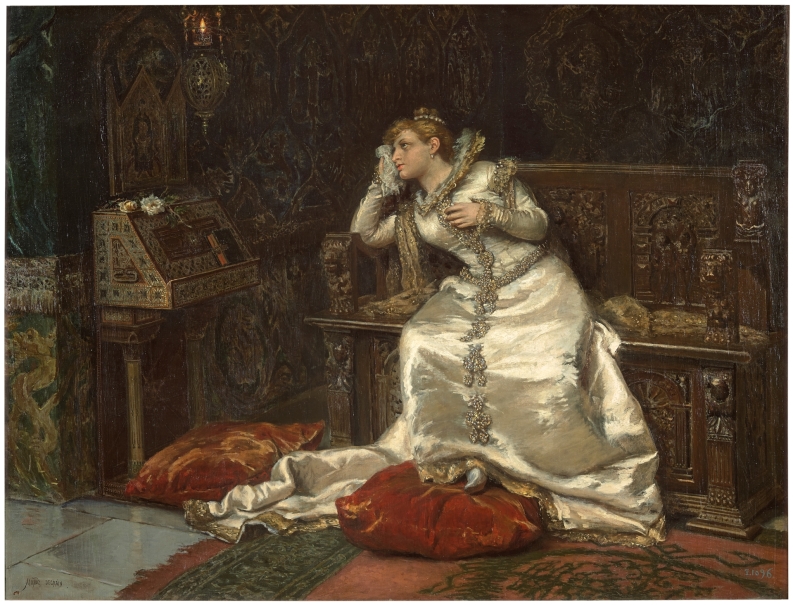
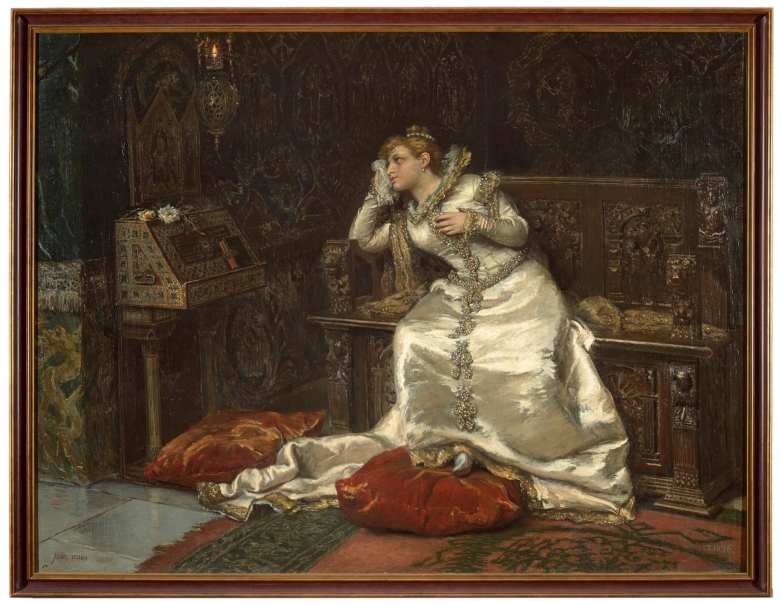
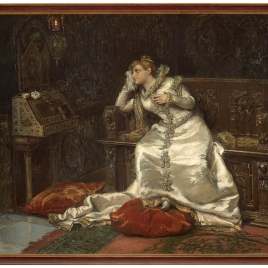
The passionate affection for the city of Venice expressed by the Valencian Antonio Muñoz Degrain throughout his life, was not only reflected in his numerous ‘vedutte’, but the city’s scenic also served as inspiration for his particular pictorial interpretation of one of the most beautiful and sublime Shakespeare´s tragedies: Othello. The tragedy first inspired the painter to create a large, magnificent canvas entitled Othello and Desdemona, which was awarded a first medal at the 1881 National Exhibition. A few years later, in 1887, the artist again immortalised the principal characters of the drama in two canvases of the same size and painted as a pair, which he presented to the National Exhibition of that year. This painting is one of them.
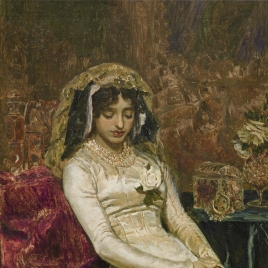
Here, he depicts a sorrowful Desdemona alone in her room, the gloom relieved only by the dim glow of an oil lamp. She appears seated on a splendid carved wooden bench and dressed in a luxurious costume, richly adorned with jewellery. She wipes her eyes with the very delicate lace handkerchief around which the plot of the tragedy revolves. It will also be the instrument used by the ruthless Othello to strangle his innocent wife.
In this important painting, Muñoz Degrain once again displays his richest and most personal artistic language, demonstrating some of his acknowledged specialities, such as the changing reflections of the dress and jewels, the objects in the semi-darkness that set the scene. The technique is extraordinarily rich and loose in its ornate decoration. All these features reveal both how modern his art is for the time, and his direct debt to the great Venetian painting of the Cinquecento, to which the theme represented on this occasion also contributes.
El mundo literario en la pintura del siglo XIX del Museo del Prado, Madrid, Centro Nacional de Exposiciones y Promoción Artística, 1994, p.178-179 nº28