Desecration of the Crucifix or Christ of the Insults
XVII century. Oil on canvas.On display elsewhere
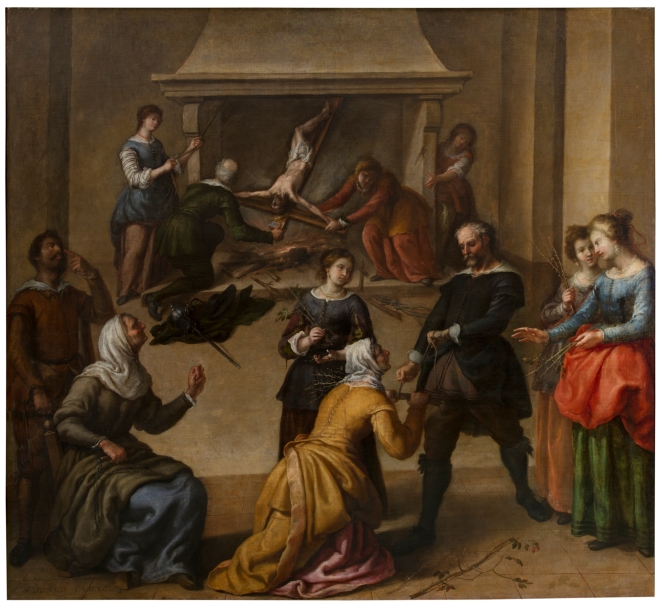
This is a very significant example of Camilo´s skill at representing uncommon narrative events. It presents one of the episodes in the story of desecration and offense to a crucifix by a family of Portuguese Jews in Madrid in 1630. The episode was exploited by a political faction opposed to the Count Duke, whom they accused of tolerance toward the Jews. It stirred feelings in Madrid and led to the founding of the Capuchin Convent of La Paciencia de Cristo, whose church was completed in 1651 with a main altarpiece on The Stripping of Christ (Christ of Patience) painted by Rizi (P2925).
A variety of artists active in Madrid at that time participated in the creation of four canvases narrating the story of the desecration of the crucifix for that convent. According to various reports by Palomino and a description by Ponz, the other artists involved in that project at the chapel were Francisco Fernández, Andrés de Vargas and Félix Castello, who painted two canvases. The Museo de la Trinidad had one work each on this subject by Fernández and Vargas, but no related works under Castello´s name. Two, however, are signed by Camilo and it would appear that Palomino accidentally confused Camilo and Castello in his report.
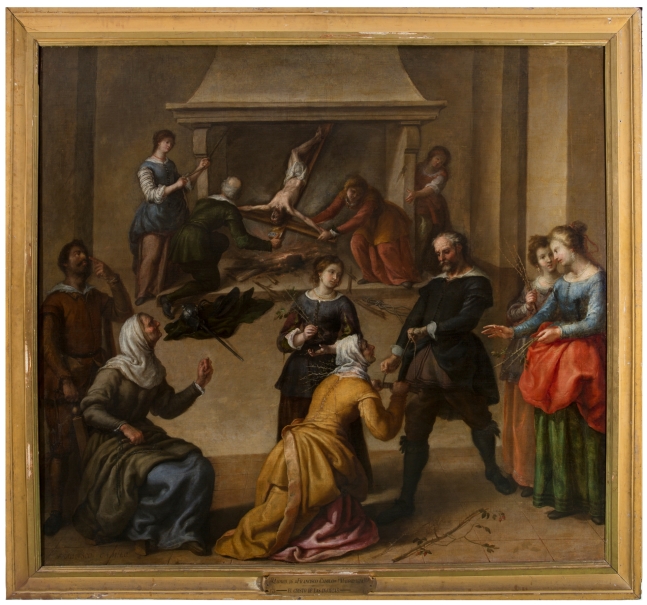
This canvas by Camilo shows the moment when the crucifix is taken down from the chimney where it had been hidden in order to whip it. Friar Mateo Anguiano´s book, La nueva Jerusalen en que la perfidia hebraica reiteró con nuevos ultrajes la Passion de Christo, Salvador del Mundo, en su sacrosanta imagen del Crucifixo de la Paciencia (Madrid, 1709), quotes the text from the cartouches that appear on the four canvases, and the one on this painting reads: They had the Holy Crucifix hanging upside down in the chimney flue, from which they removed it to whip it with different cords and switches.
The different figures prepare whips and switches and the entire canvas presents a singular scene of movement and action in a domestic setting with clothing of that time. Angulo (1959) observed that in this canvas, Camilo appears less distant from Velázquez´s art than was common among other painters from Madrid at that time, undoubtedly underlining this canvas´s clearly suggested space and atmosphere.
When he published this work in 1900, Víctor Balaguer misinterpreted the scene, believing that it showed the inquisitors surprising the Jews in the act of desecrating the crucifixion, that the kneeling man was attempting to save it from the fire, and that the one preparing the switches in the foreground was attempting to pull them out of the kneeling woman´s hands.