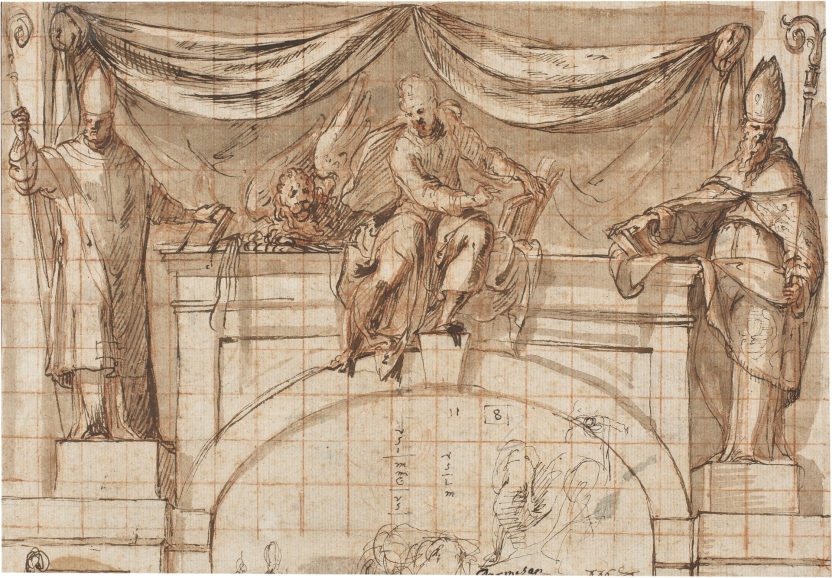
Design for the Decoration of the Front Wall of a Chapel
Third quarter of the XVI century. Wash, Chalk ground, Grey-brown ink, Pencil on yellow paper.Not on display
Although Parmigianinesque in style, the Prado drawing is clearly not of the same quality as Parmigianino´s undoubtedly authentic work. There are strong analogies in handling and technique with a number of Urbino´s documented drawings, especially in the attractive use of lightly tinted pen and wash over an extensive under-drawing in red chalk. Also typical of Urbino´s touch is the slightly globular pen line, which creates little dark accents enhancing a sense of the play of light and shade across form.
In both style and function the Prado drawing compares well with Urbino´s Study for an Arched Wall Decoration: the Coronation of Esther in the Metropolitan Museum of Art, New York, a design, with differences, for the artist´s fresco in the crossing of the church of S. Maria di Campagna, Pallanza (inv. no. 1984.293; Bora, 1984, pp. 15-16 and 32, n. 52). Like the NewYork study, the Prado sheet is also a study for a large-sized wall decoration, though this time for the front of a chapel and one presumably dedicated to St. Mark, who is the saint shown seated at the center of the composition, above an arch, flanked by two bishops. Below the arch are two separate studies for the legs of St. Mark and one for the head of the bishop to the left, holding a crozier. The boundary between the "fictive" upper space of the composition and the outside space of the "real" surrounding architecture is achieved in both drawings by an awning, pinned back in the center and at the sides.
The Prado drawing has been squared for transfer, either to a small-scale modello or to the actual-sized cartoon, suggesting that the design may have attained pictorial fruition (Text drawn from Turner, N.: From Michelangelo to Annibale Carracci. A century of Italian drawings from the Prado, Art Services International-Museo Nacional del Prado, 2008, p. 120).