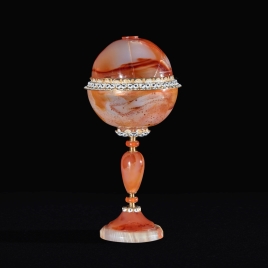
Egg-shaped agate vessel with cameos on the foot, stem and finial
Ca. 1630. Agate, Chalcedony, Gold, Enamel, Silver gilt, Cowry.Room 079B
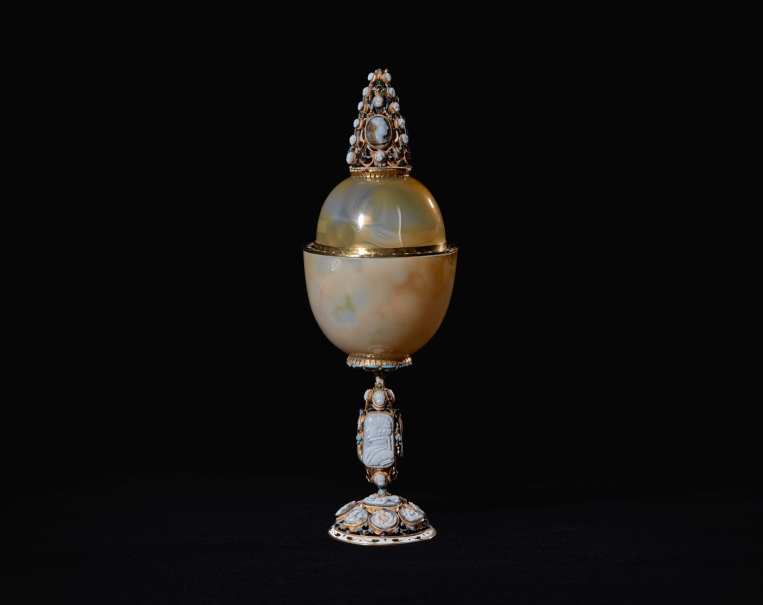
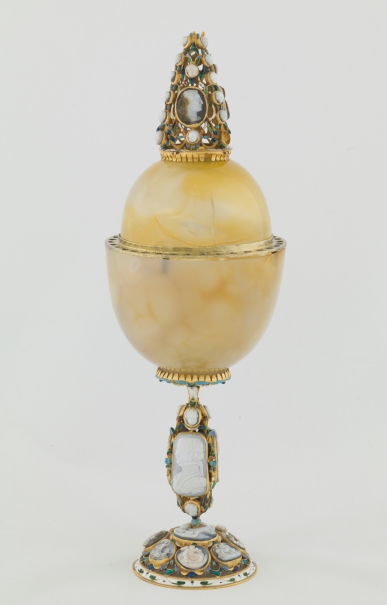
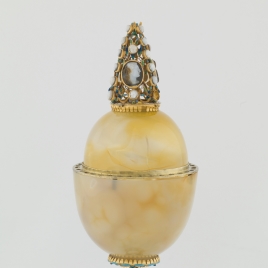
Vessel made up of two pieces of chalcedony and an enamelled gold mount. The body is formed by a deep hemispherical base and a smaller lid of the same shape surmounted by a delicate pyramidal openwork structure of pointed leaves, pavilions, fruits and rows of beads. Inserted in this are three cameos and numerous children’s heads with enamel wings. The stem, also openwork, displays three large cameos and six children’s heads. It rests on a fairly high round foot with a central cameo and seven others around it.
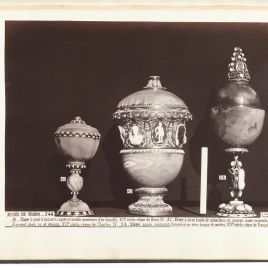
According to the 1746 inventory of La Granja de San Ildefonso, it had thirty cameos and twenty-nine children’s heads in agate. The area where the bowl joins the lid seems to have suffered major damage, since its mount is missing. Lost in about 1815, it was described in the Versailles inventory of 1689 as consisting of enamelled figures with feathers on their heads who held “a kind of openwork campanile”, a reference to the cover. The state of the work in the 19th century can be seen through the photography of Juan Laurent y Minier, "Vase agate sardoine, montures d’or avec émaux et pierreries, XVIe siècle, règne de Henri II", c. 1879, Museo del Prado, HF0835/9.
Arbeteta points out that the plumed headdress worn by the figurines on the lost mount evokes other pieces in the Dauphin’s Treasure, such as the Cup with a gold mermaid, O1, and O6. It may be a reference to fidelity, represented with a ring and the motto “Semper” (“always”) on an emblem by Paul Jove. There may also be a symbolic meaning in the openwork motif of the base, which forms a star of David, found also on the lid of a vessel in Florence (Inventario Gemme 1921, no. 540) that was perhaps inspired by a design by Pellegrini of 1530.
According to Angulo, most of the cameos are Milanese, and some are of excellent quality. On the foot alone, there is one of Leda reclining with the swan, after a model by Michelangelo; Cybele with her chariot drawn by lions and a figure of fame or genius with a trumpet; an altar with a child in front of it bearing a branch, and a satyr behind; a Silenus figure; two others standing on a dolphin’s back; Europa and the bull; a nymph on a sea horse; and, in the largest central cameo, Cupid. Also worthy of note is the infantile figure of the sleeping Eros or Thanatos on the skull.
The mounts form the profile of the vessel, and their decoration is rather different from the rest. It is outstanding for its excellent and minute workmanship, as well as a softer and more luminous colouring than the other pieces. It is similar to a cup in the Louvre, MR 239, where light blues predominate.