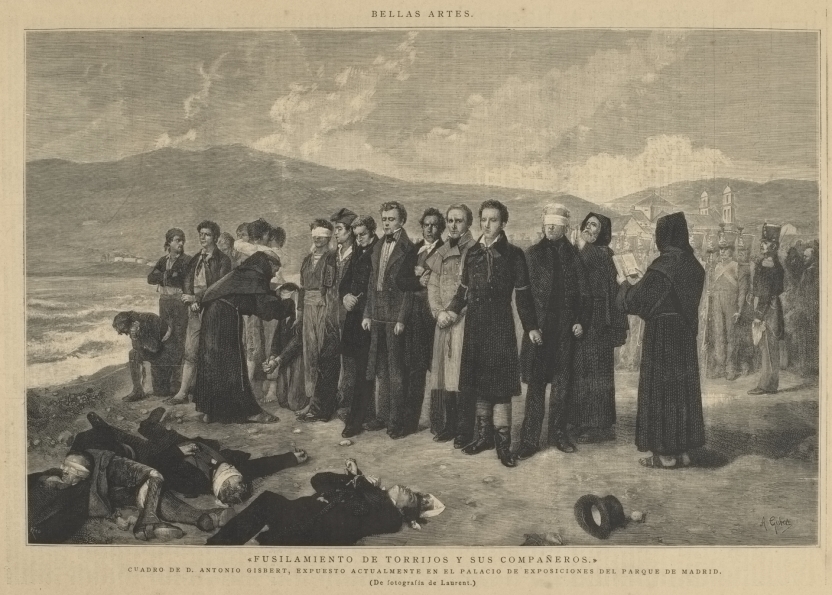
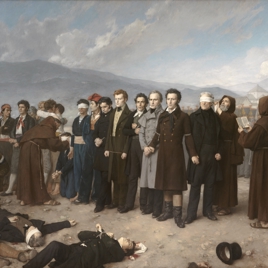
Execution of Torrijos and his Companions on the Beach at Málaga
1888. Woodcut on continuous paper.Not on display
In August 1888, when this print was published in issue number 32 of La Ilustración Española y Americana (The Spanish and American Enlightenment), its author, Bernardo Rico y Ortega, was the art director of the magazine and one of Spain’s most renowned wood engravers. His signature can be found on many illustrations in this prestigious magazine, as well as in others such as the Semanario Pintoresco Español (Weekly Spanish Picturesque), the Museo Universal (Universal Museum), and La Ilustración de Madrid (The Enlightenment in Madrid). During nearly the entire 19th century, wood engraving or xylography – produced over considerably hard boxwood blocks – was considered the ideal method for illustrating periodicals, as the wooden blocks fit perfectly with the movable typesetting sorts of the printing press. Finally, at the turn of the century, photomechanical reproduction techniques were eventually introduced; therefore, this strenuous engraving technique fell into disuse.
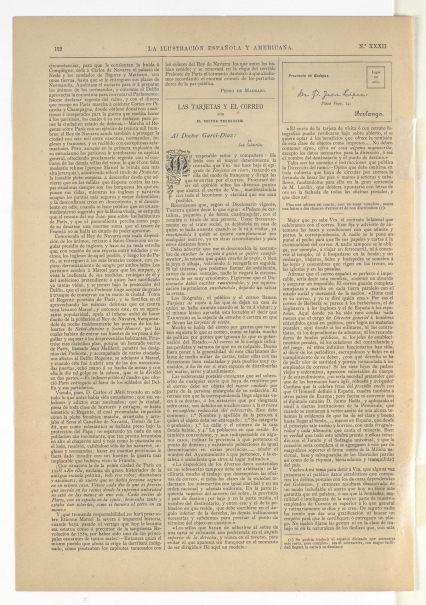
Antonio Gisbert had been commissioned to paint The Execution of Torrijos and His Companions by Royal Decree of the Council of Ministers in 1886 to extol a chapter in the history of Spanish liberalism related to the Cortes of Cádiz and the Spanish Constitution of 1812. In July 1888, Gisbert completed the painting, and it was subsequently acquired by the State for the Museo Nacional de Pintura y Escultura, where it is now kept (P004348). Nevertheless, before its arrival to the Museum, the painting was first exhibited in the Pabellón Central del Retiro (now the Palacio de Velázquez), where the Museo-Biblioteca de Ultramar was located. Given the fame of the painting, the press of the time reported on the exhibition and thus contributed to its dissemination. This xylograph by Rico is a good example of this; the print took up a full page of the magazine, which also included a laudatory commentary highlighting the addition to the state collections of ‘a truly masterful artistic work’.
On this occasion, Bernardo Rico used a photograph as the basis for engraving the boxwood block, according to the typographical inscription at the bottom of the print: ‘From a photograph by Laurent’. During 1850–1900, photography was gradually incorporated into the publishing process. Although engravers traditionally used preparatory drawings prior to engraving the matrix for their work, the appearance of photography soon meant that drawings would be replaced by instantaneous images. This would reportedly save considerable time in the preparation of the publication as well as benefit the periodical press of the day. The photographer Juan Laurent y Minier (1816–86) had developed his career in Spain, specialising in the reproduction of artworks. In 1871 the Museo Nacional de Pintura y Escultura granted him permission to photograph all the works in its collection, hence his company was unsurprisingly commissioned to photograph Gisbert’s painting. Although Laurent had died by then, and his successors (his stepdaughter and of his son-in-law, Catalina Dosch and Alfonso Roswag) most certainly continued the business under the same name, J. Laurent & Cía.
Solache Vilela, Gloria, Bernardo Rico y Ortega según pintura de A. Gisbert. Fusilamiento de Torrijos y sus compañeros en la playa de Málaga. en: Memoria de actividades 2021 Museo Nacional del Prado, Ministerio de Cultura y Deporte, 2022, p.73-75