February. Winter still life
1640. Oil on canvas.Not on display
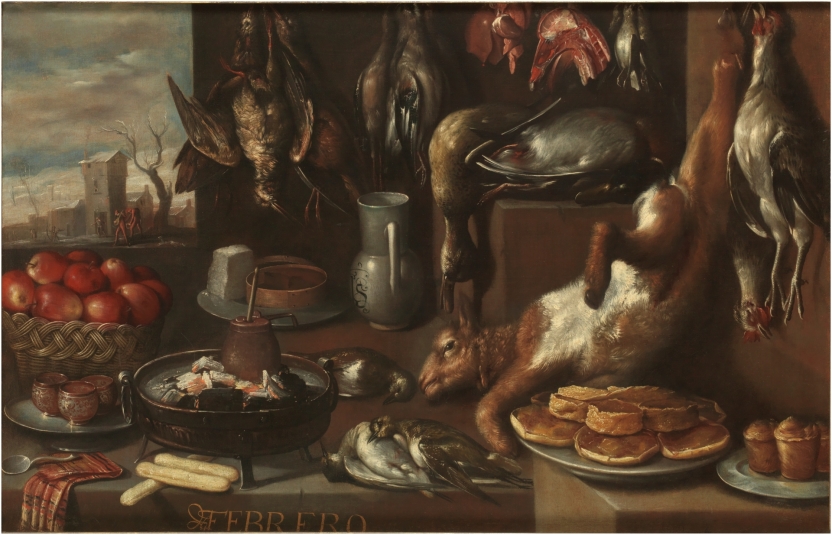
The inscription, February, indicates that this still life belongs to a series on the twelve months of the year, of which at least five others have been located. Each depicts foodstuffs, floral elements or landscapes from its corresponding month. Here, hunting game is the predominant theme, especially birds, and there is also an interesting allusion to chocolate. While the latter was drunk for most of the year, it was particularly associated with the winter, as a tasty response to the cold. A chocolate pot is heating among the coals of a brazier alongside three lacquered cups of foreign origin, some cakes and a spoon. The season is also indicated by the landscape visible through the opening in the background: a desolate, snowy terrain. Organized in steps that facilitate the presentation of a broad variety of objects, the composition reflects earlier still lifes by Van der Hamen from the 1620s, although it differs from them in its much more variegated presentation.
Documents reveal Barrera’s dedication to religious painting, but his identified works are all still lifes, especially the present type of series. The Museum in Seville has one dedicated to the four seasons, signed by him in 1638. In these series, he mixes local tradition with enumerative techniques and an allegorical air that come from the world of Flemish painting. This work is an outstanding addition to the Prado’s overall collection of Spanish painting, and even more so, to its collection of still lifes. Until now, the Prado had no works by Francisco Barrera, and no still life with this sort of serial typology.