Floreal
1915. Oil on canvas.On display elsewhere
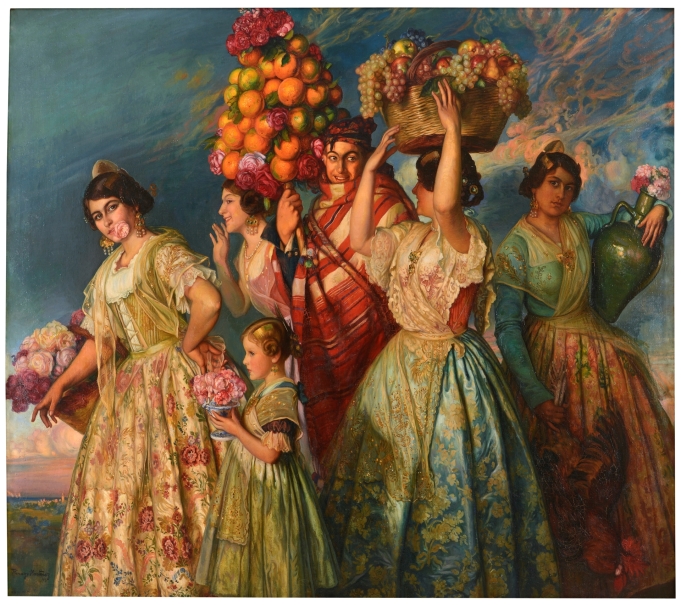
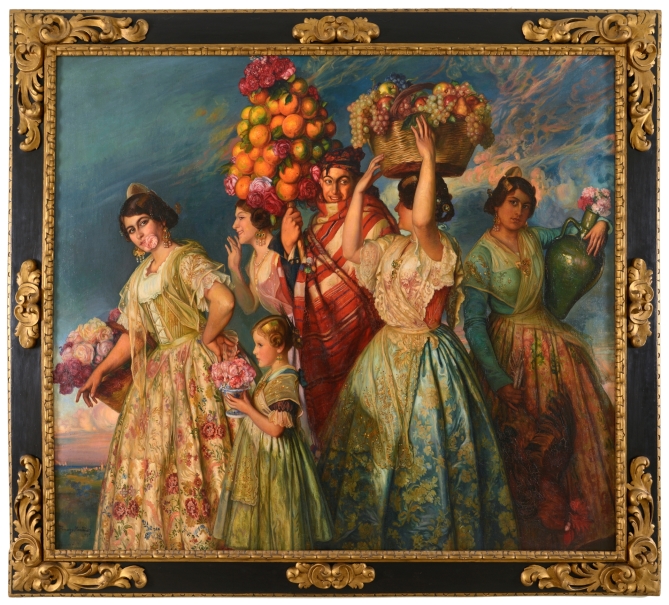
Pinazo´s Floreal is an allegory of the richness and exuberance of the Valencia land, represented with the flowers and fruits carried by some young girls and a young boy, all of them dressed in regional costumes. We don´t know if they are walking to market, with all those fruits, animals and flowers, if they are making an offering to a saint or if they are just an allegory of spring, as in the French republican calendar Floreal was the month that coincided with spring, with the flowering period. The representation of people going to a party and of cheerful, easy-going groups that walk in fields, on foot or riding horse, was quite common in regionalist painting. The valencian painters´s favourite theme to represent feast was not the dances but the rumps, dressed-up couples on a horse who are going to the Fair. Sorolla painted many rumps and so did Anglada Camarasa, whose staying in Valencia floklorist expressions. All these paintings present an easy vitalis perspective in a happy sensual world. The Valencian typical competes with Andalusian painting as the most representative image of the white, hedonist, pagan Spain, although those allegories are sometimes full of mistery and a deep feeling with reflect some melancholy and uneasiness, as can see in the case of Julio Romero de Torres. José Pinazo´s women, who are the undoubtable protagonists of his regionalist compositions, are deliacated and nice, their gaze is deep and intense, their features are soft and through them we can visaualize an ideal an legendary Valencia: Valencian poems that sing to love, live, earth and its fruits. In short, as Manuel Abril said, "a poetic rather than a naturalist interpretation".
Floreal, despite being a very studied and meditated work, is excesive and topical, qualities that Pinazo abandoned later. In contrast with Sorolla´s an Anglada´s works, wich constitute those decorative visions of Valencia, pinazo works with great attention to detail, with virtousity in the motifs, in particular when he depicts silks and embroideries of the fallera dress, so rich that the could hardly be afforded by Valencian peasant women. Like Mongrell´s and other Valencian painters´, the peasant women that he represents are little rustic and their movements are almost princely: the are like flowers in a greenhouse. In the case of Floreal, the girls´ hands and their sophisticated gestures are remarkable. Those details are specially observable in the case of the girlwhi is carrying a basket with fruits on her head, only held with two of her fingers as if she were part of a mannierist composition. Something similar can be said about some compositions by Romero de Torres or even Gustavo de Maeztu, although the treatment of women is very diferent in them. In Pinazo´s work, we cannot find a direct and provocative eroticism, as the one we find in Romero de Torres.
Pinazo´s cheerful, idealist, bucolic vision, is similar to Eugenio Hermoso´s although Eugenio Hermoso´s figures are not as slender as Pinazo´s. Pinazo´s falleras and peasant women are not rustic: the world of the countryside is presented trough teh transformation of the urban characters. In fact, Floreal´s characters belong to Pinazo´s family: his daughter Teresa (the girl who is carrying the flowers), his wife, his friend Emilio Marco and three other friends.
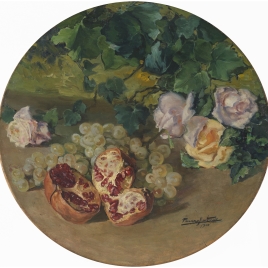
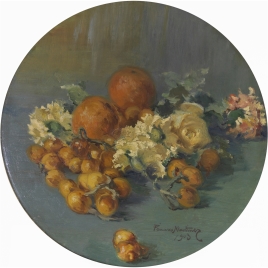
In Pinazo´s Floreal, the landscape is hardly visible in the distant background, the true protagonist being the sky with is big coloured clouds coherent with the exhuberant of the scene. The flowers, the fruits and the pottery are magnificents examples of still life, a genre that Pinazo practised with a mastery. Among the frutis and the flowers, a bunch of oranges held by a boy stand out. The orange, the driving force of Valencian economy, became an obliged reference in regionalist paintings, a local symbol of wealth and prosperity, an exaltation of the progress associated to agriculture (Text drawn from Pérez Rojas, F.J.: Tipos y paisajes. 1890-1930. Museo de Bellas Artes de Valencia, 1999, p. 504).