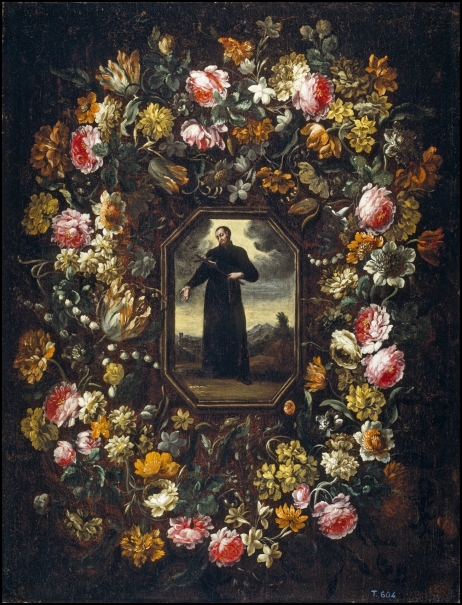
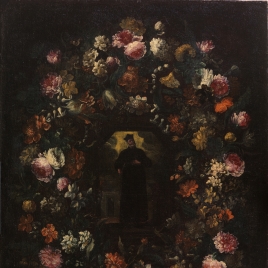
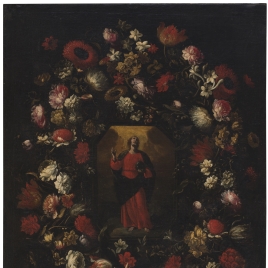
Garland of Flowers with Saint Camillus de Lellis
Second half of the XVII century. Oil on canvas.Not on display
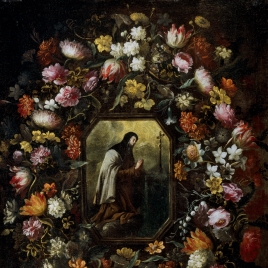
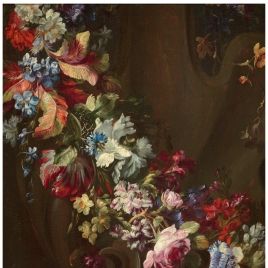
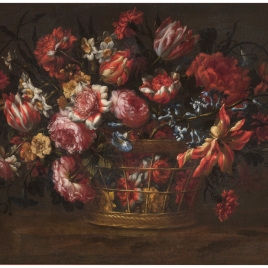
This work belongs to a series of six paintings, of which only five have survived (P1056, P1057, P5095, P5099 and P5250). Cruzada Villaamíl (1865) registered the three that he included in his catalog (P1056, P5250 and P5099) among the anonymous paintings from the Valencian school, although he hazarded an attribution to Bartolomé Pérez between question marks. Madrazo’s 1878 catalog from the Museo del Prado is the first to include two of these works (P1056 and P1057, listed as numbers 2174E and 2174F in that catalog), and there, they already appear as works by Bartolomé Pérez.
When he included those two paintings in the museum’s catalog, Madrazo wrote that they came from the Convent of San Diego in Alcalá de Henares, where there were five more, according to the inventories of the Royal Academy of San Fernando’s confiscation committee, which obtained them in 1836. That provenance was maintained in successive catalogs until 1996, although the works from this series (P1056 and P1057) were mixed up with other flower paintings attributed to Pérez that were also inexplicably assigned the same provenance (P1052, P1053, P1054 and P1055). Madrazo seems to have been confused by the fact that the inventory he consulted did not list the paintings’ dimensions. The series from the convent of San Diego in Alcalá must have disappeared entirely, but it was also registered in the Inventario general de los cuadros de la Trinidad existentes en el depósito y escogidos por la Comisión de la Academia, and must have consisted of seven paintings with much larger dimensions (112 x 196 cm) and horizontal formats: From Alcalá / Convnt. Of S. Diego / 111. Flower Paintings with a Saint in the center. 7 [paintings of second class], 4 x 7 feet.
The identity of the saint depicted on this garland is not clearly established. Cruzada Villaamil (1865) described him only as a Saint of the order of Lesser Clergymen with a Crucifix and a rosary in his hand. In 1878, Madrazo identified him as Saint Ignatius of Loyola, and that is how he appears in successive museum catalogs until 1963, when Sánchez Cantón listed him as Saint Francis Xavier, following the indications of Jesuit Miguel Batllori. While both saints have similar attributes, the provenance makes it almost certain that this is Capuchin saint Camilo de Lelis, who is generally depicted bearing a cross. Here, the mountainous landscape in the background might be an allusion to the Abruzzos, his native region (it is worth pointing out that Saint Francis Xavier is usually represented by the sea, meditating on the crucifix that he had lost in a storm and subsequently recovered when it was returned to him by a crab). This new identification seems to be confirmed by the Inventario de los cuadros y estatuas presentados en la inauguración del Museo Nacional de la Trinidad el 24 de junio de 1838, which lists The Savior and St. Camilo de Lelis both with a wreath of flowers on exhibition in the passageway of the Salón de la Patriarcal, but does not mention their provenance. The Savior appears in another garland from this series.
Álvarez Lopera, José, El museo de la Trinidad: historia, obras y documentos (1838-1872), Madrid, Museo Nacional del Prado, 2009, p.107