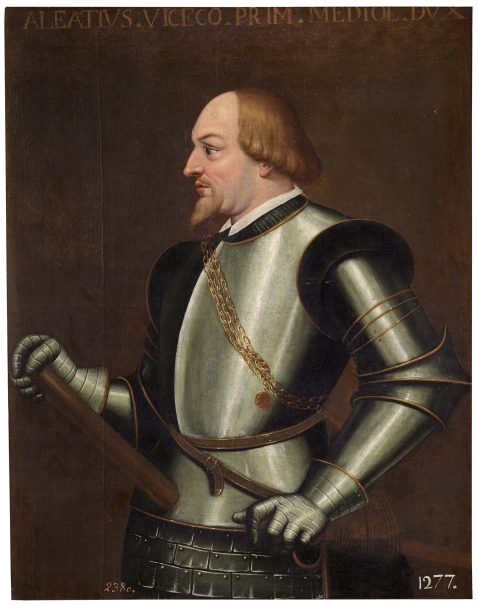
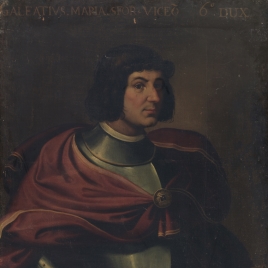
Gian Galeazzo Visconti, the first duke of Milan
First half of the XVII century. Oil on canvas.On display elsewhere
Gian Galeazzo Visconti became Lord of Milan through an arranged marriage to Elisabeth of Valois, daughter of King John II of France, which enabled his political rise. He seized power in 1385 by orchestrating a coup, imprisoning his uncle Bernabò Visconti and taking control of the city. In 1395, he was officially appointed the first Duke of Milan. Two significant architectural projects were undertaken during his rule: the Carthusian Monastery of Pavia, where he is buried, and the Gothic construction of Milan Cathedral.
With a clear propagandistic intent, the portrait presents Visconti in a three-quarter profile, portrayed in a contemplative pose and surrounded by symbols of power: his armor, a medal, a command baton, and the hilt of a sword, which subtly fades into the lower right corner. The armor stands out against the neutral background, brought to life through the play of light that defines its form and curvature. This anonymous portrait follows the style of the Florentine painter Cristofano dell’Altissimo, who, around 1522, was commissioned by Cosimo I de Medici to produce copies of portraits for the Uffizi Gallery. These were based on a collection of illustrious men assembled by Paolo Giovio at his Museo Gioviano in Como, intended to reinforce Cosimo’s political authority. The portraits were displayed alongside short biographies compiled by Giovio in his “Elogia”. Not being contemporaries, the artist likely based this portrait on earlier drawings or engravings.
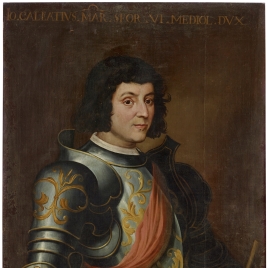
Although there is no evidence that this painting belonged to that collection, it is known to have formed part of a series of similar portraits of the Visconti and Sforza Dukes of Milan, intended for an antechamber in the Buen Retiro Palace. These portraits helped preserve the memory of their military achievements and served to legitimize King Philip IV, who also held the title of Duke of Milan. According to Elías Tormo, these canvases are most likely 17th-century works, copies of an earlier series of portraits of those who preceded the kings of Spain in the Milanese.