Girona’s great day (19 September 1809)
Ca. 1890. Oil on canvas.On display elsewhere
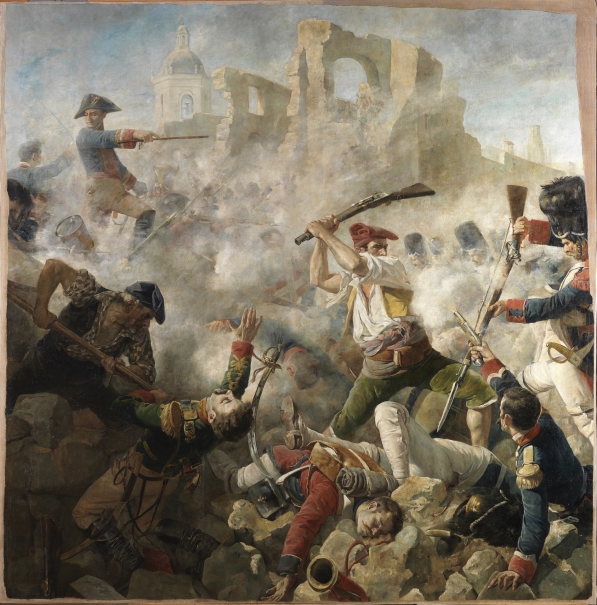
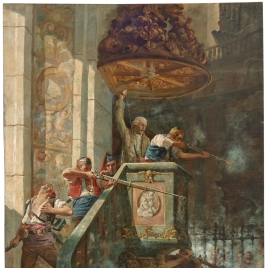
This work is probably the highest in quality amongst all those painted by César Álvarez Dumont, who, like his brother Eugenio, specialised in subjects related to the Peninsular War. Its iconography is described in the same text that was published in the catalogue, which was the artist’s point of departure for his work: At a quarter to four in the afternoon, the bell of the cathedral sounds the alarm and drums roll everywhere with the call to arms. In the streets and squares sounds the call ‘To arms, assault on the breaches!’ The attacked breaches reinforce themselves with utter bravery. Our general arrives accompanied by the lieutenant of the King of the Stronghold with his General Staff at Santa Lucía breach, as it is the closest to his home. He finds its garrison putting up the greatest resistance to the enemy; he encourages these defenders; reinforcements subsequently arrive; he gives his commands; he returns to reconnoitre the other garrisons and in all of them – which were assaulted at the same time – he finds their defenders settled, with the enclosure of the stronghold having turned into a bonfire fed with the fire of 130 pieces of artillery, furiously handled, and he issues his orders. The care-givers of Santa Barbara, made up of local heroic women, rendered eminent services, distributing cartridges and succouring the wounded irrespective of the greatest perils. The excerpt was taken from an unpublished manuscript entitled Logbook of the Siege of Girona in 1890 written by Juan Pérez Clarás, a member of the Government Board of the Siege, according to the statement by the author in the registration form for the catalogue.
The work had two vertical strips cut out, one on each side, which meant a loss of 185 cm in width from the original 488 cm. Nonetheless, the essentials of the composition remain. The hand-to-hand struggle of the defenders versus the French soldiers is also emphasised by the two groups in the foreground of the composition, which becomes even more dramatic by the corpses in the lower register of the canvas. The impression of destruction was more pronounced in the original painting, as the artist had painted the stones and debris of the ramparts jumbled at the bottom of the missing strips, thus reinforcing the composition on its flanks. In the midground, next to the heroic figure of the general leading the defence, part of a woman attending to a wounded man (one of those alluded to in Pérez Clarás’s text) has been lost, as has part of the group of defenders whom the general commands to assail. Placed at the centre of the composition and at a higher level, dominating the scene, the figure of Álvarez de Castro provides the encouragement needed by his combatants. This position, the verve of his commanding order, and the blurring of his figure due to the smoke from the discharge make him appear in another order of representation, as an invulnerable, almost immaterial hero, in a way linked to the traditional depictions of Saint James the Apostle in battles. Together with the dust of the rubble, the smoke is of paramount importance in the scene as a result of the artist’s seeking greater verisimilitude.
Even though there were critics who undoubtedly saw the progressive discrediting of history painting (which from that year onwards had a much less important presence), this work was barely mentioned. Generally, the value of the composition – which was certainly difficult to execute – was emphasised, and it was even observed that in it ‘there was not the slightest tumult’. Some reviews criticised its exaggerated movement, which was more pronounced due to the large size of the work. Albeit this is what befits a hand-to-hand battle scene, and it was in this accuracy that César particularly excelled, like his brother Eugenio.
Álvarez de Castro y su tiempo (1749-1810), Ministerio de Defensa, Secretaría General Técnica, 2010, p.132-139