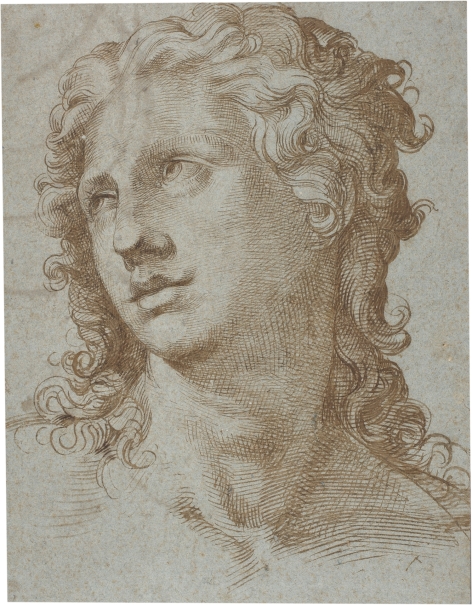
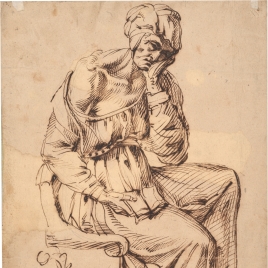
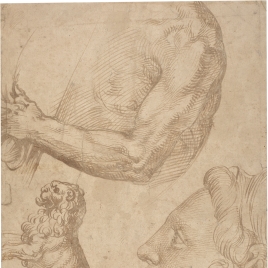
Head of a figure
1560 - 1570. Grey-brown ink, Pencil on blue paper.Not on display
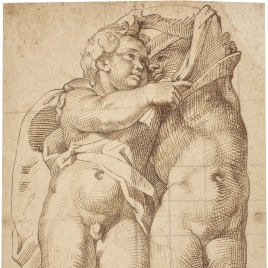
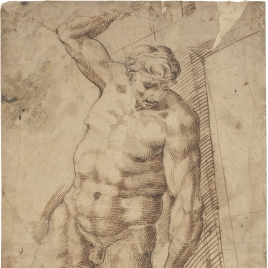
Collectors and connoisseurs have long admired the powerfully executed, often large-scale drawings by Bartolomeo Passarotti. His finished pen studies, such as Head of a figure (Testa di una figura), 1560-70, were especially sought after by collectors. In these, Passarotti perfected what may be termed the fish-net style of tight, highly finished tonal crosshatching, which had been pioneered in Raphael’s mature pen studies and was then developed into a more sophisticated and elegant language in those of the Emilian painter Parmigianino (1503-1540). In his finished studies of heads, Passarotti often copied figures from Michelangelo’s paintings and sculptures -not only for his pupils to copy from, but also as studies for figures in his own paintings.
Unfortunately it has not been possible to identify with certainty either the prototype for Head of a figure in the work of another master, such as Michelangelo or Raphael, or a corresponding head within Passarotti’s work. Among the closest parallels, however, is the head of Andromeda in Passarotti’s painting Perseus and Andromeda, c.1572-75, in the Galleria Sabauda, Turin.
In both drawing and painting the head is lit from the front, casting the side of the face into shadow, the lips are rosebud in form and the nose has a slightly bulbous tip. The most compelling common feature between the two works, however, is the sideways, slightly upward gaze directed out of the corner of the eyes. In the painting, Andromeda not only looks with awe at Perseus but also with some anxiety, as just inches above her head he is about to cut the chain binding her to the rock with a swing of his sword.
Passarotti was one of the leading painters of Bologna in the second half of the sixteenth century. He was taught in Rome by Taddeo Zuccaro (1529-1566) and lived in the city for fifteen years. His paintings made after his return to Bologna in the mid 1560s, such as Virgin enthroned with saints, 1565, for San Giacomo Maggiore, show little of the influence of Zuccaro’s style but instead a fascination for the work of Correggio.
Passarotti is today especially renowned for his down-to-earth style of portraiture, in which the sitter’s character is vividly brought to life as never before in earlier Bolognese portraits. In his reaction to the artifice in the work of the previous generation painters -Niccolò dell’Abbate (c.1512-1571), Pellegrino Tibaldi (1527-1596) and others- Passarotti to some extent anticipated the naturalism of the reform of painting carried out by the Carracci at the beginning of the 1580s. Inspired by the work of contemporary Flemish painters, from the mid 1570s onwards Passarotti painted many pictures of butcher shops, memorable for their startling realism.
Annibale Carracci’s famous Butcher’s shop, 1580-81, in the Christ Church Picture Gallery, Oxford, United Kingdom, belongs to this same tradition.
Turner, Nicholas, From Michelangelo to Annibale Carracci. A century of Italian drawings from the Prado, Chicago, Art Services International, 2008, p.114,340