formularioRDF
The itinerary <em>TITULORECORRIDO</em> has been successfully created. Now you can add in works from the Collection browser
<em>TITULOOBRA</em> added to <em>TITULORECORRIDO</em> itinerary

Close Continuar a ficha de la obra Continuar a ficha de la obra
02-06-2026
Greek Sculptor from Attica

600, 500

See author's file

Head of a Horse

Ca. 515 a.C.. Marble.
Room 072

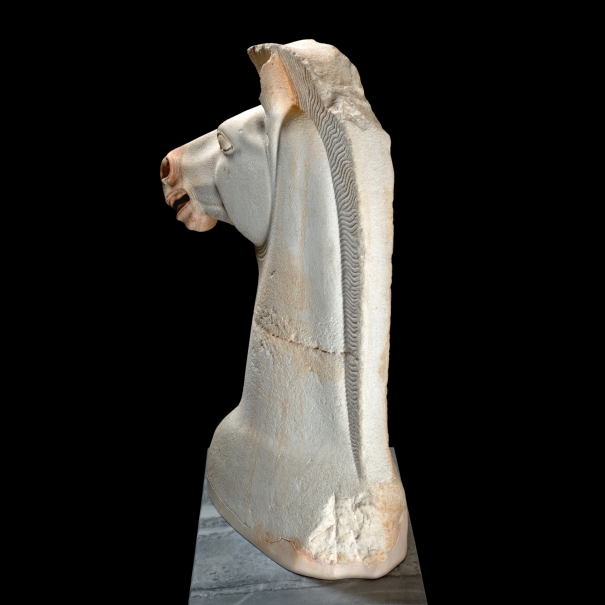
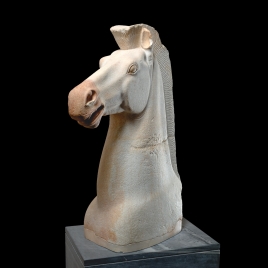
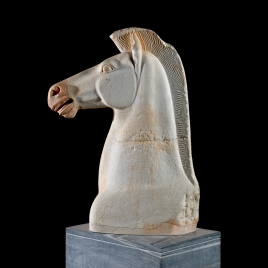
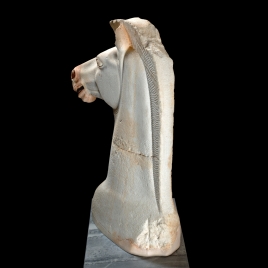
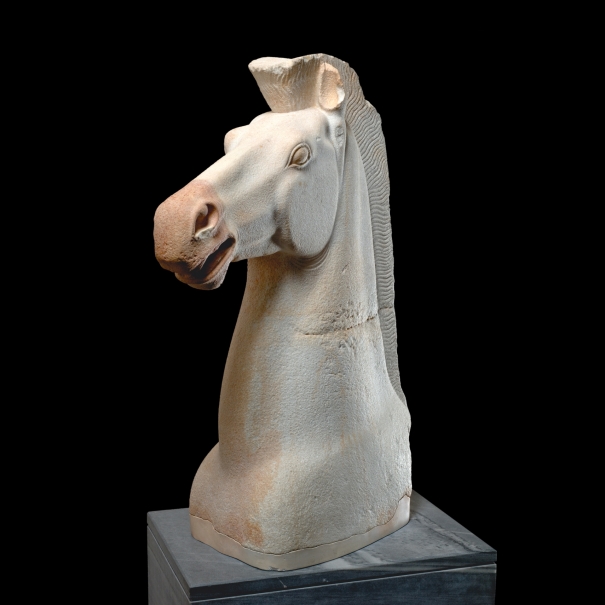
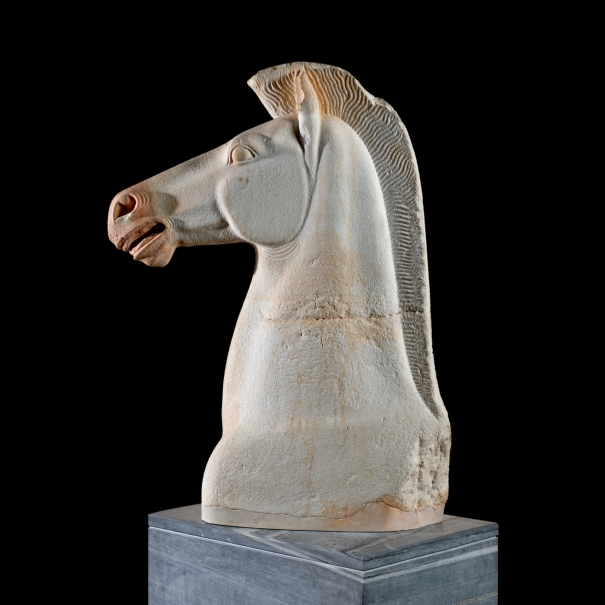
The original context for this partially conserved life-size sculpture of a horse’s head is now unknown. Only a few clues remain to clarify it. García y Bellido determined that it was from late archaic times as its style closely resembles the horses on the Acropolis in Athens. While the neck appears wide and robust in profile, with a bulging jaw and muscles artistically emphasized and a slight narrowing towards the ears; it is surprisingly slender when seen from the front. The head is gently turned to the left. While this work clearly reflects the style of Attican sculpture, it could also be from another region -the isles of Paros and Thassos, for example, where equine sculptures have also been discovered. The previously mentioned sculptures of horses at the Acropolis are votive statues about 1.10 meters high, which wealthy Greek noblemen dedicated to that city’s goddess, Athena. The present horse, however, must have been nearly twice as tall, measuring some 2.20 meters. There are other equine sculptures of the same size from the late archaic period, and the Acropolis itself had three with similar dimensions: an equestrian statue and two other horses that were probably part of a larger set, as their slightly arched bodies and gently turned heads were symmetrically matched. The last two were part of a two-horse, or possibly a four-horse chariot, but they probably did not belong to a free-standing ex-voto. Both horses lack hindquarters and are supported from below by a horizontal marble frame at the back, indicating that they may have been installed frontally as part of a mural decoration. This may have been similar to the metope at Temple C in Selinunte. There were other horses of the same size, though not the same style, at the Delphic temple of the Alcmaeonids, from the 6th century, B.C.E.. These, too, were located on the temple’s eastern pediment. The Museo del Prado’s horse shows marks from a similar use. The gently arched horizontal groove on the left side of the neck could have been made by metal reins, now lost. These would have been at that height on the horse’s neck, as can be seen in the depictions of horses from the Treasure of Sifnos in Delphos. Similarly, the groove-shaped orifice under the neck could have resulted from the horse’s attachment to another at its side. The orifice over the horse’s mane may originally have held a metal spike (meniskos, in Greek) to keep birds away. These marks are also important proof of the piece’s authenticity, which has been questioned, at least verbally, on some occasions (Text from Schröder, S. F.: Catálogo de la escultura clásica, Museo Nacional del Prado, 2004, pp. 8-11).
Technical data

Imagen del carrusel
Imagen del carrusel
Imagen del carrusel
Inventory number
E000438
Author
Greek Sculptor from Attica
Title
Head of a Horse
Date
Ca. 515 a.C.
Technique
Sculpted
Medium
Marble
Dimension
Depth: 60 cm; Height: 109 cm; Weight: 281 Kg; Weight of the support: 915 Kg
Provenance
Bequest of Marius de Zayas, 1944
Entry date
1944

Bibliography +

Winter, F, Archaische Reiterbilder von der Akropolis, Jahrbuch des Deutschen Archäeologischen Instituts, 8, 1893, pp. 138 ss., n.º 8, 9; fig. 9.

Dickins, G, Catalogue of the Acropolis Museum, Atenas, 1912, pp. 55 s., n.º A, B.

Payne, H; Young, G. M, Archaic Marble Sculpture from the Acropolis, Cresset Press, 1936, pp. láms. 139 ss.

Hafner, G, Viergespanne in Vorderansicht, Junker and Dünnhaupt, Berlin, 1938, pp. 13, n.º 147-155; 35 ss.

Stucchi, S, Saggio di scavo a Gortina (Notiziario), Annuario della Scuola archeologica di Atene e delle Missioni italiane in Oriente, 30/32, 1952/1954, pp. 53 s., fig. 15.

Garcia y Bellido, Antonio, La escultura clásica del "Legado Zayas", en el Museo del Prado, Archivo Español de Arqueología, 25, 1952, pp. 87-102.

Blanco Freijeiro, Antonio, Catálogo de la escultura. Museo del Prado, Museo Nacional del Prado, Madrid, 1957, pp. nº438-E.

Coste-Messelière, Pierre de la, Delphes, Hachette, París, 1957, pp. láms. 72-75.

Daux, Georges (ed.), Guide de Thasos, École française d'Athènes, Atenas, 1968, pp. 122, n.º 19, fig. 59.

Brouskari, María, The Acropolis Museum : a descriptive catalogue, The Commercial Bank of Greece, Atenas, 1974, pp. 66, 140; figs. 113, 249.

Ridgway, Brunilde Sismondo, The archaic style in greek sculpture, Princeton University Press, Princeton, 1977, pp. 140, 163.

Giuliani, Luca, Die archaischen Metopen von Selinunt, Ph. von Zabern, Mainz, 1979, pp. 27 ss., lám. 5,1.

Blanco, Antonio; Lorente, Manuel, Catálogo de la escultura. Museo del Prado (2ª ed.), Patronato Nacional de Museos, Madrid, 1981, pp. nº438.

Stucky, R. A, Überlegungen zum “Perserreiter”, Antike Kunst, 25, 1982, pp. 97 ss., lám. 17.

Floren, Josef, Die geometrische un archaische Plastik, C.H.Becks'Sche Verlags Buchnandlung, Munich, 1987, pp. 277 ss.

Stucchi, S, A proposito di cavalli, Rendiconti. Atti della Pontificia academia romana di archeologia, 61, 1988/1989, pp. 200 s., con nota 13, figs. 7, 8.

Schröder, S. F, Dos originales griegos en el Museo del Prado, Boletín de la Asociación española de amigos de la arqueología, 33, 1993, pp. 7 s., figs. 5, 6.

Croissant, F, Observations sur la date et le style du fronton de la Gigantomachie, Acr. 631, Revue des études anciennes, 95, 1993, pp. 61 ss., fig. 1.

Marszal, J. M, Stephanos, Homenaje a B. S. Ridgway / editado por K. J. Hartswick, M. C. Sturgeon, 1998, pp. 174 ss., con nota 25, fig. 19, 1.

Elvira Barba, Miguel Angel - Schröder, Stephan, Escultura clásica. Guía. Museo Nacional del Prado, Fundación Marcelino Botín - Museo del Prado, Santander, 1999, pp. 50.

Schröder, Stephan F, Catálogo de la escultura clásica: Museo del Prado II, Museo Nacional del Prado, Madrid, 2004, pp. 8-11.

Schröder, Stephan F, Marius de Zayas, el donante reencontrado, Boletín del Museo del Prado, XXII, 2004, pp. 81 / lám. 1.

Museo Nacional del Prado, Enciclopedia del Museo del Prado, II, T.F. Editores: Fundación Amigos, Madrid, 2006, pp. 584.

Museo Nacional del Prado, La Guía del Prado, Museo Nacional del Prado, Madrid, 2008, pp. 442.

Museo Nacional del Prado, El Museo del Prado: la colección de escultura, artes decorativas y dibujos, Museo Nacional del Prado, Madrid, 2009.

Location +

Room 072 (On Display)

Expuesto
Update date: 02-06-2026 | Registry created on 28-04-2015

Visor 360

Drag with the cursor to rotate the piece

Print on demand

Print artworks available in our catalogue in high quality and your preferred size and finish.

Image archive

Request artworks available in our catalogue in digital format.

Up