Henry IV
Second half of the XVII century. Oil on canvas.On display elsewhere
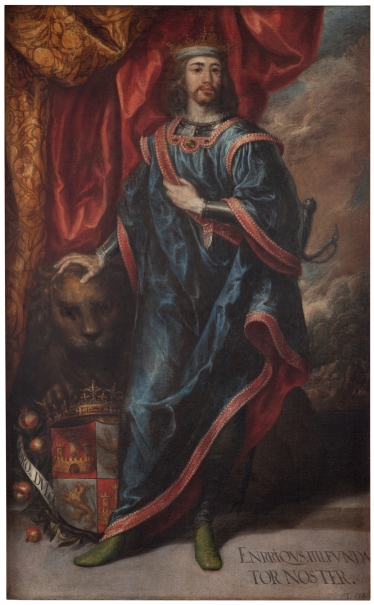
This heroic full-length portrait presents the king under a red-and-gold curtain with a landscape in the background. He wears a crown and, under a blue tunic, armor. His right hand rests on the head of a lion whose paw rests, in turn, on the coat of arms of Castile and León, territories ruled by Henry IV. The arms are surrounded by pomegranate flowers with the slogan, AGRO DULCE, an insignia of this monarch that alludes to his war against the Nasrid Dynasty in Granada (1457-1459). His left hand holds the sash bearing his sword.
History has not been especially generous with Henry IV (1435-1474), who became king of Castile in 1454. Politically, his rein was fraught by a civil war that pitted supporters of his sister, Isabella against those of his daughter, Juana, a conflict favored by the monarch´s continuous changes of heart with regard to his own succession. Physically, he was described by contemporaneous sources as unattractive: tall and corpulent with powerful arms and large hands with long, rough fingers. His ferocious expression was reinforced by a deformed nose, due to a childhood accident. His eyes were far apart and his brows, very high. His teeth were described as mirror like, and his blond hair and beard, unkempt. His long legs bore a large body over excessively delicate feet. He did not bother to wear clothing and shoes worthy of a king and paid little attention to his personal hygiene. As to his moral character: he was considered a withdrawn and solitary king who neglected matters of state in favor of hunting or intellectual pleasures such as music, which he especially enjoyed. The present portrait, however, offers quite a different image, as he was considered much more noble and dignified in the 17th century.
Alonso del Arco (ca. 1635-1704) was a prolific artist and disciple of Antonio Pereda. His lively and colorful style marked him as one of the most gifted baroque painters in Madrid during the second half of the 17th century, with Flemish and Venetian influences and an undeniable gift for portraiture.
The existence of two similar-sized portraits of Henry IV complicates efforts to clarify the provenance of the one presented here. Cruzada Villaamil (1865) registered it as attributed to Carreño and suggested, apparently without any supporting documentation, that it was undoubtedly painted by Carreño for some celebrations or to adorn some hall or cloister at the convent of San Jerónimo del Prado, where there was a gallery of portraits of the kings of Spain.
Recently, Moreno Alcalde (1983) and Gómez Nebreda (2001) have determined this work´s provenence, apparently with some certainty, as the monastery of Hieronymite monks in Parral, Segovia. This is based on the original inventory of paintings from suppressed convents in the province of Segovia, drawn up by José Castelaro y Perea.
According to Alcalde and Nebreda, the inscription on the lower right part of the painting states that the canvas was painted expressly for that monastery founded by Henry IV in 1447. However, the monastery of San Jerónimo in Madrid was also founded by Henry IV, and its construction began in 1460, so that argument has little bearing. On the other hand, it is worth mentioning that the painting from the monastery in Parral is listed in Castelaro´s inventory as a quite damaged copy, while the one at the monastery of San Jerónimo was registered in the general inventory of paintings in storage at the Museo de la Trinidad and chosen by the Academy´s commission as a first-rate work. Finally, there is the fact that the inventory of paintings and statues presented at the inauguration of the Museo Nacional de la Trinidad on June 24, 1838 registers the painting hung in the Museo de la Trinidad in 1838—obviously the one presented here—as coming from San Jerónimo. It thus seems clear that the present canvas is the one from San Jerónimo el Real in Madrid, while the canvas from El Parral, now lost, possibly due to its poor condition, was a copy of the present one.