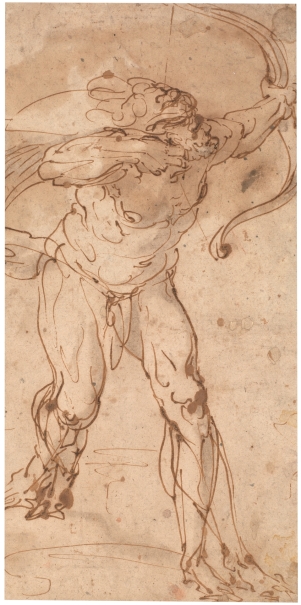
Hercules shooting his bow
1544 - 1550. Pencil ground, Grey-brown ink, Wash, Pencil on brown paper.Not on display
Hercules used his bow when firing at the Stymphalian birds, the destruction of which was the sixth of his Labors. These voracious creatures ate human flesh, had brazen claws, wings and beaks and used their feathers as arrows. Their habitat was a lake near Stymphalus in Arcadia. On hearing of the task that Hercules had been allotted, Athena provided the hero with a brass rattle, by the noise of which he startled the birds, killing them one by one with his arrows as they flew away. In the drawing, only the figure of Hercules appears, but the curving lines beneath his feet are perhaps an indication of the waters´ edge of the lake. He has just fired an arrow upwards into the air, indicating that the composition for which the study was conceived would have shown the birds above and to the right.
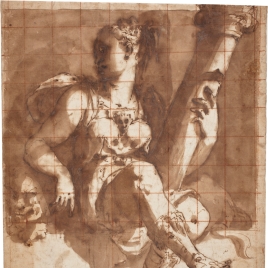
It is recorded that Luca Cambiaso and his father Giovanni painted scenes from the Labors of Hercules in the lunettes of the salotto in the Palazzo della Prefettura, formerly Antonio Doria, Genoa. A contemporary visitor to the palace would naturally have caught the analogy between the exploits of the ancient hero and those of the palace´s owner, Admiral Antonio Doria, a man-of-arms who had similarly carried out great deeds during his glorious career. These lunette decorations are now almost completely lost, and an accurate visual record of their former appearance appears not to have survived. Because of the proximity of style between the Prado´s Hercules and other drawings by Luca Cambiaso connected with the frescoes in the Palazzo della Prefettura, it is reasonable to suppose that it may have come into being in connection with the lunette cycle of the Labors of Hercules. Moreover, the pose of Hercules recalls that of Apollo Firing his Bow at the Greeks outside the Gates of Troy, the fresco by Luca and Giovanni Cambiaso on the ceiling of the Salone di Apollo in the same palace.
The drawing´s execution is again strongly reminiscent of the style of Perino del Vaga (Text drawn from Turner, N.: From Michelangelo to Annibale Carracci. A century of Italian drawings from the Prado, Art Services International-Museo Nacional del Prado, 2008, p. 106).