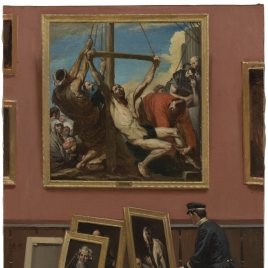
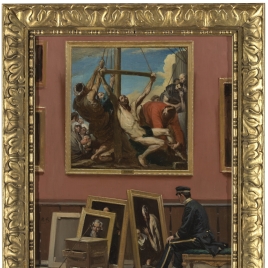
Interior of the Museo del Prado
Ca. 1897. Oil on canvas.Room 101
The author of this work, a painter born in Adra (Almería), produced portraits, still lifes and lithographs. He also made copies of works in the Museo del Prado and was the artist of some of the museum’s own interiors. This genre was developed in Spain during the last two decades of the century. Among the artists who most frequently engaged with it were Manuel García Hispaleto, Francisco Aznar García and the brothers Eugenio and César Álvarez Dumont. We know of at least three other works related to this one, executed in the 1890s by Pineda. The Museo del Prado keeps a portrait by Pineda dated 1917 in the Museo de Bellas Artes in Malaga (P7851) but no examples of this genre.
The painting depicts an aspect of the section of the Museo del Prado’s Central Gallery on the north side, on whose east wall hung the work of José de Ribera. This work did not have its own room until 1900-10. José de Ribera’s Martyrdom of Saint Philip (P1101) is a highlight on the wall. On the floor, as if they had just been taken down, are four paintings: one is turned against the plinth and another is covered almost entirely by Ribera’s Saint Andrew (P1077), next to which Saint Paul the Hermit (P1115) – by the same artist – can be identified.
The painting of Saint Andrew hung, as revealed by the view taken by Jean Laurent in his graphoscope (1882-83), in the centre of a row of three paintings below the Martyrdom of Saint Philip. Saint Paul the Hermit hung to the right on the same row. Their presence on the floor is therefore an imaginative play on the part of the artist, as is the proximity of the room’s security guard, who is absorbed in the contemplation of Saint Paul. The bench and the iron railing protecting the works accurately correspond to what existed, as does the red colour of the wall. This was the result of Federico de Madrazo’s initiative, who was director of the Museum until his death in 1894.
At least three other works by Pineda, of the same size, are documented in private collections, before paintings by Diego Velázquez (Las Meninas in one case and The Surrender of Breda in another) and Bartolomé Esteban Murillo. The latter depicts a copyist before The Immaculate Conception at the Escorial. The artist also presented two works to the 1897 General Exhibition of Fine Arts in Madrid, titled Interior del Museo de Pinturas de Madrid (Interior of the Madrid Museum of Paintings). They are undoubtedly related to this one now acquired by the Prado. Their measurements are somewhat larger, although this may be due to the frame also having been taken into consideration.
As in the aforementioned works, the Museum’s interior is animated by a figure. Furthermore, there is a similar play with the paintings resting on the ground. This denotes a search for naturalness and a mastery of the resources of perspective in the depiction of those who, like Saint Paul the Hermit, appear foreshortened. Pineda’s dedication as a teacher of technical drawing (in 1897 he was a teacher at the Central School of Arts and Crafts in Madrid, from which he retired) meant that he had a skilled command of perspective. The presence of a small table with an open drawer, on which a mahl stick rests, is an allusion to – like other copyists – the artist’s own practice of working in the Museum and may also refer to the possibility that the paintings on the floor are copies.
Some of his paintings, especially after those by Velázquez, reveal that the painter was an excellent copyist. Five of these are in the National Gallery in Dublin and one in the Museum of Adra, his native town. The depiction in the now-acquired painting of The Martyrdom of Saint Philip reveals his skill in interpreting painting of the past.
Barón, Javier, 'Miguel Pineda Montón. Interior del Museo del Prado'. En: Memoria de actividades 2021 Museo Nacional del Prado, Ministerio de Cultura y Deporte, 2022, p.31-33