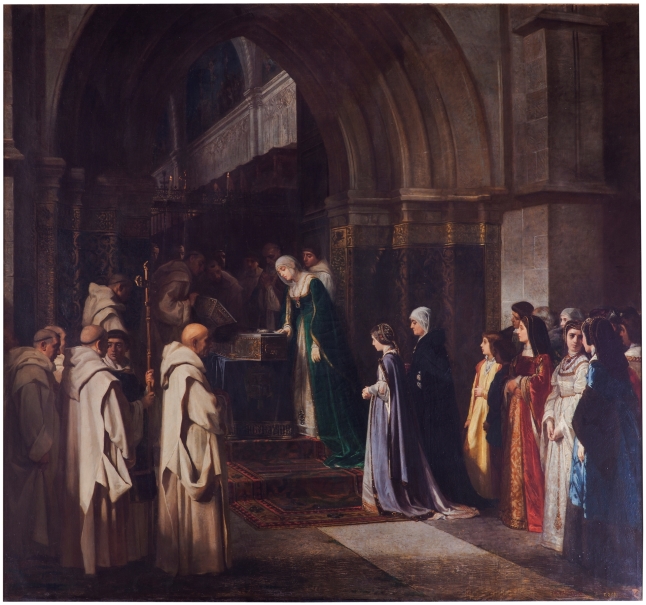
Isabella I of Castile at the Carthusian monastery of Miraflores
Ca. 1866. Oil on canvas.On display elsewhere
This painting depicts a historical episode from the life of Isabella I of Castile, also known as Isabella the Catholic (1451–1504). It narrates her visit to the Carthusian monastery of Miraflores, Burgos, around 1486, to see the corpse of her father John II (1405–1454). The construction of the Carthusian monastery was commissioned under the patronage of the King himself. In 1442, he ceded to a community of Carthusian monks under the patronage of Saint Francis of Assisi el Palacio de la Quinta de recreo that his father Henry III (1379–1406) had ordered to be built around 1400. After some delays in the construction of the building, the definitive impetus arrived in 1554, when Juan de Colonia, who was finishing work on the Cathedral of Burgos, was commissioned to draw the plans. Álvarez Catalá (1836–1901) has placed the scene at the most dramatic moment of the historical episode. At the insistence of Isabella, who was barely three years old when her father died, the monks agreed to show her the coffin in which the body of the deceased King was being kept until the tomb he would share with his wife Isabella of Portugal (1428–1496) was completed under Gil de Siloe (1467–1505).
The main group of characters is displaced to the back of the composition, framed by the entrance arches to the cloister. The choir of the Carthusian church acts as a beautiful backdrop. The Queen, dressed in green, bows sternly towards her father´s corpse as she rests her hand on the coffin. To her left are her daughter, the Infant Isabella, and her guardian. To her right are the silhouettes of some Carthusian monks who, together with the group holding the processional cross in the foreground, watch over the transfer of the royal remains. To the right of the composition, the group of ladies, knights and pages help to define the space in a rigid scheme which, in the manner of a corridor, directs the viewer´s gaze directly to the main scene. The eerie, almost mysterious atmosphere is defined by the technical use of the light. This leaves the background of the composition and the main scene in semi-darkness, and illuminates only the most important details as well as the characters in the foreground. Technically speaking, the work is notable for its detailed execution and the references to the great Spanish Baroque painters, such as Zurbarán in the Carthusian habits and Velázquez´s spatial perspective.
In the lower left-hand corner, the work has a reference number corresponding to the 1900 catalogue of Museo de Arte Moderno, (M.AM.) 14 (A), accompanied by the initial of the artist´s surname, in the usual formula of the inventory mark of the institution. In addition, on a yellow patch, the number of the Inventory of New Acquisitions of Museo del Prado, T.219, also appears, as a result of the inventory process carried out at the institution with the inclusion in its collections in 1971 of the works from Museo de Arte Moderno (which no longer exists). This canvas was acquired by the Spanish State by Royal Order on 3 May 1867 for the Museo de la Trinidad, and was transferred to Museo de Arte Moderno in 1894. It was deposited at the Faculty of Law of the Complutense University of Madrid from 1921 onwards. Then, it was transferred to Museo de Bellas Artes in Granada in 1958. Lastly, it was deposited in Palacio de la Madraza in the same city by Royal Order of 15 July 1976. Luis Álvarez Catalá was born in Madrid, although he was of Asturian origins. The artist was a disciple of Federico Madrazo at Escuela de Bellas Artes de San Fernando. He then moved to Rome in 1857 to continue his training, where he remained for more than thirty years. He became a full member of the Academies of Fine Arts in Rome and Berlin. Moreover, he worked as director of Museo del Prado (1898–1901). With this painting, documented in 1866, the artist won the second-class medal at the 1866 National Exhibition of Fine Arts. Although the reviews were uneven, its technical and chromatic quality was praised.
López-Fanjul y Díez del Corral, María, 'Luis Álvarez Catalá. Visita de Isabel La Católica a la Cartuja de Miraflores para ver el cadáver de su padre'. en: Esther Galera Mendoza y Lola Caparrós Masegosa (eds.) Obras maestras del patrimonio de la universidad de Granada, Granada, Universidad de Granada, 2006, p.116-117