Isabella II
1848. Oil on canvas.On display elsewhere
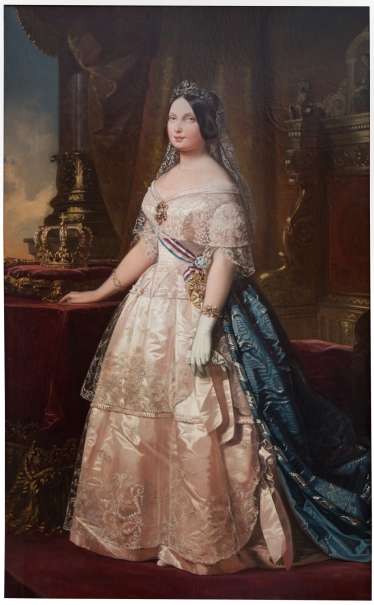
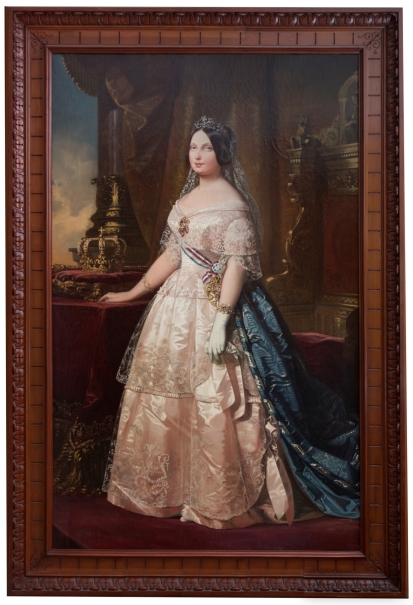
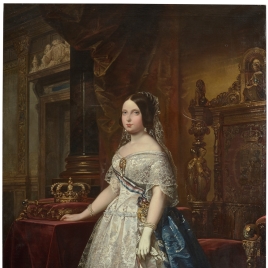
Portrait of Isabella II (Madrid, 1830–Paris, 1904). Queen of Spain (1833–1868). She wears the ribbons of the Spanish Order of Noble Ladies of Queen Maria Luisa and the Portuguese orders of Queen Saint Isabel of Portugal and Our Lady of the Conception of Villaviciosa, whose scallop shells can be seen at the end of the ribbons (Project for the cataloguing of heraldic and faleristic elements, Real Academia Matritense de Heráldica y Genealogía).
This is one of the three copies of the 1844 portrait of Isabella II by Federico de Madrazo that is kept in the Museo de la Real Academia de Bellas Artes de San Fernando and that is held by the Museo del Prado. Due to its status as an official image, there are numerous replicas and copies of this portrait of different type and quality, with slight variations in composition compared to the painting in the Academia de San Fernando. Another was executed by Isidoro Lozano so as to complete the Chronological Series of the Kings of Spain. Nonetheless, he modified the design of the throne and the background – which he replaced with a cloudscape – as well as the appearance of the queen’s jewellery, as her head is covered by a splendid diadem.
The Museo del Prado keeps another replica (P005515) which is absolutely literal in every detail to the original. Representing an intermediate step between Isidoro Lozano’s painting and the previous one is another copy (P003298) kept in the Prado. Despite sometimes being considered an original by Madrazo, it is treated as a copy, as the clumsiness of its design – particularly in the proportions and arrangement of the queen’s arms – would seem to indicate. However, it is a very interesting painting as it is only sketched out, and the nervous, rapid brushstrokes in the preparation and design of the ornamental elements of the composition are clearly visible. The copy in the Museo Naval has also been considered an original, although its execution suggests that it is a copy for the same reasons as the copy in the Museo Romántico: its succinct execution in the treatment of the accessories, its clumsy drawing and its excessive flatness (Text drawn from Díez, J.L. in: Federico de Madrazo (1814–1895), Museo del Prado, 1994, pp. 183–184).