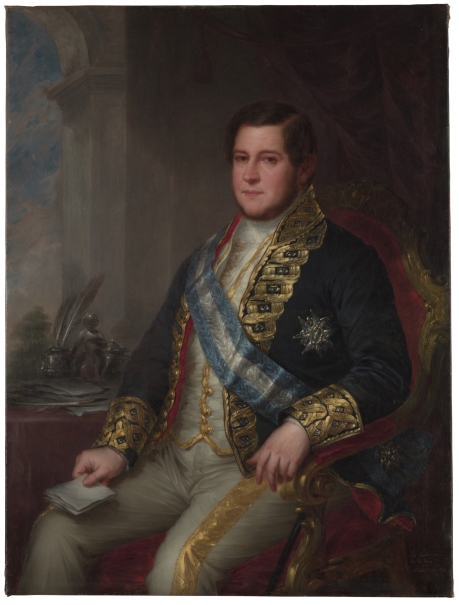
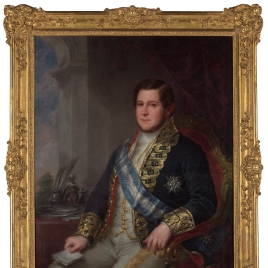
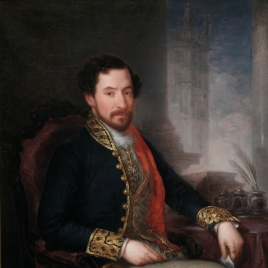
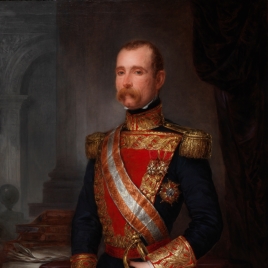
Juan Bravo Murillo, Minister of Commerce, Instruction and Public Works
1848. Oil on canvas.On display elsewhere
After completing his executive commitments with the Academy of Seville, Gutiérrez de la Vega settled definitively at the court in 1848. Since his first trip to Madrid in 1831, the bourgeoisie and the Crown itself had provided him with economic support through numerous portrait commissions. He was one of the most active members of the forum of the artistic and literary gatherings of the Lyceum along with his fellow countryman and painter Antonio Maria Esquivel. There he earned great repute among the bourgeoisie and the political class that attended these gatherings. This work is a beautiful example of official portraiture. The government commissioned it for the iconotheque of the top leaders of the Ministry of Commerce, Instruction and Public Works. The painting depicts the politician wearing the uniform of Minister of Development in 1848, when he took charge of the Ministry during the government of Narváez.
Juan Méndez Bravo Murillo was born in Fregenal de la Sierra (Badajoz) on June 9, 1803. He studied law in Seville and Salamanca and worked as a public prosecutor in Cadiz in 1832. He arrived in Madrid in 1835, where he soon became known as a jurist and competent man in Treasury matters. He belonged to the moderate party and was a deputy to the Cortes in 1837. He was repressed during the government of Espartero, so he fled to France until the fall of the Duke of Victory. On his return, his political career took off and in 1847 he was appointed Minister of Grace and Justice in the cabinet of the Duke of Sotomayor. Following his responsibilities as Minister of Development, in 1849 he was appointed Minister of the Navy and Minister of the Treasury, which he held for nearly three and a half years. During these years he sanctioned the important Accounting Law that bears his name. He also imposed the Decimal Metric System and became President of the Council of Ministers in 1851. His mandate stood out for his firmness and cruelty in the enforcement of the sanctions imposed on the priest Merino for his frustrated attempt against Queen Isabella II. After 1852 he carried out international diplomatic tasks, becoming president of the Congress in 1858 and senator from 1863 onwards. The revolution of September 1868 led to his retirement from politics. He died in Madrid on January 10, 1873.
The portrait represents the robust figure of the politician at the age of forty-five. He wears the official dress of his ministry. He also bears the decoration and the grand cross of knight of the royal and distinguished order of Carlos III. He holds a sheet of paper that may be a reference to the most important project of his work at the head of the Ministry of Development, which was the construction of the Canal of Isabella II. This was a monumental work in its time, aimed at providing drinking water to Madrid. To the left and on the table, there are some writing materials. In the background, revealed through the opening of a curtain, is a landscape framed by the architecture of a room. Following the neat technique and the colorful style of the Sevillian artist, it is worth highlighting the excellent and evident artistic refinement in the execution of the uniform´s embroidery. He places special emphasis on highlighting the sparkles and the quality of the different textures and the and the entwined play of the fabrics that encircle the politician´s torso. Likewise, a toned diagonal light gradually falls on the figure and the decorative objects, masterfully making up for the ordinariness of a conventional composition, which is excessively recurrent in commissions from official bodies. Pardo Canalís (1971) reproduced a copy of this portrait for the Ministry of Development.
Gutiérrez Márquez, A., Juan Bravo Murillo, ministro de Fomento (1848). En Barón, J.: El retrato español en el Prado. De Goya a Sorolla, Madrid, Museo Nacional del Prado, 2007, p.106, n. 25