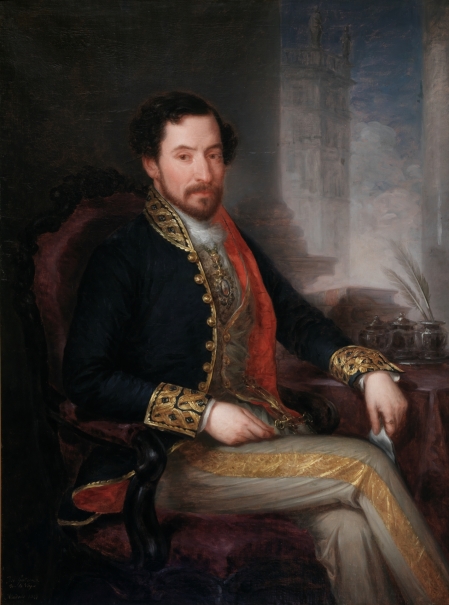
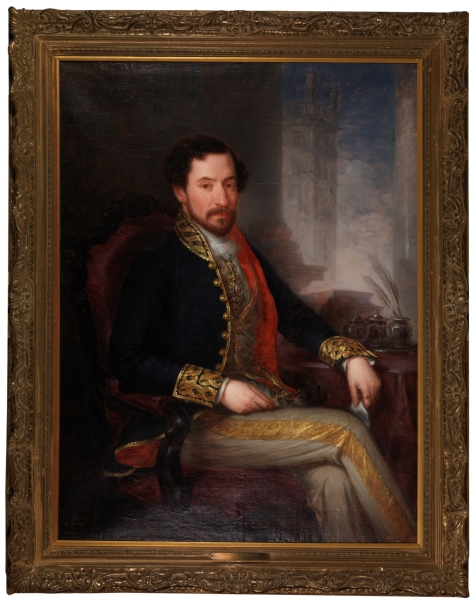
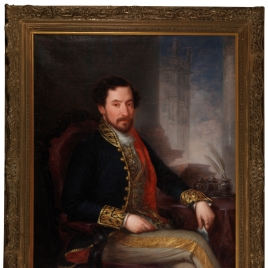
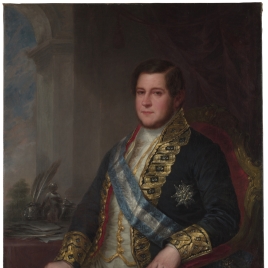
Nicomedes Pastor Diaz, Minister of Commerce, Instruction and Public Works
1848. Oil on canvas.On display elsewhere
Nicomedes Pastor Díaz was born in Vivero (Lugo) on September 15, 1811. He was the son of a Navy Corps Officer and studied philosophy at the Seminary of Mondoñedo. Afterwards, he attended the University of Santiago, where he developed a preference for literature and poetry. There he took up writing in Spanish ("El Amor sin Objeto", "Mi Color", "Al silencio", "La Inmortalidad" and "En la muerte de un hermano niño") and in Galician ("A alborada"). This marked the beginning of the poetic revival in the Galician language. The closure of the universities decreed by Calomarde, who was then head of the Cabinet, made Pastor move to Alcalá in 1832 to continue his studies. There he became friends with the renowned poet Quintana and established a good relationship with the conservatives Donoso Cortés, Pacheco and Estébanez Calderón. He was also acquainted with Larra, Espronceda and Ventura de la Vega. However, José Zorrilla (1837) would later become his great friend and protégé. He graduated as a lawyer in 1833, embarking on an unstoppable career in the three most important male occupations at the time: he was a poet, journalist, and politician. His publications appeared in the popular magazines and newspapers "El Artista", "La Abeja" and "El Siglo". Pastor Díaz inclined increasingly towards conservative positions, encouraged by his religious training and character, and gradually moved away from the liberalism of his fellow members of the Esproncediano movement. After the creation of the Ministry of the Interior and the sub-delegations of Development, Minister Javier de Burgos, responsible for the closure of the newspaper El Siglo, appointed Pastor Díaz as an official in Cáceres. This was his first assignment of his long political career. In 1835 Salustiano Olózaga recommended him as a candidate for the Ministry of the Interior, after which he was appointed Political Secretary in Santander. He opposed Espartero during the last stage of his progressive regency. He founded, together with Cárdenas, Pacheco and Ríos Rosas, the weekly newspaper "El Conservador" (1841) and offered his services to the Queen Governor during the Regency conflict. This earned him a month in jail and great prestige in the service of the Monarchy. In fact, it was Pastor Díaz who suggested in "El Sol" (1842) the coming of age of Queen Isabella II. After the closing of "El Conservador" he founded "El Heraldo" (1842). Alongside his political career, he pursued both a literary career and a career as a researcher, publishing his "Compendio Histórico-Crítico de la Jurisprudencia Romana", based on the work of the English historian Gibbon. In 1847 he was appointed a full member of the Royal Academy and in 1848 he was appointed rector of the University of Madrid, a position he held until 1850.
The 1843 counter-revolution boosted his political career. He went from being deputy for La Coruña to Minister of Commerce, Education and Public Works in 1847. In 1856, O´Donnell appointed him Minister of State. When Narváez replaced O´Donnell, Nicomedes Pastor became Councilor of State. He became member of the Academy of Moral and Political Sciences in 1857. In 1855 he published "Desde Villahermosa a China" and "Roma sin el Papa". Between 1859 and 1861 he was ambassador in Lisbon. After O´Donnell´s return to power in 1863, he was appointed Minister of Grace and Justice, a position in which he remained for two months, as he was forced to retire due to illness, and died on March 22, 1863. During his political life he received the decorations of Carlos III, San Genaro, Christ of Portugal, San José of Parma and San Mauricio and San Lázaro.
This painting is his official portrait as Minister of Commerce, Instruction and Public Works. His uniform bears the medal of full academician of the Royal Spanish Academy, which he joined in 1847.
Díez, José Luis (dir.), Pintura del Siglo XIX en el Museo del Prado: catálogo general, Madrid, Museo Nacional del Prado, 2015, p.249