Kitchen Still Life
1651. Oil on canvas.Not on display
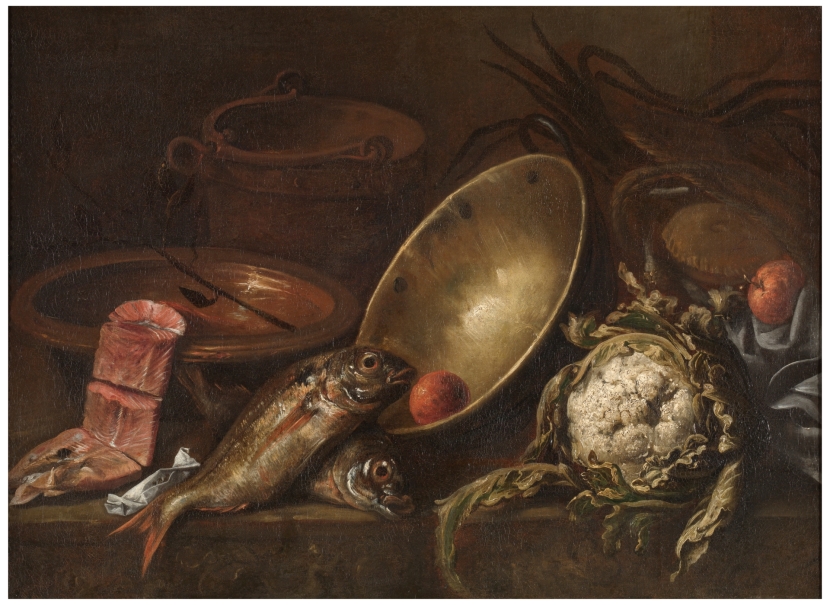
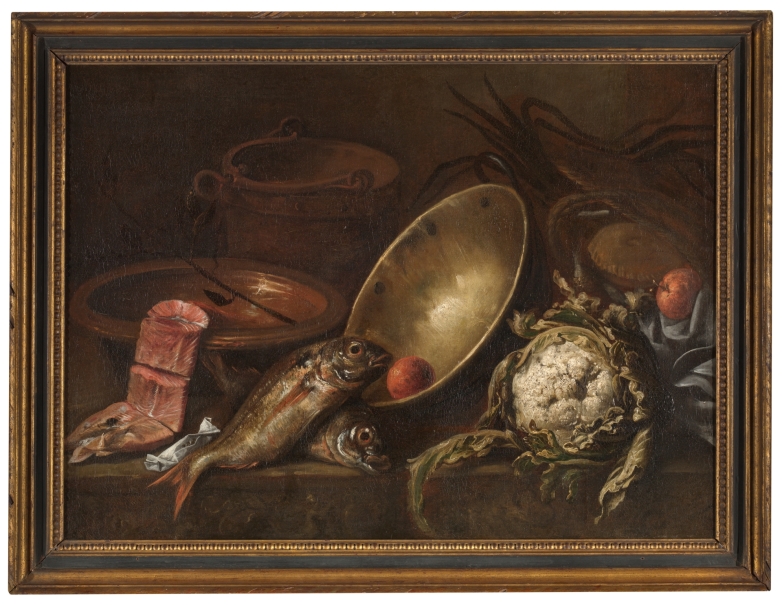
This attractive and singular mid-17th-century Spanish still life was originally thought to be by Antonio de Pereda, due to its similarity to two canvases at the Museo de Arte Antiga in Lisbon, which he signed and dated in 1651. However, notwithstanding its approximate resemblance to Pereda’s creations, a convincing attribution has yet to be encountered. Foodstuffs and utensils are scattered in complex disorder on a rough table of the sort found in almost any kitchen. Fish, vegetables and fruit surround a basin, a cauldron and a pot, along with other similar elements that appear to have been left there with the intention of making stew in the very near future.
In Portús’s opinion, this work’s aesthetic and technical characteristics recall a canvas attributed to Mateo Cerezo (P3159), although there are natural differences that argue against attributing it to him. Overall, it is rather mediocre, and not as polished as the works of other known artists. It draws on Van der Hamen and even Loarte, indicating that its creator moved in relatively narrow circles with respect to the still-life genre. It does, however, offer knowledge of still lifes in the court of Madrid around the middle of the 16th century, while simultaneously reflecting the influences of later artists—specifically the two mentioned above, but also some others. Still, its rustic interpretation of reality fails to achieve the detailed refinement and criteria that make many pieces by this artist’s contemporaries true masterworks.
Luna, Juan J., El bodegón español en el Prado: de Van der Hamen a Goya, Madrid, Museo Nacional del Prado, 2008, p.92/93