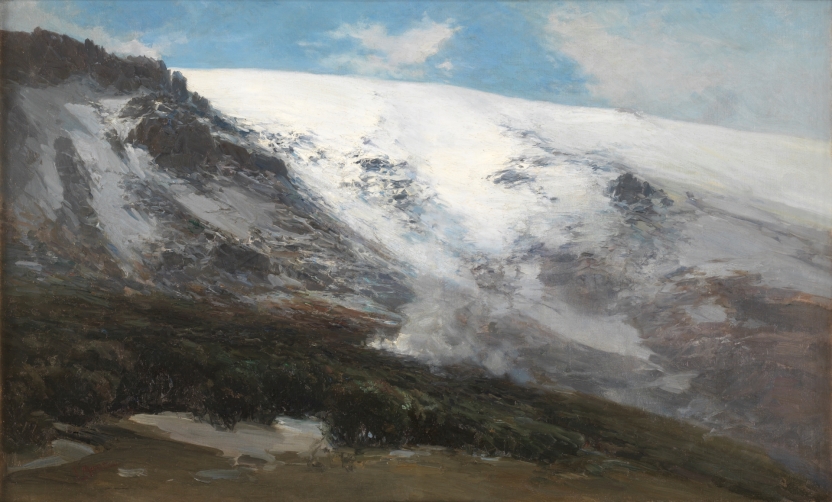
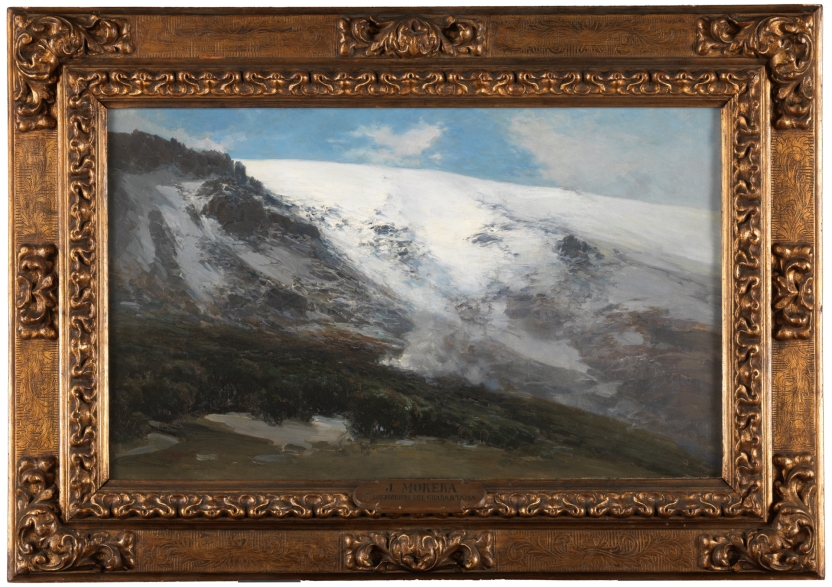
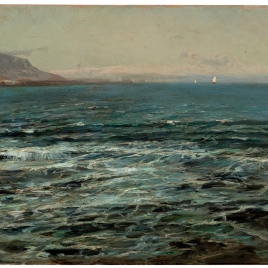
La Morcuera Pass (Guadarrama)
Ca. 1901. Oil on canvas.Not on display
At the end of the 19th century and the beginning of the 20th, the salons of the bourgeoisie were mainly decorated with examples of modern, eclectic realism with idealistic overtones within the framework of the academic tradition. One of the representatives of that dominant trend was the Lleida-born Jaime Morera y Galicia, a favourite disciple of Carlos de Haes, who defended his aesthetic by placing himself in the middle ground: a version of Spanish scenes that was not obsessed by their differences – as was the case with the landscape trend of the Spanish model – but rather by the search for the moderation of the light in the Iberian Plateau, keeping the transitions from one colour to another through the regulated application of hues.
In his book En la Sierra del Guadarrama. Divagaciones sobre recuerdos de unos años de una pintura entre nieves [In the Sierra del Guadarrama. Ramblings on memories of a few years of painting among the snows] (1927) – in wheich he comments on his journey through these mountains and villages between 1890 and 1895 – he criticises techniques that use pure, unshaded colours to paint lights and shadows. He states that these lead the painter down ‘paths’ directed to the conventionalisms of modern painting. In order to paint ‘sparkling’ light, he uses only blue or violet for the darks. These colours are not found in nature and lead to sameness. This is a clear allusion to the Impressionist formulas with their violets for capturing the luminosity of the shadows. In this text, he writes that he sought in the Madrid mountains the moments and lights of cloudy days with nuances and soft tonal gradations, which would lead him to see the grandeur of the mountains on veiled days, thus recognising that the apotheosis of nature would surpass him if it were not for the fact that nature rules. This is the register of his best landscapes, such as this one of Puerto de la Morcuera (Guadarrama).
Pena López, Carmen, 'La invención del paisaje español' En: Del realismo al impresionismo, Madrid, Fundación Amigos Museo del Prado - Galaxia Gutenberg, 2014, p.143-165 [156]