Landscape in Gredos
XIX century. Oil on canvas.Not on display
The author of this work was one of the most renowned Spanish landscape painters during the 20th century. His influence would last for decades thanks to his instruction at the Academia de Bellas Artes de San Fernando. This painting offers a different yet supplementary vision of this genre to that of his peers, namely Joaquín Mir and Eliseo Meifrén. The canvas is a good example of the trace of Martínez Vázquez’s master, Antonio Muñoz Degrain, in the development of this genre during the first half of the 19th century.
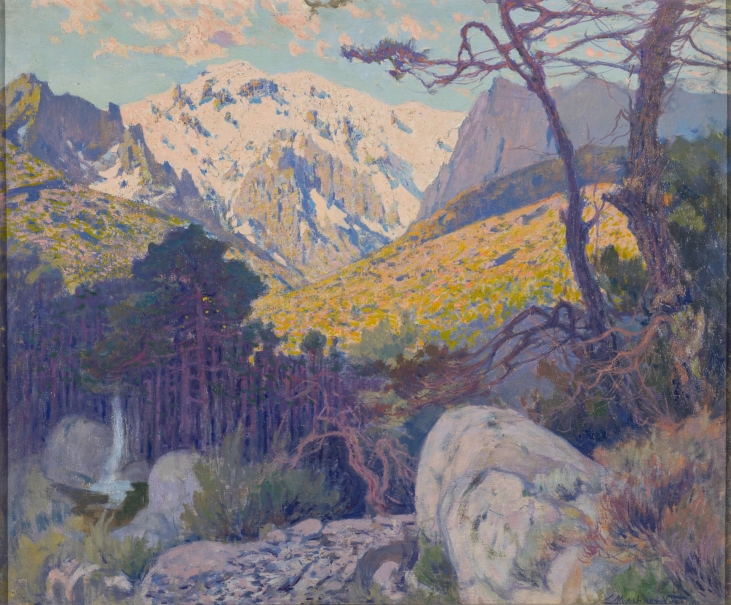
Martínez Vázquez turned the Sierra de Gredos into the central motif of his production, prioritizing it over many other sites and cities he visited over the course of his extensive career and leading him to become popularly known as ‘the painter of Gredos’. His own identification with the sites where he was raised (he was born in Fresnedilla, a small village in Ávila that borders the Tiétar river) was not only a clear influence, but also their natural richness and their diversity of motifs were inspiring. While the artist often represented specific spots that were linked with particular villages (like Guisando), he chose to offer an ideal vision of the environment on other occasions. It is in these works of art – such as the Prado’s – where he achieves to harmoniously depict scattered granite formations in different locations and elements of the flora, as cytisus and trees blown askance by the wind. All of them supposedly signify the true identity of this mountain range, and this the reason why they share the leading role. Thus, although the mountainous elevations in the background are reminiscent of Espaldar de los Galayos and La Mira, it is actually an essential landscape, in which an ideal vision of the environment betokens everything that may single it out. It is therefore no surprise that the author himself gave generic titles to many of his works from Gredos, which is why the Prado’s must be identified in this way.
On the other hand, the landscape portrays a type of composition commonly employed in his views of Gredos: the rocks on the foreground and the trees erected in umbrage on one of the sides (in this case it is the left side) and grow to the upper register of the canvas, preceding the background mountain range that is suffused in strong light. In addition, the mountains seem to be partially covered in snow – unlike other of his works during those years, in which they were entirely covered in snow (for instance, The snows of Cervunal mountain, Museo Nacional Centro de Arte Reina Sofía) – and are represented over a cloudscape that barely fills a narrow strip in the upper register. The sky is usually depicted similarly throughout the author’s wide oeuvre, with the purpose of emphasizing the greatness of the inner part of the mountain and the wild nature of its environment. In the Prado’s canvas, it appears blessed by the spring gift of the flowered cytisus, which grants the canvas with a special uniqueness. The absence of all human traces whatsoever reinforces that idea. The painter usually refers to the human presence by means of any sort of construction or shepherds, even though they are non-existent in this work. As is the case with many paintings during those years (such as Spring in Gredos, 1931, Academia de San Fernando), a water stream is depicted here in the foreground, to the right.
Like the composition, the technique and use of colour are also characteristic of the artist’s work during the 1920s and the 1930s. During those years, the artist would repeatedly employ an orange and mauve palette in both rocks and trees, the branches of which are even outlined in those tones. Some and others of these features were inherited from his training with Muñoz Degrain, as well as his grandiose vision of nature, which here has been stripped of any chromatic dreaminess. The occasionally mottled brushstrokes (like in the vegetation under the mountain) have been applied more loosely and lightly – which is especially visible in the shrubs on the lower right angle – than in his later work, where he would apply them more thickly, fluently, smoothly, and with more impasto. This painting reveals a glimpse of the preparation of the canvas in many parts, especially in the lower register, where the brushstrokes are loose and light, just like his other works from before 1936.
Martínez Plaza, Pedro José, 'Eduardo Martínez Vázquez. Paisaje de Gredos'. Memoria de actividades del Museo Nacional del Prado 2020, Madrid, Ministerio de Cultura y Deporte,, 2021, p.80-82