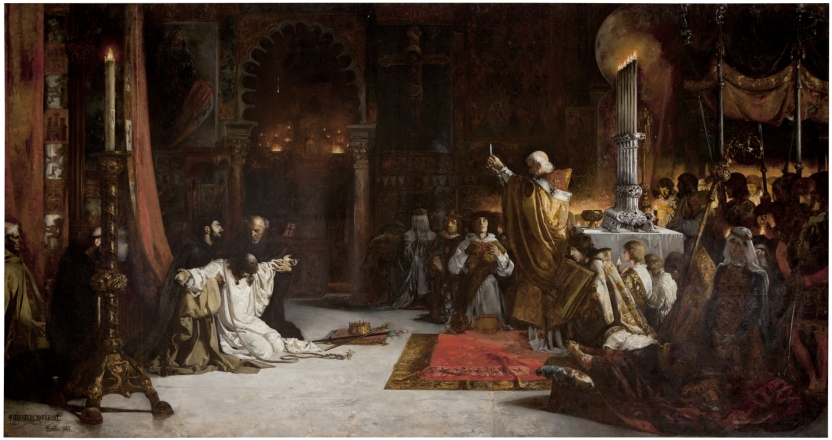
Last Moments of Ferdinand III the Saint
1887. Oil on canvas.On display elsewhere
This canvas is considered the masterpiece of Virgilio Mattoni. It is a reflection of his deep religiosity, as he devoted the most important part of his pictorial production to this genre, as well as of the ambitious expectations he placed on it to make himself known in Madrid. It was painted for the National Exhibition of 1887, where it won a second-place medal. Its catalogue transcribed the passage describing the agony of King Ferdinand III that the canvas illustrates, extracted from the Crónica de España (Chronicle of Spain), written by his own son Alfonso X the Wise.
Mattoni wished to immortalise in the painting – intended to be his first finest form of promotion to the court – an episode from the history of Spain with a special connection to his native Seville. In this episode of the last moments of Ferdinand III before his death on 30 May 1252, elements so highly esteemed in the historical genre converge in the agony of a Spanish king in sanctity together with the powerful presence of religion. On this occasion, the setting is the Reales Alcázares of the Sevillian capital.
In his agony, Ferdinand III has just leapt from the bed in a room in the recently conquered Arab Alcazar. He is dressed in a simple white nightdress and his head is covered with ashes, with one that the king took and put around his neck. He fell to his knees on the floor with his arms in a cross, held by two monks, before the vision of the Sacred Form, raised in the hands of the archbishop Don Remondo, dressed as a pontifical. At the feet of the monarch, on a thin cushion, lie the crown, sceptre and sword, now useless symbols of his kingship, faithfully copied from those in the Royal Chapel of the Seville Cathedral. In the foreground, Queen Juana collapses on the cushion of her kneeler, full of despair, while one of her ladies, kneeling beside the archbishop’s crozier and mitre, looks on compassionately. In the background, behind a beautiful poly-lobed arch, a chapel opens up, dimly lit by two oil lamps, in which an altar with the famous Virgin of the Battles can be seen. It is a small ivory image which, according to tradition, was always carried by King Ferdinand III in the tree of his saddle, and which is also preserved today in the Seville Cathedral. Kneeling next to the wall are other figures of royal prominence, amongst whom we can identify the Infantes Don Alfonso, Don Juan and Don Felipe and the Infanta Doña Leonor, covered with a veil.
Perhaps the greatest success of this impressive scene lies in the enormous dramatic tension achieved by the artist in arranging its grandiose composition in such a markedly rectangular format. He situates the main elements of the plot at its extremes, defined in the fragile and abandoned figure of the dying king prostrate on the ground and in the host raised by the archbishop with an intimidating, almost threatening solemnity. Before him, the monarch falls in surrender, thus underlining the overwhelming supremacy of religion over worldly powers, with its symbols relegated to mere useless objects on the ground, as Mattoni has so graphically painted next to the king. The dramatic use of light accentuates the gruesome nature of the episode, although it also provides some of its most beautiful plastic effects in some fragments. This is the case of the magnificent play of backlighting between the figures under the canopy and illuminated from below by the warm glow of the candles, or the figures of the royal ladies in shadow in the foreground. In addition, Mattoni also reveals an unquestionable mastery of his personal realist vision of the scene, resolved with a dense pictorial mastery with which he models the clothes and faces of the figures.
The painting caused the desired impact on the critics and the public in Madrid after its exhibition, provoking great acclaim.