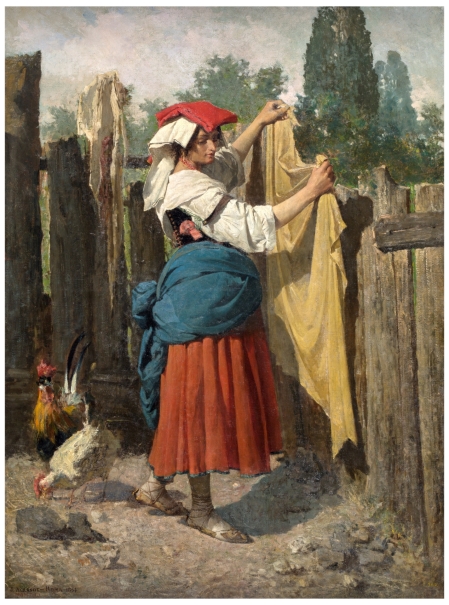
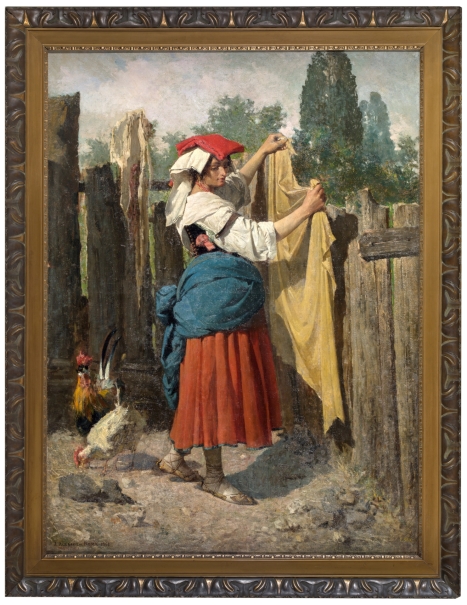
Laundress of the Scarpa (Papal States)
1864. Oil on canvas.Not on display
Mariano Fortuny (1838–1874) had a decisive influence on the art of Joaquín Agrasot, with whom he maintained a very close personal and family friendship until the death of the late master from Reus. However, far from arousing in him a superficial imitation of the exquisitely virtuous and decorative style of the ‘Fortunyan’ works– destined for the market at the height of his overwhelming international success–, Agrasot shows in this painting an entirely personal and particularly suggestive assimilation of the Roman style of Fortuny´s early maturity. He depicts a young laundress from Scarpa – a village near Rome on the right bank of the river Teverone, a tributary of the Tiber–in the typical attire of a Roman peasant women, hanging her clothes on the palisade of a farmyard. According to tradition, the model used for the painting was found by Agrasot at the Termini station in Rome. Indeed, leaving aside a certain academic rhetoric in his pose, Agrasot defined the forms of the figure emphasized with a solid and marked drawing, giving an extraordinary force to the presence of the young lady, highlighting her volume with a great precision in the details of her clothing and ornaments. The setting, in contrast, is developed with pure and painterly ease, achieving effects of richness and pictorial lavishness particularly attractive in aspects such as the group of hens, rendered with enormous brio and technical audacity.
The painting was sent by Agrasot from Rome to the 1864 National Exhibition, where it was awarded a 3rd medal. Pantorba described it as ‘a good piece (of painting) although hard’, qualities very much representative of the artist´s early Roman years. His technique, with its dense impasto, still follows a precise drawing that models the figures with a marked corporeality, before the ease he showed in his later production. Nevertheless, it is resolved with the rich pictorial texture characteristic of this artist firmly immersed in the return to realism advocated by the circle of Spanish painters living in Rome at that time. Although in this case, Agrasot, who was twenty-six when he painted this canvas and still showing a certain timidity in its format, did not win a higher award at the exhibition. The jury had questioned whether the hens had in fact been painted by Fortuny, to the point of giving rise, in certain bibliography, to the legend that they were indeed the work of the senior artist (Díez, J. L., Eduardo Rosales y la conquista del realismo por los pintores españoles en Roma 1855–1875’ in: Del realismo al impresionismo, Fundación Amigos Museo del Prado, 2014, p. 96 and Díez, J. L., Maestros de la pintura valenciana del siglo XIX in the Museo del Prado, Museo del Prado, 1997, p. 116).