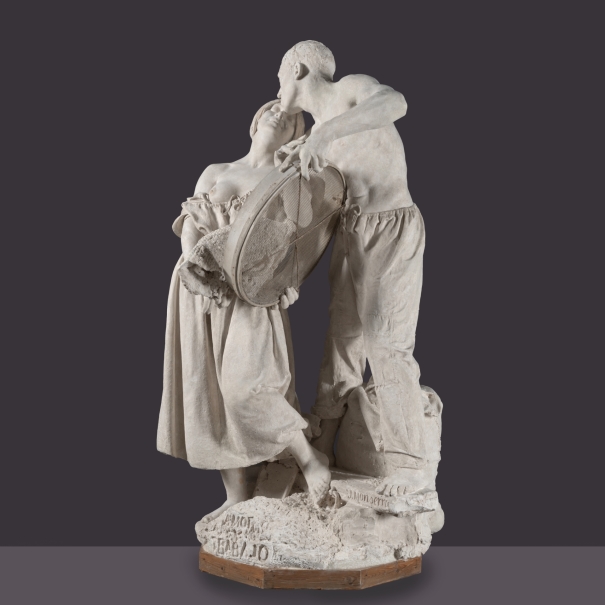
Love and labour
1899. Plaster, Wood, Metal.On display elsewhere
Traied at the Escuela de Bellas Artes in Barcelona and having previously been awarded a third-class medal in 1895 and a second-class medal in 1897 at succesive national exhibitions, he presented this sculptural group at the 1899 National Exhibition of Fine Arts, where he was awarded the first-class medal.
Montserrat y Portella was awarded the First-Class Medal at the 1899 National Exhibition of Fine Arts for this sculptural group.
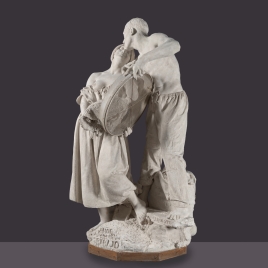
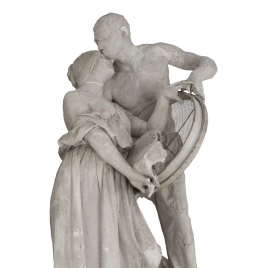
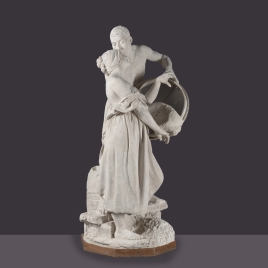
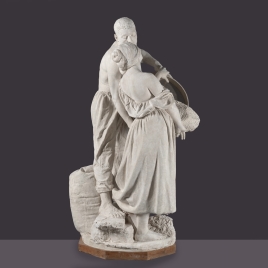
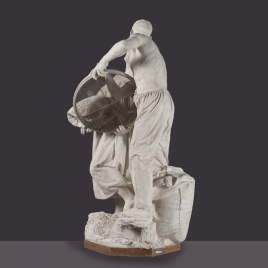
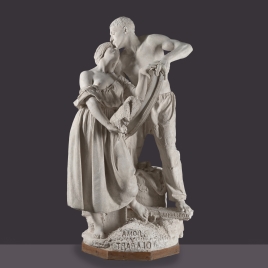
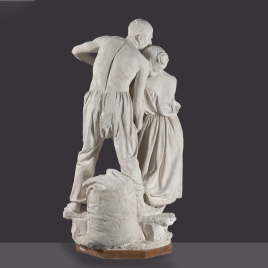
The composition, which presents an idyllic vision of rural life, retains Montserrat’s characteristic formal language, expressed through an idealized realism that evokes the dreamlike quality of a couple sharing their love while engaged in agricultural labor. The young man, who holds an actual sieve—rather than a sculpted one, an unusual choice in sculpture that also accounts for the life-size scale of the figures—adopts a protective posture toward the woman as they lean in for a kiss. She, meanwhile, is in the act of pouring fava beans from a basket for winnowing, so entranced that they nearly slip from her hands. The work is skillfully modeled, particularly in the exposed anatomical elements, and meticulously finished with careful attention to the rustic attire. The Barcelona press, adopting a conservative stance, described it as a representation of “chaste happiness. The two lovers do indeed desire each other, but they also love one another—which is not the same.”
Critical reception was generally positive, particularly due to the esteem held for the artist: “Love and Labour is a beautiful sculptural group by Monserrat, boldly realistic, full of vitality and courage, perfectly finished, with all the movement of nature and the suppleness of flesh.” Nonetheless, other assessments highlighted certain reservations: “In terms of craftsmanship, it cannot be said to be poor, [...] regarding the male figure [...] it lacks movement that is compatible with naturalism; it is also wanting in grace, as well as in modeling—thus, it deserves no more than a second-class medal.”
In 2023, the group was restored at the Museo del Prado, and in 2024, it was selected for inclusion in the “Prado Extendido” program, being relocated to the Museo Etnográfico de Castilla y León in Zamora.
Azcue Brea, Leticia, 'Amor y trabajo'. Arte y transformaciones sociales en España (1885-1910), Madrid, Museo Nacional del Prado, 2024, p.91-92 nº.3