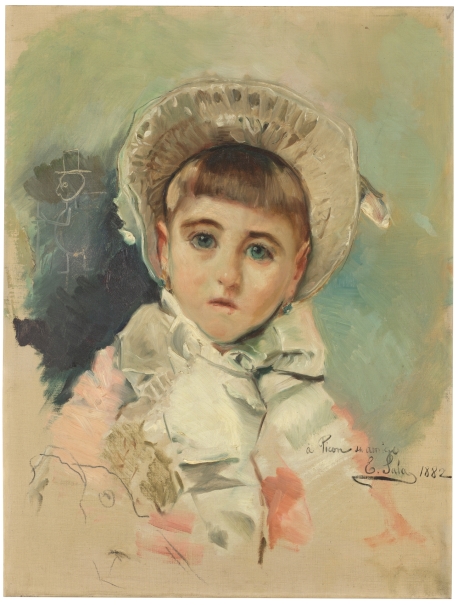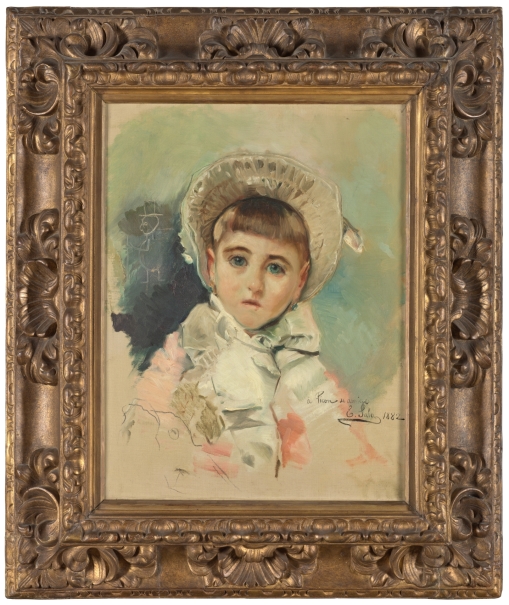
María Octavia Picón y Pardiñas in a white bonnet
1882. Oil on canvas.On display elsewhere
The painter has chosen a bust-length portrait to represent a girl of about three years old, who poses with a serious expression and looks directly at the viewer with her large blue eyes, with the frankness of which only a child is capable. She wears a coat and her head is covered with a white bonnet that is tied around the neck into a large spectacular bow. In addition to the texture of the fabrics, her affluent social position is revealed in the bonnet–that Emilio Sala has managed to capture with few broad brushstrokes– and in the gold earrings with large blue stones, resembling sapphires. Although the girl´s face is more carefully worked on, the painter has also quickly used the large crisscrossing brushstrokes technique for both colouring and outlining. The colours used are green, blue and white, with some hues of pink on the sleeves and in the lower area, which invigorate the chromaticism of the composition. Sala has casually drawn a stick figure on the dark-coloured stain located above the figure´s shoulder, that is a clear allusion to the childish state of the sitter. On much of the canvas the traits of preparation, as well as some strokes in pencil, especially in the lower left area, which perhaps served the master to fit the image, can be perceived. Nevertheless, Sala completed the portrait by signing it and dedicating it to the girl´s father. It is possible that the rapidity of the technique and its unfinished state indicate that the painting was improvised and created in a single session, perhaps when the girl accompanied her father on one of his visits to the painter. This would contribute to the increasing sensation of freshness and immediacy that captures the viewer.
Even though the child representation in the portraits made by Emilio Sala is not too frequent, Museo del Prado also keeps one portrait of the future actress María Guerrero, at the age of ten (P004188) with whose father the painter had a great friendship as well as a working relationship. The sitter is María Picón y Pardiñas, daughter of Jacinto Octavio Picón y Bouchet (1852–1923), an honourable gentleman of liberal political ideas, who from a very young age devoted himself to art criticism in the most important publications of the time. In addition, he was Velázquez´s biographer, as well as an important novelist, academic at the Real Academia Española and the Real Academia de Bellas Artes, secretary and vice-president of the Ateneo, deputy of the Cortes and vice-president of the Patronato del Museo del Prado. As a prestigious art critic, Jacinto Octavio Picón y Bouchet had working relationships with numerous artists and some of them took portraits of him; however, in the case of Emilio Sala it became a personal friendship, even with acting as his representative in Madrid during the painter´s Parisian period. Therefore, it is no wonder for us that the painter gifted the portrait of Picón’s little daughter as well as later depicted his friend with the rest of the family members, while always signing the canvases with an intimate and affectionate dedication. This canvas, together with other family portraits, was bequeathed to Museo de Arte Moderno by the will of Jacinto Octavio Picón upon his death, which occurred in Madrid, on 20 December 1923.
Orihuela, M., María Picón y Pardiñas, con capota blanca (1882). en Barón, J.: El retrato español en el Prado. De Goya a Sorolla, Madrid, Museo Nacional del Prado, 2007, p.174, n. 60