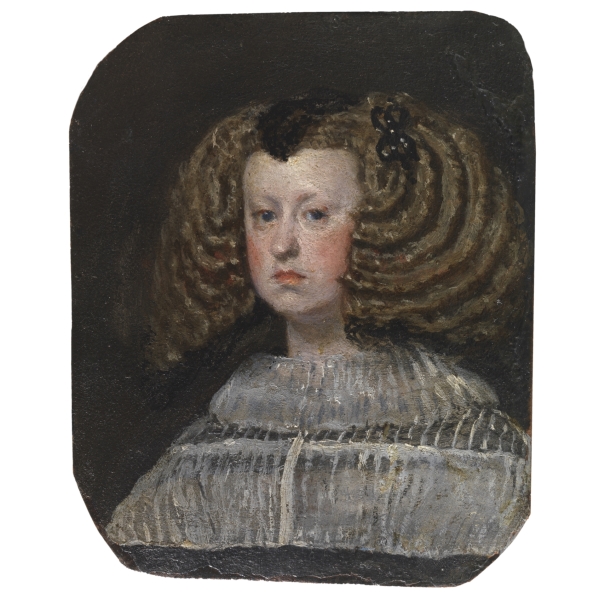
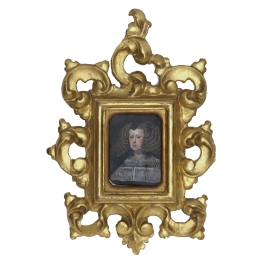
Mariana of Austria, Queen of Spain
Ca. 1655. Oil on copperplate.Not on display
Mariana of Austria, daughter of emperor Ferdinand III (1608–1675) and of the Spanish infanta Maria Anna of Austria – the youngest daughter of King Phillip III and Margaret of Austria (1606–1646) – was born in the Imperial Palace of Vienna on 21 December 1634. She was betrothed since she was a child to her cousin Balthasar Charles (1629–1646). Following the prince’s untimely death, King Phillip IV (1605–1665), widower of Elisabeth of France (1621–1644), betrothed the young archduchess, who thus became queen consort of Spain (1649–1665), and queen regent afterwards, as mother of Charles II (1665–1675). She passed away in the Uceda Palace in Madrid, on 16 May 1696. This portrait was painted shortly after her wedding with Phillip IV, between 1652-55, the same years in which Velázquez made her a magnificent portrait, now in the Museo del Prado (P001191). It is also reminiscent of the unfinished bust in the Meadows Museum in Dallas (inv. 78.01). This is a quality, realistic, vibrant and austere work of art within the standards of the Madrid court portrait, which is the reason why many critics, including Perera, Gomis, and Tomás, attributed it to Velázquez. Like other 16th- and 17th-century grand masters, he painted small portraits on playing cards or copper sheets, which are difficult to identify; nonetheless, a small portrait of Count-Duke of Olivares, from Charles IV’s collection, is his most certain attribution as of yet. It is known that Velázquez painted this type of portraits after he arrived at Madrid, as it was one of his many duties as court painter.
These royal family portraits – as well as the royal favourite’s portraits, the Count-Duke – had a double function: on the one hand, they were used as a gift of the State, and on the other, they were intimate portraits. As per the preserved documentation, Velázquez painted a couple, due ritrattini, for Vincenzo II Gonzaga, count of Mantua, in 1627. In 1629, he carried out another two: one of the king and the other of his favourite, for the Marquesss of Montesclaros. Many years later, in 1638, he made a portrait of the king for the back of an eagle-shaped diamond jewel, meant to be for Francesco I d´Este, duke of Modena. In 1640, he made some portraits of the queen for pieces of jewellery that were to be delivered to Marie de Rohan, duchess of Chevreuse, through the marquess Virgilio Malvezzi, although it is uncertain that he finished them anyway. These references attest to the role that this type of portraits played in the Spanish court’s diplomatic relationships. Nevertheless, both the small portrait of Queen Mariana in the Museo del Prado and another one in the Museo Lázaro Galdiano that likely portrays her, is evidence of the private use of this kind of painting. They appear larger and with a rectangular format, which means that they were not intended for jewellery, but rather to be seen privately; portraits that could be easily kept and hidden. Velázquez painted small portraits. However, other artists, namely Eugenio de las Cuevas, Diego de Lucena, Tomás de Aguiar, or Francisco Palacios, made most of the commissions. The known documents about them are scant. Eugenio de las Cuevas (1613–1667) from Madrid painted fine and tasteful small paintings, including small sheets for jewellery and small portraits; Diego de Lucena from Andalusia utterly excelled in both small and large formats; and Tomás de Aguiar, who was active in Madrid in the mid-17th century, made reputable oil portraits that achieved likeness of their subjects.
Espinosa Martín, Carmen, Las miniaturas en el Museo del Prado: catálogo razonado, Museo Nacional del Prado, 2011, p.26-27