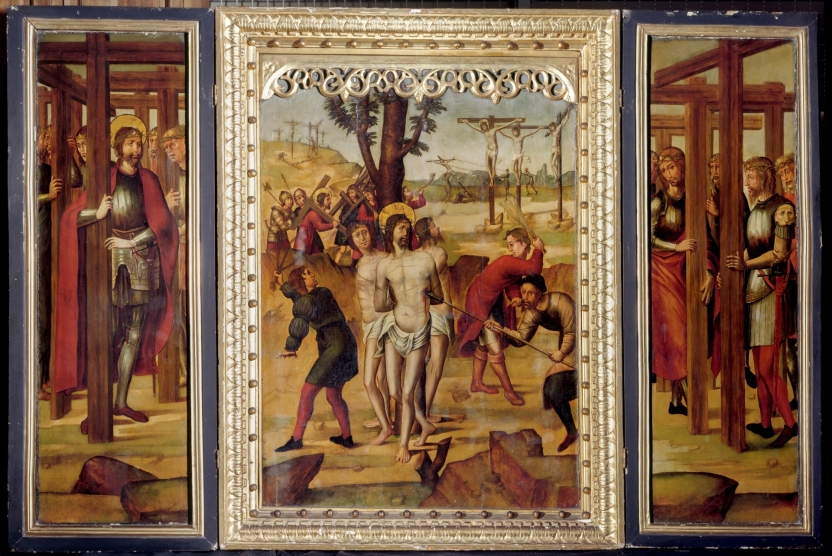
Martyrdom of Saint Acathius
1540 - 1545. Oil on panel.Not on display
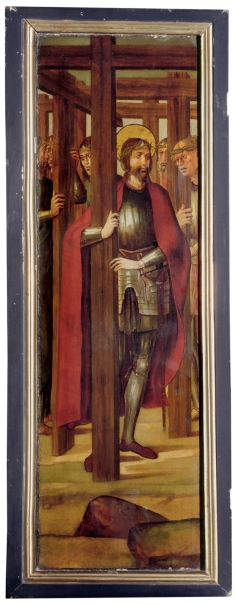
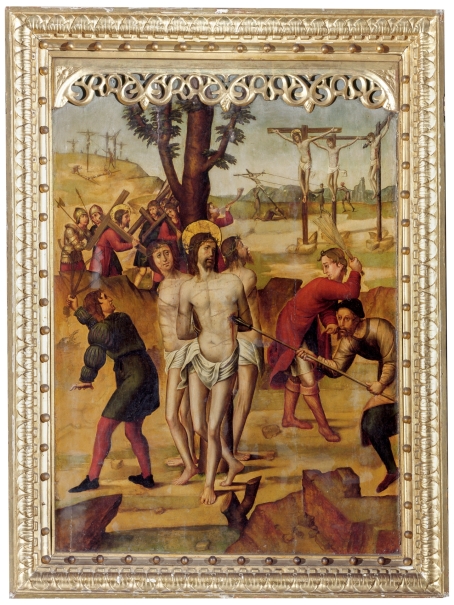
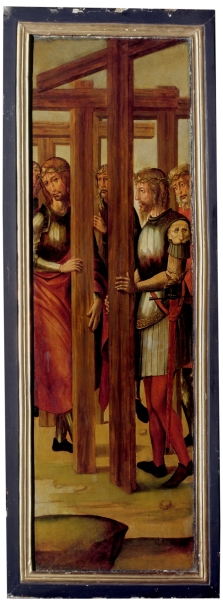
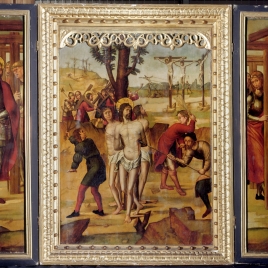
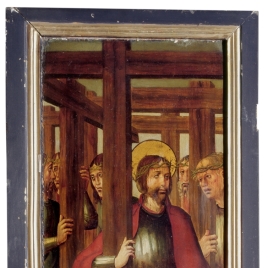
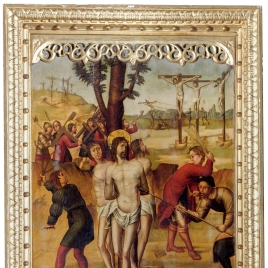
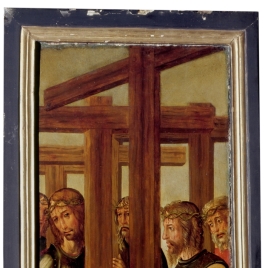
The central panel depicts the flagellation and lancing of Saint Acathius and his two closest companions, Eliad and Theodore. In the background, the martyrs themselves and some of their companions are depicted bearing crosses, on their way to be tortured and crucified. Only the main saint, Acathius, has been given a golden halo. The side panels, or wings, portray the saint and his companions, all of whom are in military armour and crowned with thorns, carrying the crosses, but as banners of glory rather than as instruments of martyrdom.
The subject depicted is the martyrdom of Saint Acathius and his 10,000 soldiers on Mount Ararat, taken from the legendary Passio decem millium martyrum, a relatively frequent motif in Central European painting, yet uncommon in Spain. According to Reu (1958), the legend arose in the 12th century – having been inspired by the much older one of the Theban Legion of Saint Maurice – to promote courage and confidence amongst the crusaders as they set out for the East. In accordance with the mythical tale, Acathius – a centurion of the legions of Cappadocia under the service of emperors Hadrian and Antoninus Pius in the expedition to the Euphrates to prevail against the rebels in that region – along with his 9,000 soldiers, achieved a great victory over 100,000 enemies on Mount Ararat. He was guided by an angel who appeared before them and converted them to Christianity. The emperor’s allied kings – particularly the Persian King Sapor – demanded that Acathius and his soldiers abjure their new religion. However, his threats and martyrdom (flagellation, crowning with thorns, stoning, and falling off a cliff) not only failed to bring about their apostasy, but also led 1,000 more soldiers to join them, thus amounting to 10,000 Christians who were eventually impaled and crucified. The name Acathius is directly related to the acacia, a thorny tree whose branches were the instrument of many of those martyrdoms.
The relics of Saint Acathius are worshipped in Rome, Bologna, Avignon, Cologne and Prague, which explains why his iconography is for the most part Italian and German. He is especially venerated in Switzerland and Southern Germany (Franconia, Bavaria, Bohemia) and is amongst the vierzehn Nothelfer, the Fourteen Holy Helpers who intercede against illnesses, resulting in maximum popular veneration. Both the canvas by Albrecht Durer from 1508 (now in the Wien Museum in Vienna) and the canvas by Carpaccio from 1515 (in the Gallerie dell’Accademia in Venice) have been of paramount importance in the iconography of Saint Acacius and date closely to this painting. He is not a particularly popular saint in Spain, but there are some representations of him located for the most part in the region of Castile that date between the end of the 15th century and the beginning of the 16th century. Fernando Gallego or someone close to him portrayed him in a panel (currently in the Meadows Museum in Dallas) crucified with his companions, amongst whom Eliad and Theodore are visible. The crosses are made of either squared timber or unpolished maythorn timber. Many years later, at the beginning of the 17th century in 1609, the Toledo-born painter Antón Pizarro also painted the saint in two canvases that are today located in the church of los Santos Justo y Pastor (Saints Justus and Pastor) in Toledo. One of them represents the flagellation, whereas the other represents the crucifixion of the martyrs. In the crucifixion, the two companions are emphasised flanking the saint, analogously to this panel and Fernando Gallego’s. The exact reasons for which this saint from Cappadocia is worshipped in Toledo remain unknown. He probably began being venerated after any alleged relics or some unspecified special wonder that might have arrived there. Outside Toledo, it is worth mentioning that there is a painting in the Museo Diocesano de Tarragona in which the saint and his companions are depicted receiving garlands from the Virgin.
But this triptych, that probably dates from 1540–45 and that must have been executed in an area very close to the imperial city, acknowledges said special presence. Regarding the artist who painted it, it is not possible yet to attribute with sufficient precision even though the relationship of the panels with the world of Juan de Borgoña is evident, it does not seem as though we can consider them to have been by him. Post considered it to have been by the master of Bolea, the still-unknown disciple of Borgoña, who worked in the altarpiece of the town of Huesca, a work certainly reminiscent of these panels. Nonetheless, the canon of the characters – especially in the triptych wings – seems to be generally provided with more slenderness than that of the master of Bolea and of course than that of Juan de Borgoña, which is probably testament to a later date. Some hints of the mannerist canon – introduced in Toledo by Berruguete starting in 1540 – can be perceived, although the gestures and attitude are still those of Borgoña’s serene and tranquil calmness.
Museo del Prado, Un mecenas póstumo: el legado Villaescusa. Adquisiciones 1992-1993, Madrid, Museo del Prado, 1993, p.28-31