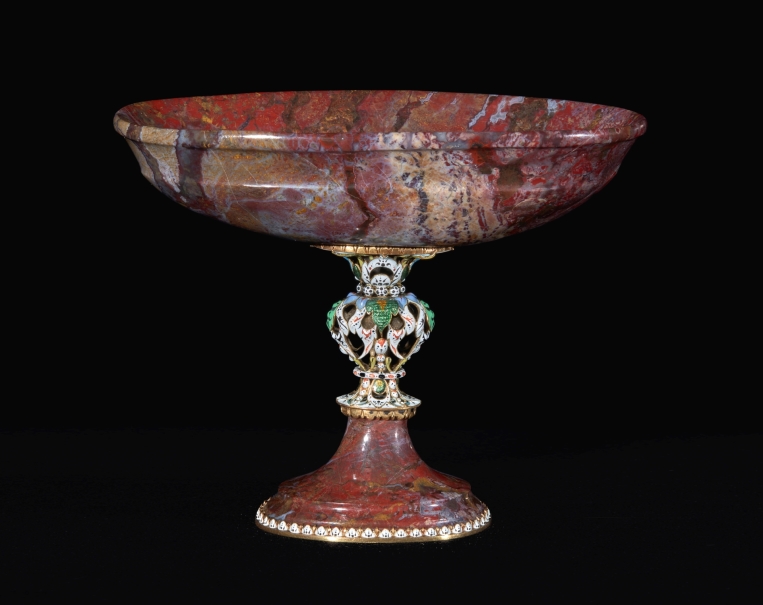
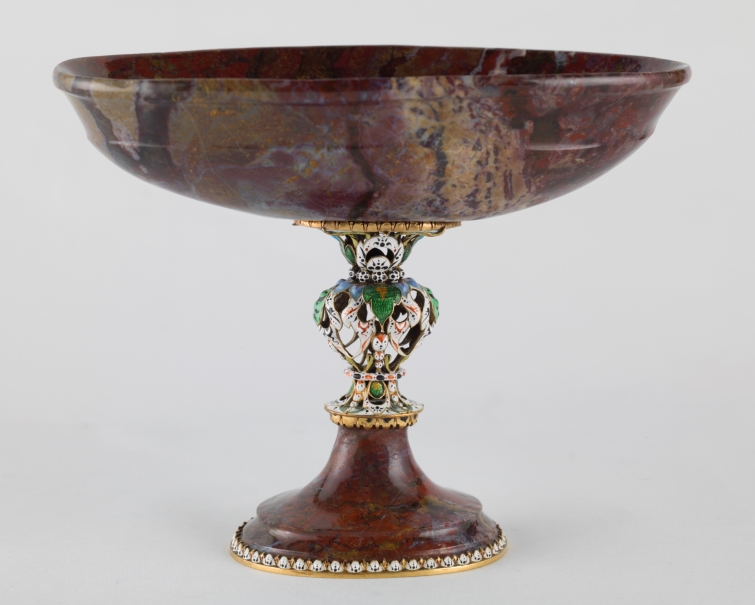
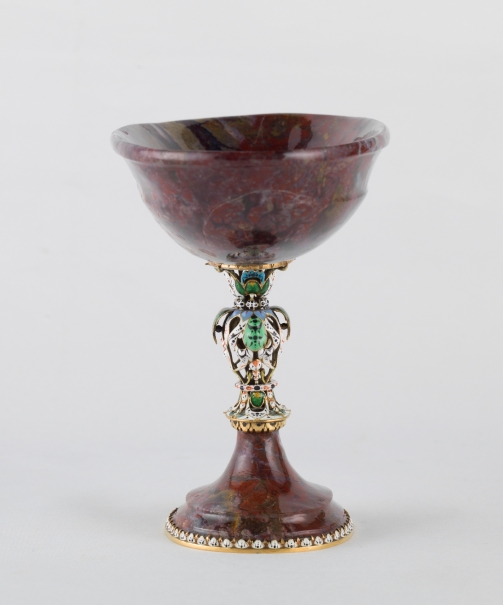
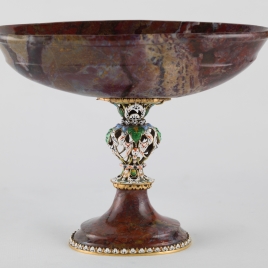
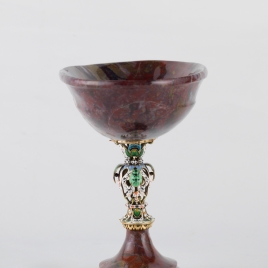
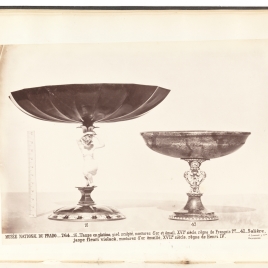
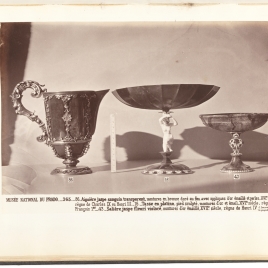
Oval jasper bowl with fretwork stem
XVII century. Enamel, Jasper, Gold.Room 079B
This vessel combines stone elements originating from German mines with elegant adornments in enamelled gold characteristic of the Paris school. The body consists of a jasper bowl with an oval mouth and a section in the shape of a lowered arch. It has a large, bulbous node with bell-shaped extremities, all in enamelled gold fretwork, forming an airy structure of pointed leaves and diminishing beads, enamelled in opaque lilac, green and translucent red, on an incised and white background with red lines and black spots. The base is oval and bell-shaped, with a slightly recessed plinth, decorated with a narrow adornment of gold featuring small teeth enamelled in black and white, between small garlands of incised gold. The vessel may have been carved in Germany or Italy, somewhat earlier than the node, which lends bulk to its volume.
Similar pieces, originating from the royal French collection, are held at the Louvre, such as the goblet MR 118, the goblet OA 2034, the jug MR 241, the tray MR 242 and various other examples, all from the Mazerin collection. Each features adornments in gold, fretted and enamelled, with designs of pointed leaves, based on the models made popular by the Légaré brothers, Gédéon and Gilles, which include sketches for floral designs based on black commas and points to enliven the decoration of areas with opaque enamelling in light colours, preferably in white and sky blue, which are combined with soft translucent reds and greens. The work involved in the node of this vessel fully matches the characteristics described, with the typical pointed leaves and set of rounded hollows associated with the Paris school, as expressed by a series of models produced in 1625 by the engraver Moncornet and designed by Balthazar Lemercier, in addition to models by Pierre Delabarre and other artists, which emerged at around the same time. Various pieces in the Prado, such as O8, O11, O31 and O33, belong to the same style.
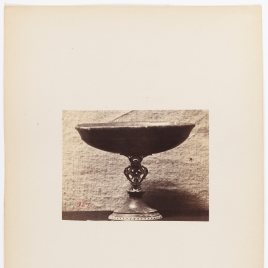
The state of the work in the 19th century can be seen through the photography of Juan Laurent Minier, "Salière, jaspe fleuri violacé, montures d’or émaillé. XVIIe siècle, règne de Henri IV”, ca. 1879, Museo del Prado, HF0835/30.