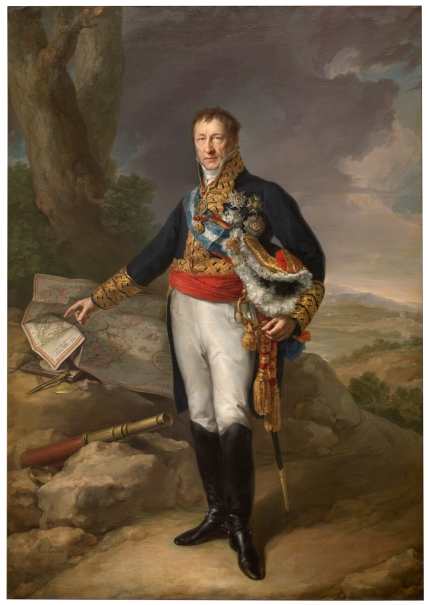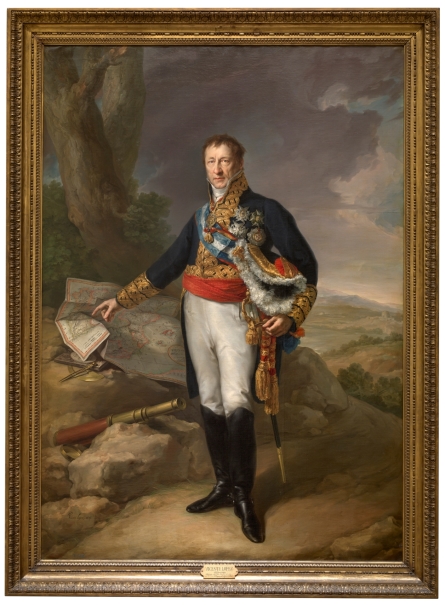
Pedro de Alcántara de Toledo y Salm-Salm, 13th Duke of El Infantado
1827. Oil on canvas.Not on display
Pedro Alcántara Álvarez de Toledo Silva y Mendoza Salm Salm, 13th Duke of El Infantado (Madrid, 1768–1841), was Minister of State and President of the Government (1824–1826).
This work is a full-length portrait of the Duke. He is fifty-nine years old and stands in front of a landscape painting of open countryside. He wears a Captain General’s uniform, with the star and cross of the order of Charles III and the insignia and sash of the Golden Fleece. He also wears the Laureate Cross of Saint Ferdinand and the badges of the Portuguese Military Order of Christ and the French Order of the Holy Spirit. He holds a bicorne with his left arm. With his right, he points to an English edition of a map of the Iberian Peninsula. Alongside, his case, various cartographic instruments and a spyglass appear. This work is a large ornate military portrait, in which the artist paints the general in a valiant pose of leadership. He stands next to his tools used for planning campaign strategies, following the model created in France at the end of the 18th century and spread throughout Europe. Goya had already used it years earlier in Spain, in portraits such as General José de Urrutia (P736). López himself had also used it in the effigies of Marshal Suchet (Vernon Castle, Duchess of La Albufera) and General José Pascual de Zayas y Chacón (Havana, Museo de Bellas Artes). Pedro Alcántara Álvarez de Toledo Silva y Mendoza, XIII Duke of El Infantado, IX Duke of Pastrana, X Duke of Lerma, X Duke of Francavilla, four times Grandee of Spain, Prince of Mélito and Éboli, XI Marquis of Távara, XIV Marquis of Santillana, XII of Cenete, XIII of Argüeso and Campóo, X of Algecilla, IX of Almenara, XI Count of Villada, XXI Count of Saldaña and XI Marquis of Cea, XIV Count of the Real de Manzanares and XII of El Cid, was born in Madrid on the 20th of July 1768.
He was the son of Pedro de Alcántara Álvarez de Toledo, XII Duke of El Infantado, and of Princess Mariana de Salm-Salm. He was a figure of extraordinary political and military significance in Spain at that time. In 1793, he financed the creation of his own regiment to fight against the French in Catalonia and, years later, in 1800, in the famous War of the Oranges in Portugal. This is the area at which he points on the map. Although he served for some time as colonel to Joseph Bonaparte, he was a trusted figure of King Ferdinand VII, whom he accompanied to Bayonne. In command of an army corps, he fought in 1809 in the Peninsular War. In 1812, he was appointed a member of the Junta of the third Regency, known as the Quintillo, as well as in 1823. The following year he was appointed Minister of State and President of the Government, a position that he relinquished in 1826. He died in Madrid on the 27th of November 1841, unmarried. Nevertheless, he had children from his relationship with Manuela Lesparre, and his duchy passed to the House of Osuna. The canvas is an extraordinarily significant example of Vicente López´s exceptional talent for large, highly decorative court portraits. The virtuoso description of the clothing is particularly important in these works, as is the reproduction of the smallest details of embroidery and medals, signs of social ranks, official hierarchies and public honours.
Díez, J. L., Pedro Alcántara de Toledo y Salm Salm, XIII duque del Infantado (1827). En Barón, J.: El retrato español en el Prado. De Goya a Sorolla, Madrid, Museo Nacional del Prado, 2007, p.78, n. 11