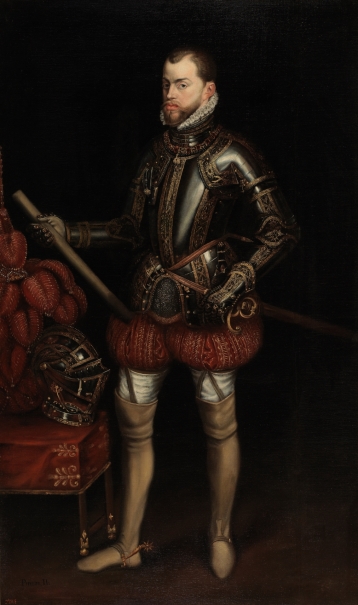
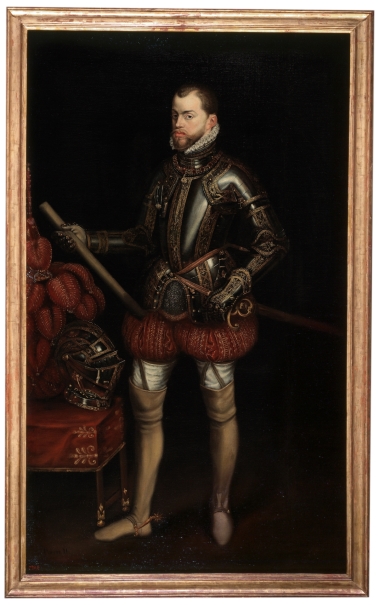
Philip II, in the armour of Saint Quentin
First half of the XVII century. Oil on canvas.On display elsewhere
Portraits of the Habsburg family were widely disseminated through throughout the 16th and much of the 17th century in numerous versions and copies of varying quality, depending on circumstance and context. The portraits of Charles V and Philip II were the most frequently painted during this period due both to the significance of their reigns and the impact of their disseminated images on their realms. This portrait of the King was specifically intended to be paired with the portrait of the Emperor (P006083), a copy of the canvas painted by Juan Pantoja de la Cruz in 1605 from an original work by Titian. The close relationship between the two portraits explains the specific characteristics of this composition. It was based, almost entirely, on the full-length portrait painted by Antonio Moro in 1560 to celebrate the victory over the French at Saint Quentin. In this portrait, Philip II appears as defiant, brightly illuminated, and emerging from a dark background clad in armour. It is likely that this work served as a model for the version located in Museo del Prado, as indicated by certain details of the sitter’s face and the crimson tonality adopted for the galligaskins. However, there are some notable variations. First, the arrangement of the monarch is inverted with respect to the original work, undoubtedly due to its relationship with the portrait of Charles V. Secondly, more pieces of the famous armour were included, including those that cover his arms (shoulder pad, strut, brassard) and the gauntlets. Also noteworthy is the helmet resting on a nearby buffet. Both the portrait of Charles V and this one of Philip II were painted by an artist whose technique was correct and concise in the reproduction of the faces, while at the same time capable of capturing the pieces of armour with absolute fidelity. This is the most significant detail in the work. Moreover, it suggests that the commission for the two portraits was intended precisely to underline the prestige of these valuable military garments (Ruiz Gómez, L. in El arte del poder. La Real Armería y el retrato de corte [The Art of Power. The Royal Armoury and Court Portraiture], Museo Nacional del Prado, 2010, p. 230).