Plate of Pastries
Ca. 1845. Oil on canvas.On display elsewhere
As a result of its history of manifold intercultural exchanges, Spain has come to have rich and delicious varieties of pastries. Those intercultural exchanges impacted not only cooking as it effects ordinary life, but also haute cuisine at a more specialised level. Painters have always expressed a keen interest in depicting delectable Spanish pastries: buns, doughnuts, puff pastries, chocolates, nougat, pastries, marzipans, sponge cakes, sobaos, muffins, cocas, melindres, biscuits, jellies, pies, tarts, and a multiform field of such endless delights.
Since the time when Van der Hamen executed his admirable still life creations, pastries were the true protagonists of his artistic career, as well as of his followers’ and imitators’. As a matter of fact, pastries were not only part of deeply rooted traditions linked to invitations to households with refined customs, but also played a role on a quotidian level in people’s lives, either opulent or less wealthy. They may have constituted the type of food that was spontaneously offered to houseguests or attendees of all kinds of ceremonies, including funerary ones.
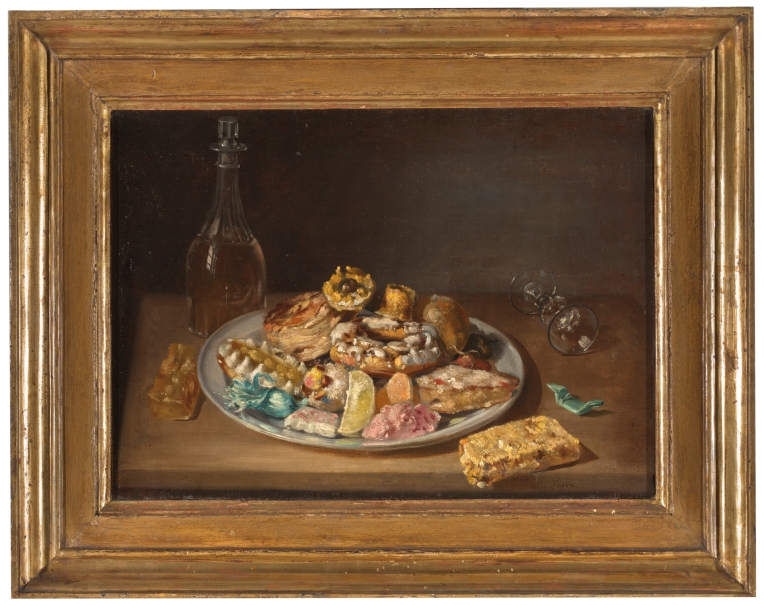
Even though Miguel Parra is better known for specialising in floral compositions, he did not disdain the common still life painting that reflected traditional domestic spirit. This work in particular is a good example of such dedication to different typologies of still life painting, even though he imposed his own personal criteria upon a field that had achieved such a splendid outcome in Spain.
Curiously enough, here we can observe a special capturing of shapes and textures through loose brushstrokes. Despite reproducing and individualising each and every character in the piece, the artist sought to achieve a general effect, rather than a particular one, as a sum of diverse elements. It is no doubt that the ceramic plate – probably manufactured in Alcora – as well as the glass bottle – probably filled with sweet wine – and the cup have been correspondingly treated in order to highlight their qualities. Similarly, the pastries are finely depicted, as is the wrapping. However, the artist seems to have been more careful in depicting the highlights when he insisted on the varied – and sugared – surfaces of the candied fruits or the pastries.
The assemblage, painted from a very high point of view, stands out over a rustic table of which three sides are visible, while the neutral background seems to retreat. The whole group of motifs expresses a typical offering of a warm reception, combining beverage and edibles. This could range from a dessert as a common thread, to the end of a meal, a mid-afternoon snack or even a sudden banquet, which compels the host to gather these kinds of treats in order for them to be enjoyed during a gathering – maybe even an unexpected one – because of a reception in a household for the sake of maintaining good manners of politeness in human treatment.
Luna, Juan J., El bodegón español en el Prado: de Van der Hamen a Goya, Madrid, Museo Nacional del Prado, 2008, p.146-147 nº56B