Pocket tool case
Third quarter of the XVIII century. Copper alloy.Not on display
This sort of English painted enamel object was first made around 1725, but little is known of the early production, in part because this was a very modest craft. It reached its zenith between 1753 and 1756, when such pieces were manufactured by a London firm in Battersea that even employed decorative artists from the nearby Chelsea porcelain factory. This firm declared bankruptcy in 1756 and its models were acquired by other factories in Staffordshire and London. Its main products were snuff boxes and cases for a variety of uses, including incense holders, buttons, small boxes for cosmetic moles, medallions and other curiosities. Given the Battersea factory’s short life, most of the objects that have reached our day, and all those from after the seventeen seventies, are from workshops in Staffordshire, London, Birmingham and so on.
The major technical breakthrough consisted of stamped decoration, which was obtained by placing a sheet of paper over a model engraved on a copper plate and tracing its form so that it could be mechanically reproduced, thus vastly lowering production costs. Since the printing was monochromatic—black, at first, and later, red—it was subsequently hand colored to generate very beautiful tones and nuances.
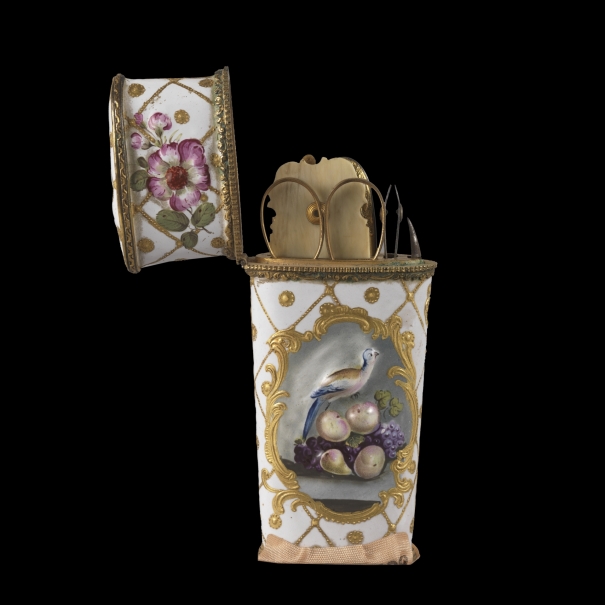
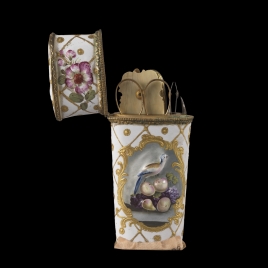
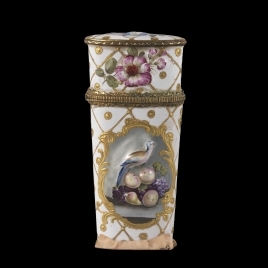
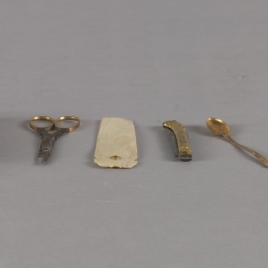
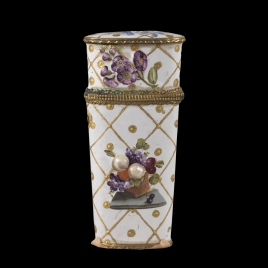
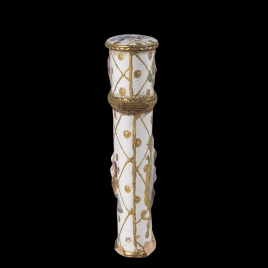
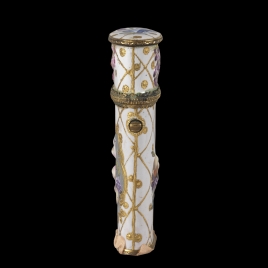
The present case is of enameled copper, with inner compartments for small scissors, a small chased spoon, a pencil holder, an ivory folder, a bodkin and an awl. The outside is covered with a coat of white enamel decorated with a grid of raised golden dots and a rosette of the same sort at the center of each square. Each side has a small square with a frame of gilded rocailles in relief over a white background. On one side, a bird with bright blue, mauve, green and gray feathers perches on a wooden surface with grapes, apples and pears. On the other, we see a basket of fruit on a gray surface. And on the lid, sprays of flowers. This sort of case became very popular in the third quarter of the 18th century, and they were some of the Staffordshire workshops’ most carefully executed objects.
Ceballos-Escalera, Isabel de, Catálogo del legado Fernández Durán (Artes decorativas), Madrid, Patronato Nacional de Museos, 1974, p.55-56