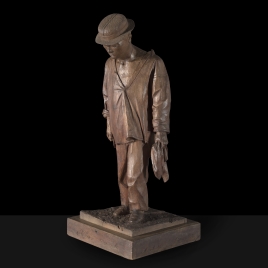
Poor defeated man
Ca. 1887. Wood.On display elsewhere
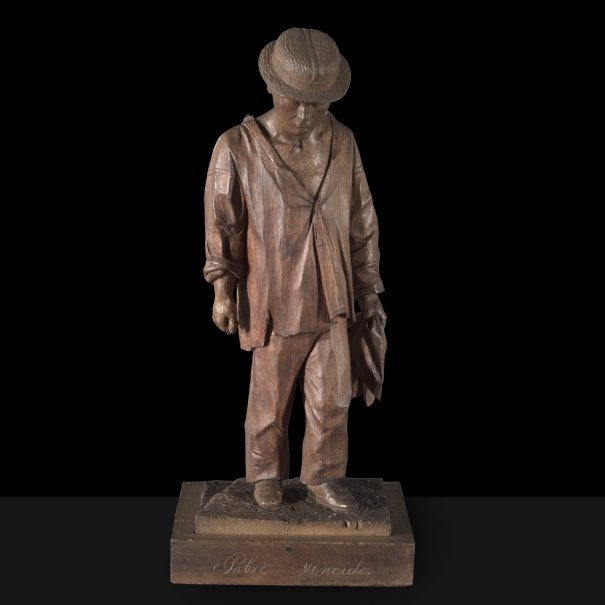
With this carving, the artist was awarded the Bronze Medal at the General Exhibition of the Overseas Philippine Islands held in Madrid. At the time, the exhibition aimed to present a comprehensive view of life in this overseas province, and the ensemble of paintings and sculptures submitted was evaluated as “preliminary efforts and [...] early creations of an emerging art.” Nevertheless, the merit of several sculptors and woodcarvers was acknowledged “for the promise they represent for Filipino art.” The work was subsequently included in the permanent display at what is now the Palacio de Velázquez in Madrid’s Retiro Park—formerly the Museo-Biblioteca de Ultramar—with the stated purpose of “maintaining the bonds of knowledge and communication between Spain and its overseas provinces.”
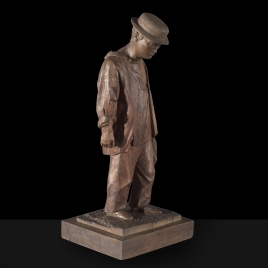
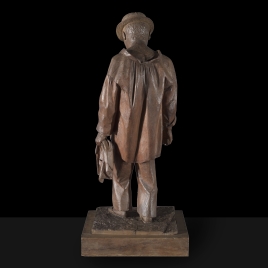
The carving likely represents either a laborer returning exhausted from the fields or, perhaps, an unemployed man, with the intention of conveying the hardships faced by many Filipinos during that period. In any case, the precise cause of the subject’s dejection and weariness is ambiguous. One interpretation suggests he may be “a downcast man, presumably defeated in a cockfight, holding in his hand the empty cloth in which he was meant to wrap the animal.” The date of the work, 1887, has also led some scholars to interpret the figure as a dying victim of war.
Azcue Brea, Leticia, "Domingo Teotico y Eugenio. Pobre vencido'. Arte y transformaciones sociales en España (1885-1910), Madrid, Museo Nacional del Prado, 2024, p.335-336 nº.240