formularioRDF
The itinerary <em>TITULORECORRIDO</em> has been successfully created. Now you can add in works from the Collection browser
<em>TITULOOBRA</em> added to <em>TITULORECORRIDO</em> itinerary

EXHIBITION: MUSEO DEL PRADO AND FUNDACIÓN BBVA

Art and Social Change in Spain (1885-1910)

Museo Nacional del Prado. Madrid 5/21/2024 - 9/22/2024

Until 22 September and in an almost unprecedented manner, all the exhibition galleries in the Jerónimos building will be used to present Art and Social Change in Spain (1885-1910). With the sole sponsorship of Fundación BBVA, the exhibition offers a unique opportunity on a scale never previously seen in Spain to learn more about painting’s move towards social themes of a type that had previously been largely absent or only rarely depicted.

The diversity of techniques and creative registers in the almost 300 works that comprise the exhibition - many never previously exhibited - make it possible to illustrate artists’ very wide range of responses to the challenge of representing the transformations taking place in the society their day through aspects of it rarely depicted in art up to that point. These include industrial and women’s work, education, illness and medicine, workplace accidents, prostitution, emigration, poverty and ethnic and social marginalisation, colonialism, strikes, anarchism and demonstrations.

Although the origins of this exhibition project lie in the importance of the Prado's collections of social painting, in itself a reflection of the works created for presentation at the various National Fine Arts Exhibitions, the generosity of almost a hundred public and private lenders means that visitors can see works such as Victims of a Fiesta by Darío de Regoyos, Burial in the Countryside by Pablo Picasso and Study of a Gypsy Woman by Isidre Nonell.

Curated by Javier Barón, Chief Curator of the Department of 19th-century Painting at the Museum, the exhibition offers visitors the opportunity to discover the phenomenon of social art which, although relatively short-lived - barely twenty-five years around the turn of the 19th and 20th centuries - reveals numerous appealing and interesting aspects.

In the period between the liberal governments of 1885 and 1910 decisive transformations took place in Spain with regard to the modernisation of the country, in a way comparable to the rest of Europe. Artists ceased to depict historical subjects in order to focus on contemporary life, with the result that their works became eloquent testimonies of those changes. Influenced by photography, Spanish painters aimed for objectivity in representation, adopting a naturalistic style similar to the one that had triumphed in France and other countries but with a distinctive national identity in some works thanks to the study of Velázquez and his role as a prestigious point of reference. Many of those works were presented at the National Fine Arts Exhibitions, from where the State acquired a significant number of them, explaining why the Museo Nacional del Prado houses the most important collection of social painting in Spain. Twenty of these paintings, most of them of large format, constitute the core of the exhibition. The first that the Museum has devoted to this subject, it is particularly relevant given the presence of works of this type in its collections which are not, however, extensively represented in the permanent display and are thus insufficiently known. In addition to painting, sculpture and the graphic arts are also included, as well as photography and film, which together played the most significant role in configuring the image of the era.

The themes chosen to articulate the sections of the exhibition encompass different aspects of contemporary life, including those which due to their lack of beauty, supposed indecorousness, apparent triviality or seeming absence of interest had barely been considered before. They include industrial and women’s work, education, illness and medicine, workplace accidents, prostitution, emigration, poverty and ethnic and social marginalisation, colonialism, strikes, anarchism and demonstrations. Other themes which, in contrast, had a long tradition in painting, such agricultural labour, the work of seafarers, religion and death, were now seen in a new light and for this reason they are also present in the selection.

The exhibition analyses the diversity of interpretations of all these themes, the relationship between different artistic fields, such as photography, illustration and painting, and the crisis of the system of naturalistic representation following the triumph of its most notable exponents, such as the brothers Luis and José Jiménez Aranda, Vicente Cutanda, Joaquín Sorolla, Santiago Rusiñol and Ramon Casas.

Social art of the first generation flourished between the Paris Universal Exhibitions of 1889 and 1900, at which two Spanish painters, Luis Jiménez Aranda and Joaquín Sorolla, received the medal of honour respectively. Although it continued to be cultivated by other artists until 1910, naturalist proposals were replaced by others of a more expressive nature. Simultaneously, the influence of Velázquez declined and was progressively replaced by that of El Greco among the innovative artists who were also aware of the transformations that had taken place elsewhere in Europe. The first important example was Darío de Regoyos followed, after 1900, by Francisco Iturrino, Ricardo Baroja, Hermen Anglada-Camarasa, Isidre Nonell, Evaristo Valle, Joaquim Sunyer, Pablo Gargallo, Pablo Picasso, Juan Gris and José Gutierrez Solana. Ignacio Zuloaga and Julio Romero de Torres also pursued new directions from markedly individual viewpoints that revealed more interest in certain aspects of the art of the past. Filmmaking had taken the potential for representing life to its furthest extent, with the result that artists abandoned large formats and objectivity and pursued a radically modern orientation which took into account the revolution brought about by Post-Impressionism in Paris. It was there that painters, sculptors and graphic artists, including numerous Catalans and Basques, found an appropriate channel to develop their ideas with greater freedom and outside the context of the academy. With regard to the present exhibition, the fact that they continued to depict the same themes previously favoured by the naturalists makes it possible to highlight the rich variety of approaches to those subjects in a short period of time which is consequently of great interest and significance.

Curator:
Javier Barón, Jefe de Conservación del Área de Pintura del Siglo XIX.

Access

Room A, B, C and D . Jerónimos Building

RDF

RDF

With the sole sponsorship of:

Multimedia

Exhibition

The exhibition

The exhibition
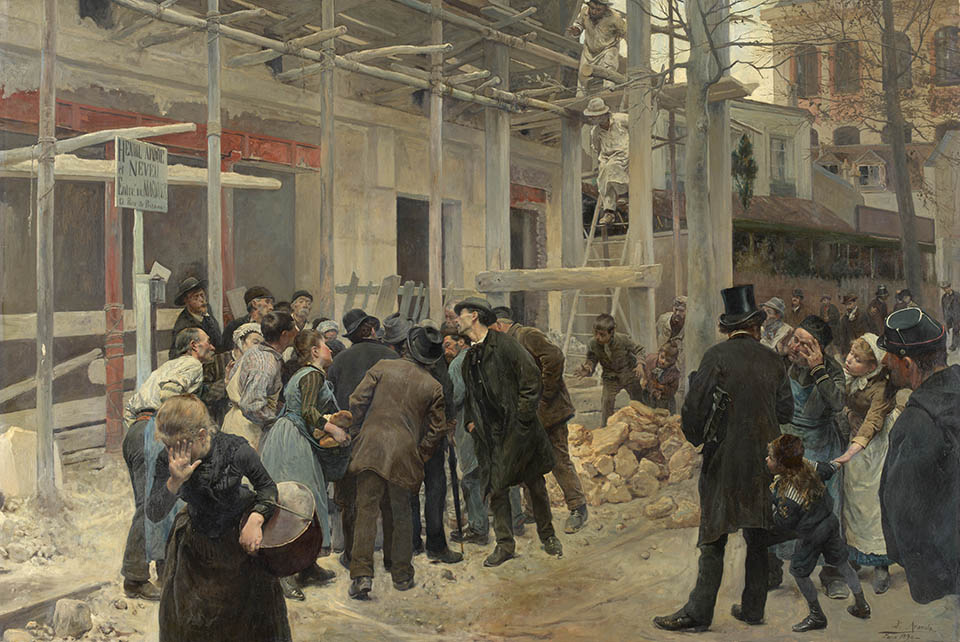
A Misfortune

José Jiménez Aranda

1890

Oil on canvas, 106 x 150 cm

Private collection

From 1885 onwards Spain underwent a series of significant social changes that were reflected in art in its different manifestations. Themes and subjects now broadened to encompass all aspects of life. Some of them, such as factory labour, illness, social marginalisation, prostitution and protest movements, had previously been uncommon. All now appeared with an unprecedented objectivity, based on a naturalism in which painting competed with photography, the latter medium employing greater veracity to portray the same subjects, as did cinematography following its invention in 1895.

Social painting, like sculpture, enjoyed a preeminence comparable to that previously possessed by history painting; many works obtained prizes at the National Fine Art Exhibitions and were acquired by the State. Two of them, by Luis Jiménez Aranda and Joaquín Sorolla, even obtained the highest honour at the Universal Exhibitions in Paris in 1889 and 1900, respectively.

At the same time, new options of a more expressive type emerged which depicted these subjects with a critical eye in works of smaller format, often on paper. Darío de Regoyos inaugurated a trend continued by Ignacio Zuloaga and José Gutiérrez Solana. Other innovative artists, such as Isidre Nonell, Pablo Gargallo, Pablo Picasso and Juan Gris, definitively transformed the approach to social themes.

Rural labour

Rural labour
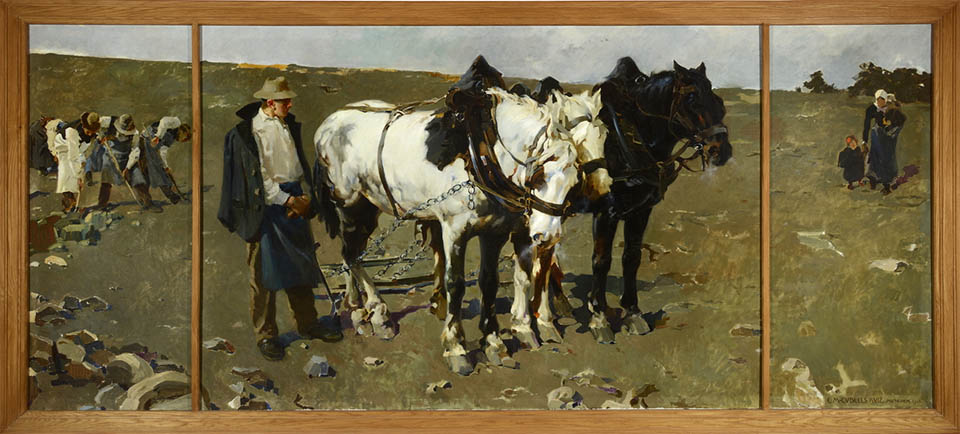
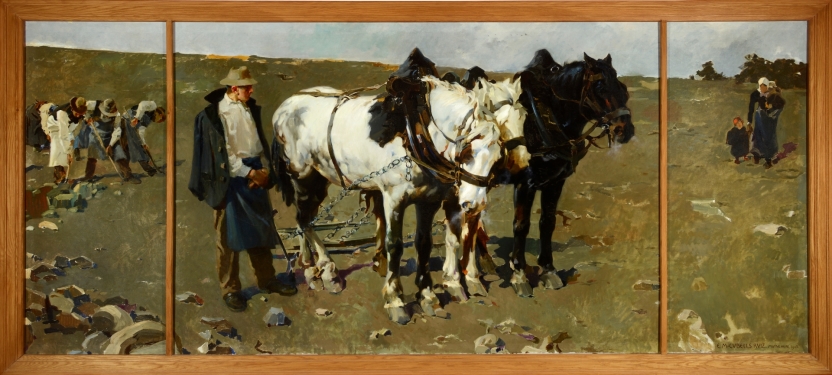
Work, Rest and Family

Enrique Martínez Cubells and Ruiz Diosayuda

1903

Oil on canvas. 387 x 167 cm.

Madrid, Museo Nacional del Prado

Agriculture and livestock farming continued to be both the principal source of wealth at this period and the main employment sector. As a subject for depiction it had a long tradition in art. Painters and sculptors consciously moved away from the earlier picturesque genre mode, using large-scale formats and a more precise naturalist style already employed by various French artists such as Jules Breton (still within the context of Realism), Jules Bastien-Lepage and Léon Lhermitte.

Agricultural subjects were depicted in Spain as extensive scenes with life-size figures, sometimes in triptych format, as in the work of Enrique Martínez Cubells. The efforts of men and women working alongside each other were presented with a dignified appearance, on occasions slightly idealised. Joaquín Sorolla went further in his quest for greater veracity through the use of an exceptionally free technique. Darío de Regoyos decisively rejected both directions, employing an expressive, anti-naturalist simplification to reveal the most sombre side of Spanish reality.

Francisco Iturrino and Darío de Regoyos’s graphic work reveals an overtly modern approach to the depiction of rural labours and one involving a critical vision expressed through the harshness of the landscape, the suffering of the animals and the distortion of the human figures. In his “Basque Album” Regoyos focused on local ethnographic characteristics, depicted in lithographs of an expressive simplification that makes them extremely innovative.

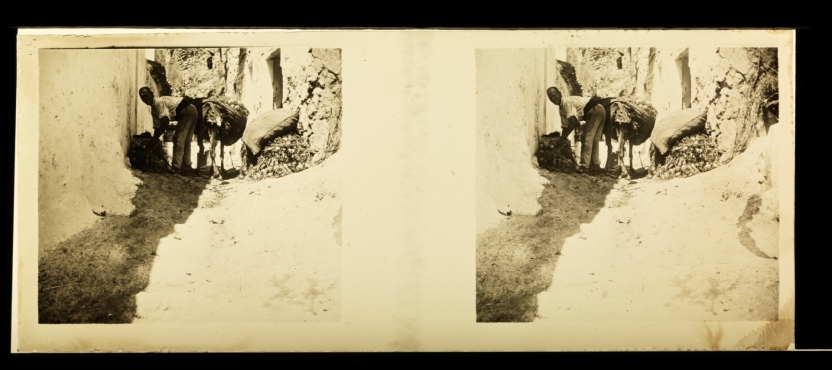
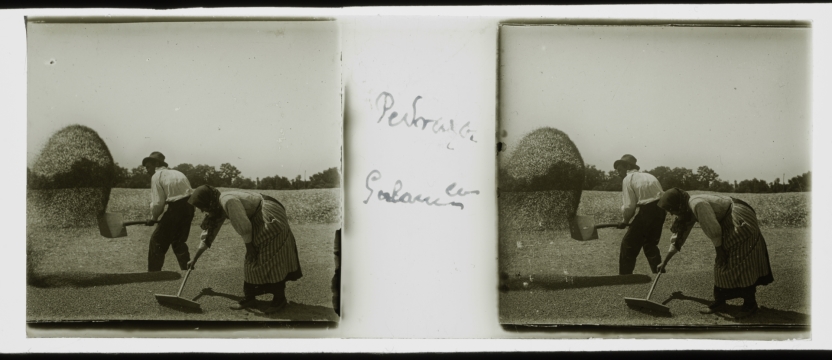
In photography, the most amenable vision of the countryside, in some cases interpreted with a Pictorialist approach, presented scenes characterised by a timeless, bucolic happiness, as in the work of Arturo Truan, Julio García de la Puente and Fernando Cevallos de León. Alongside this, a more objective approach is evident in the depiction of the work of cork cutters in the Sierra de Cádiz by Francisco Hernández-Rubio and in stereoscopic photographic plates.

The labours of the sea

The dangers inherent to the activities of fishermen and mariners added drama to the depiction of these subjects in the work of many artists. This encouraged a slightly artificial vision which was rejected by Joaquín Sorolla, who opted to paint the everyday labours of the sea with a naturalism based on his first-hand knowledge of this work and of his models, selected from real fishermen and observed from life. Sorolla’s broad brushstrokes and rapid execution allowed him to capture dynamic, changing scenes in which the atmosphere was fundamental. Other artists preferred to base themselves on a study of typical men of the sea: Mateo Inurria brought a more synthetic approach to his work while Adolfo Guiard reveals the influence of French artists such as Degas derived from his early period in Paris. Nicanor Piñole moved away from a naturalist depiction of the setting in favour of a simplified approach which concentrated on the character and static monumentality of the figures set against the urban landscape of the quayside.

The harshness of fishing, conveyed in Juan Martínez Abades’s depiction of catching bream, and of life at sea in general, as depicted by Ventura Álvarez Sala, was the frequent subject of texts and images in weekly publications. These were often by painters who had specialised in marine subjects in their canvases and who employed a more rapid, summary type of execution in their illustrations.

Photographs depicted both men of the sea (in the case of Josep Esquirol) and scenes of ports with the boats setting out for the catch (in a work attributed to Pablo Isidro Duomarco) or moored and with the fishermen on deck. This was a popular subject due to its appealing, lively nature and one that implied the ability to resolve the technical difficulties inherent to the depiction of a setting in movement, in this case the sea. A group of anonymous photographs in the Museo Sorolla shows scenes such as the return of the fishing fleet pulled ashore by oxen which are very similar to those painted by Joaquín Sorolla.

Industrial labour

Industrial labour
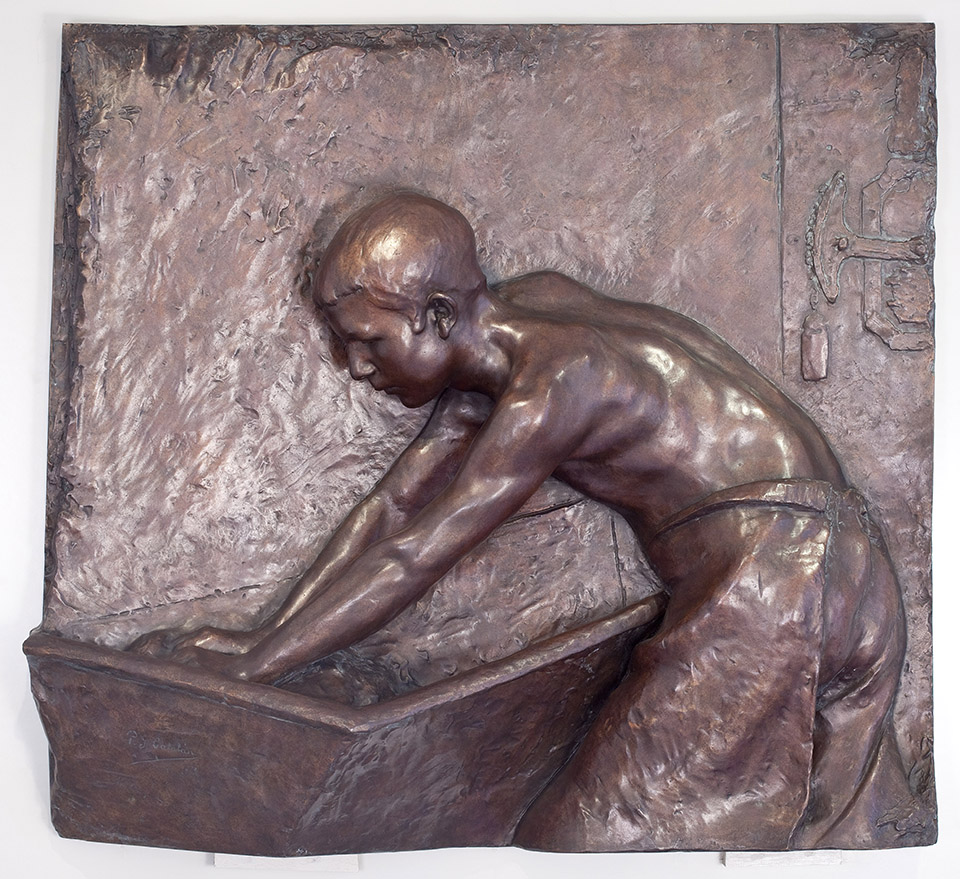
In the Through

Pablo Gargallo (1881-1934)

Bronze, 103,5 x 114 x 26 cm

1898

Zaragoza, Museo Pablo Gargallo, Ayuntamiento de Zaragoza, n.º inv. 159

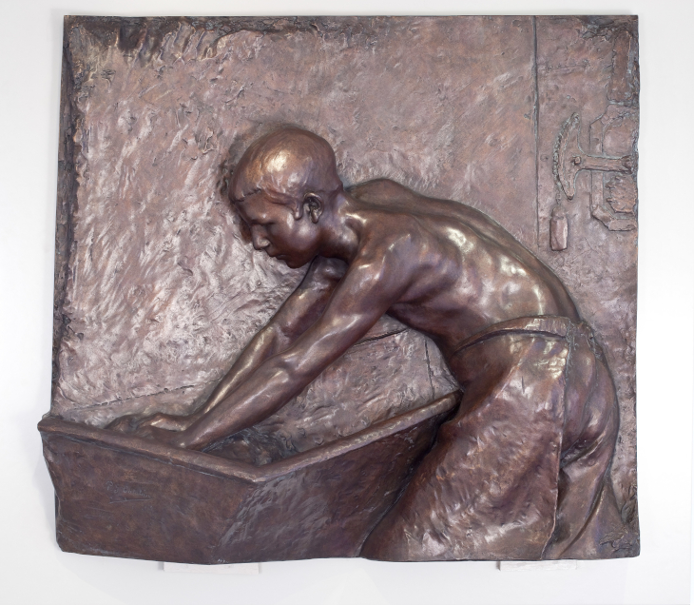
The industrial sector expanded in Spain at this period, with increasing numbers of workers employed. Among them were women and children who were paid far less than men. Various artists, including Santiago Rusiñol, produced early depictions of child labour in the textile and metalworking industries. Scenes of different activities in workshops and factories led artists to study their interiors. Influenced by photography, they captured the size of these spaces through oblique compositions which accentuated depth and introduced a sense of drama. The precise depiction of the machinery and tools emphasised the realism in the portrayal of these types of work, never previously depicted in this manner, while the figures of the workers assumed a heroic aspect.

In contrast, artists such as Darío de Regoyos reveal a Post-Impressionist vision in simple, frontal compositions executed with lively colours and a direct brushstroke. The work of Pablo Gargallo also reveals an aesthetic simplification that anticipates a new direction in sculpture.

Developments in lithography and other graphic media encouraged the greater use of the poster as an advertising medium by a wide range of businesses including industrial manufacturers. The latter frequently commissioned prestigious artists who produced high quality creations, notably in the context of Catalan Modernismo. Artists made the preliminary designs, such as the one by Manuel Benedito for the Unión Española de Explosivos, which were then reproduced in poster form. They featured workers or depictions of factories, sometimes with allegories, as in the example by Ramon Casas. The most dramatic aspects of industrial labour were revealed through the medium of etching, its expressive capacity based on the gradation of tones of black evident in Men laying Tarmac by Ricardo Baroja.

Due to its technical capabilities photography provided extremely precise records of factory labour, seen here in works by Edmundo Lacazette and Julio Peinado in Asturias, Luis Rodríguez Alonso in Palencia, Francisco Fernández Trujillo in the shipyards of Cadiz and José Gómez de la Carrera in Cuba.

Women’s work

Women’s work
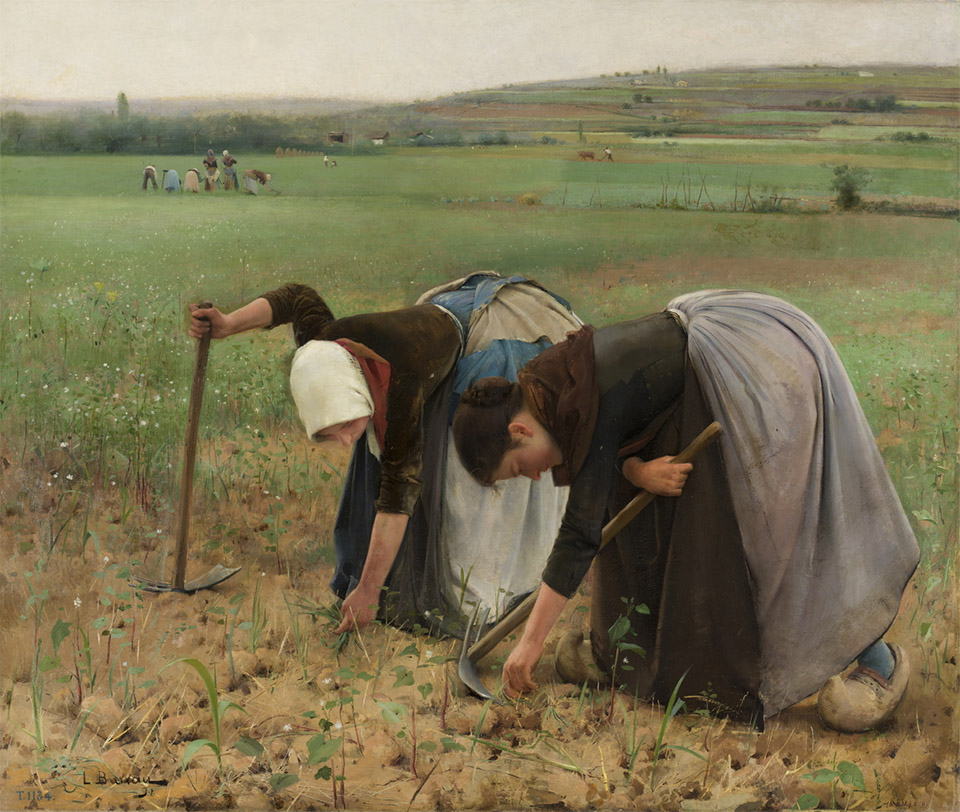
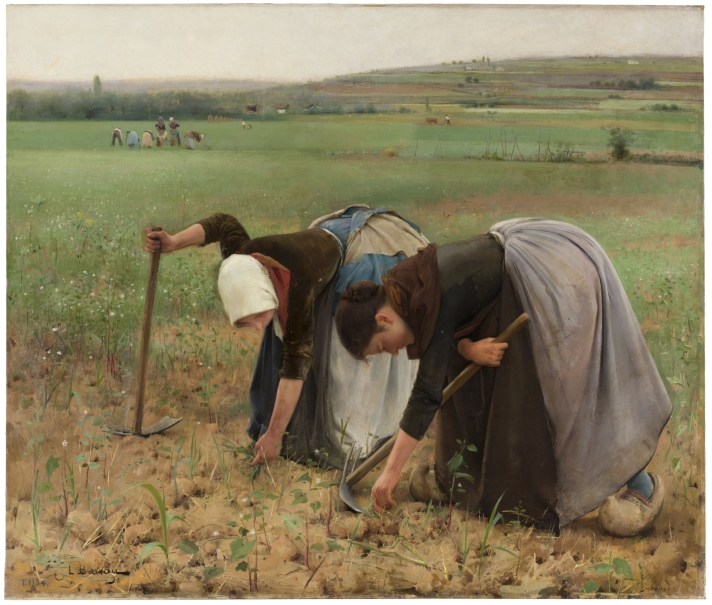
Women weeding the field

Laureano Barrau Buñol

Oil on canvas. 188 x 160,5 cm.

Madrid, Museo Nacional del Prado

Artists depicted women’s growing presence in the world of work. Although they did not undertake the hardest or most dangerous jobs, women had always participated in the tasks of agriculture and fishing. Laureà Barrau’s paintings, for example, show them weeding. Female employment in the primary sector only declined after 1900 with their gradual incorporation into craft activities, shown in Gilders by Manuel Cusí, and industrial manufacturing. With regard to the latter, in 1883 the Commission for Social Reform recommended that women should not undertake the heaviest work. Reality, however, was different and not only women but also girls were engaged in the textile industry among others, as portrayed by Joan Planella. Women also undertook other hard tasks just as pulling barges with a tow rope, recorded in a painting by Anselmo Guinea. Following a period in Paris, Guinea’s work revealed French influence, which is also evident in a different, more modern way in Juli González’s fisherwoman.

Traditional female occupations provided the subject matter for a large number of lithographs and etchings, often with a social emphasis that went beyond the mere depiction of these activities. This is the case with Joaquim Sunyer’s etching of an urban washerwoman, a subject with a very defined tradition since the work of Honoré Daumier. Almost ethnographic in nature are the depictions of women collecting seaweed by Tomás Campuzano from his series of etchings “Images of the Cantabrian Coast”, and selling sardines by Darío de Regoyos, a lithograph from his “Basque Album”. Both depicting age-old female activities, the first is a naturalistic portrayal and the second an extremely original one.

Female labours of this type were very precisely represented in photography through images of washerwomen, seamstresses and dressmakers, some images even capturing a sense of movement, as in Asturian Peasants in the Museo Sorolla. Female participation in industrial work is also extremely well documented in the photographs taken by Julio Peinado in Gijón and the one by Francisco Hernández-Rubio in Santander.

Religion

Religion
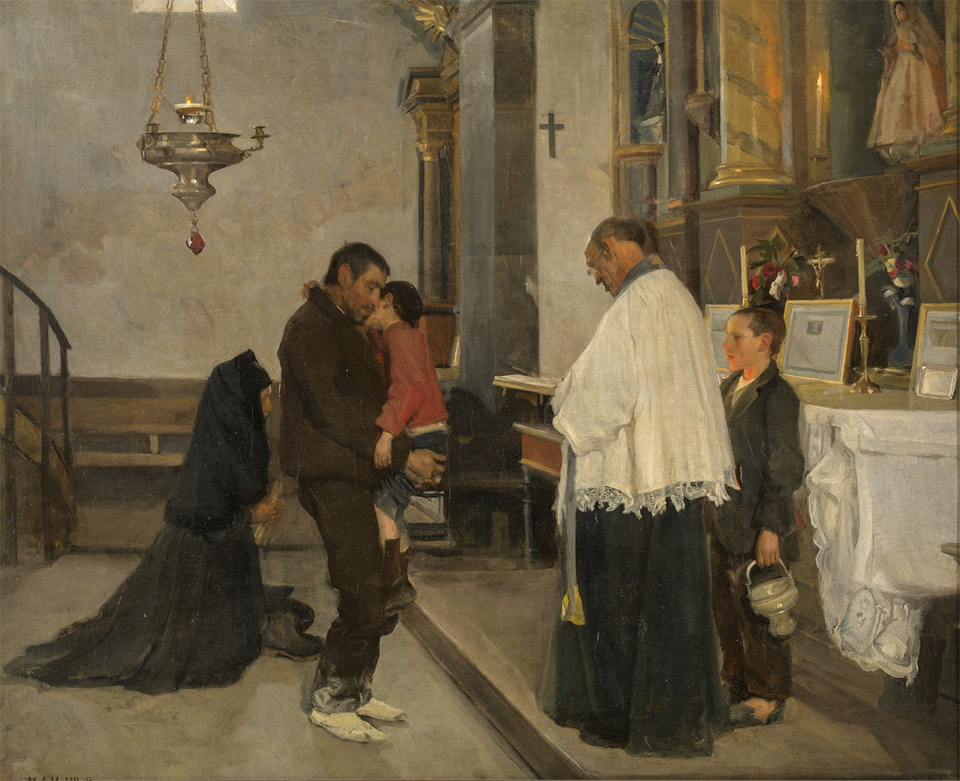
Salus infirmorum

Luis Menéndez Pidal

Oil on canvas, 80 x 100 cm

1896

Madrid, Museo Nacional del Prado, P-5685

The Constitution of 1876 established Catholicism as the official State religion. Supported by Antonio Cánovas del Castillo, the Church had a powerful influence on all sectors of society despite the gradual emergence of secular thought, the basis of Regenerationism. The rites of the Sacraments (Examination of Conscience by Ramon Casas), charitable works and medical assistance (Salus infirmorum by Luis Menéndez Pidal), Easter week processions (by Darío de Regoyos and José Gutiérrez Solana) and the offering of ex-votos (The Promise. Asturias by Ventura Álvarez Sala) were subjects frequently depicted by artists. The conservative trend, typified by Menéndez Pidal, should be distinguished from the critical approach evident in the work of Regoyos and Gutiérrez Solana, for whom religion was inseparable from the most antiquated Spain and literally opposed to progression (as seen in Good Friday in Castile by Regoyos). Particularly interesting is The Cathedral of the Poor by Joaquim Mir, which shows the unique circumstance of the construction of the most important church of the period, the Sagrada Familia in Barcelona.

Despite the spread of secular thought, the religiosity of the Spanish population remained present in all spheres. The Church was responsible for both education and social care, undertaken by some of the religious Orders, while also collaborating with the civil authorities in numerous events such as the inauguration of railway lines. In turn, most religious ceremonies, such as masses and processions, were veritable social encounters, as numerous photographs record in detail. The Pictorialist approach evident in some of these images, such as the example by José Ortiz Echagüe, reveals the growing ascendency of this other art form. In contrast, the processions in Seville photographed by Juan Barrera could have provided inspiration for painters.

The expressive potential of graphic techniques such as drawing, pastel and watercolour as well as etching, made them appropriate media for showing the most archaic, oppressive and caricatural aspects of religious practices, evident in the examples by Darío de Regoyos, Evaristo Valle and Ricardo Baroja.

Illness and medicine

Illness and medicine
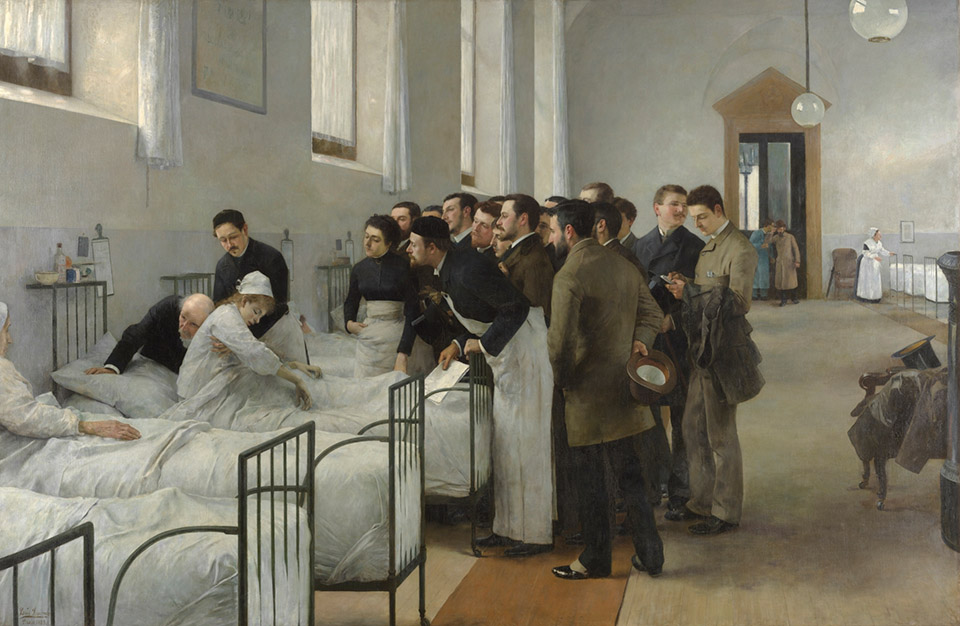
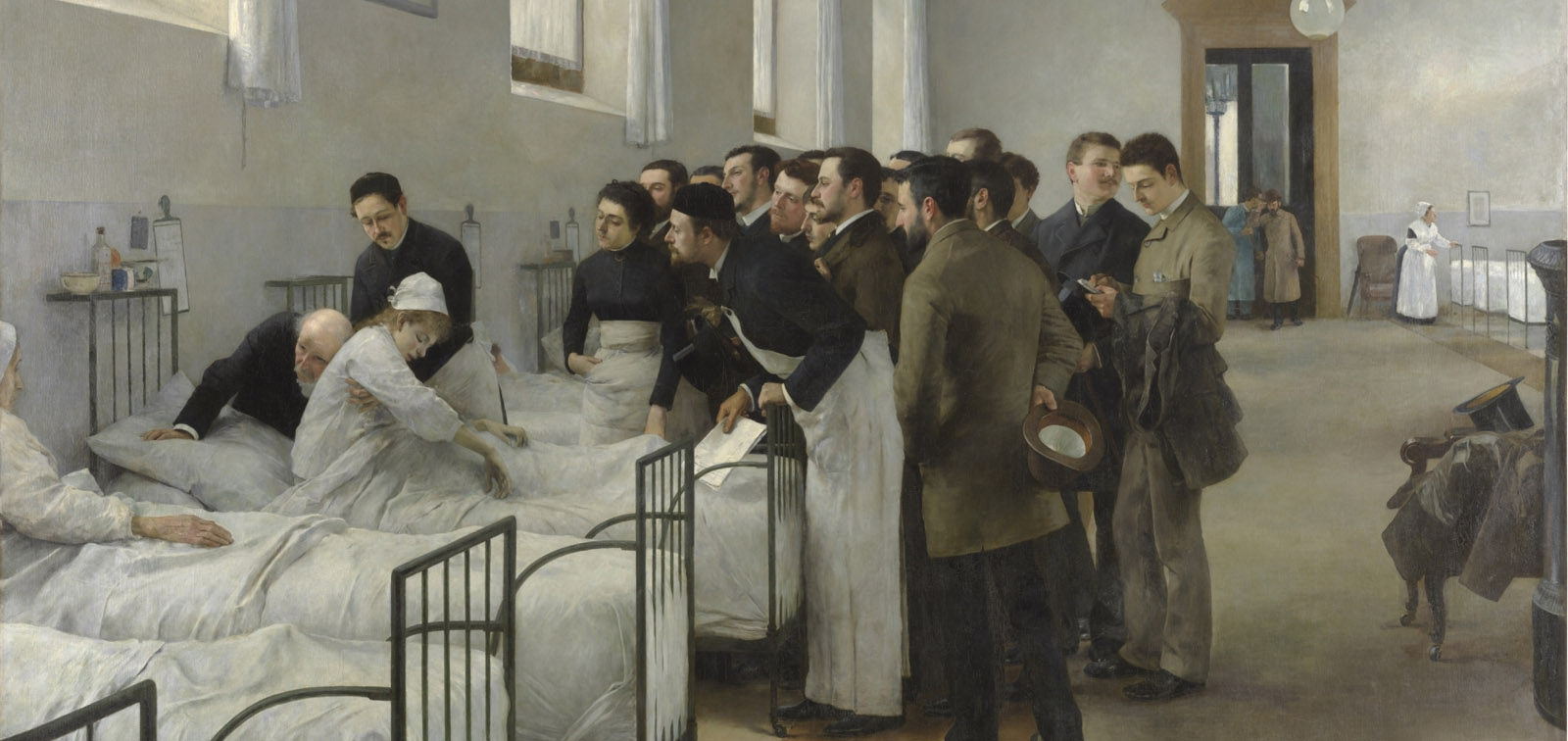
A Hospital Ward during the Chief Physician’s Round

Luis Jiménez Aranda

Oil on canvas, 290 x 445 cm

1889

Madrid, Museo Nacional del Prado, P-7342

The fight against specific diseases, particularly infectious ones, led to social action involving informational campaigns aimed at the general public. These were based on posters, such as the one by Ramon Casas targeting syphilis. Its preparatory design, expressed in a Symbolist style within an overall Modernismo, makes use of the archetype of a female temptress who transmits the disease.

Photographs provided useful assistance to medicine, as seen here in the images of patients with different diseases or amputations. Due to their objective precision photographs could go much further than paintings or sculptures, introducing into the field of representation aspects previously only depicted by the latter two artistic disciplines in relation to other narratives (such as miraculous healings).

Photographs also recorded vaccinations, operations, lectures and doctors’ rounds in hospitals and convalescent homes in compositions similar to those employed in painting. The mentally ill began to receive specialist treatment, as shown in the photograph of patients being taken to the hospital at Ciempozuelos.

Accidents at work

Accidents at work
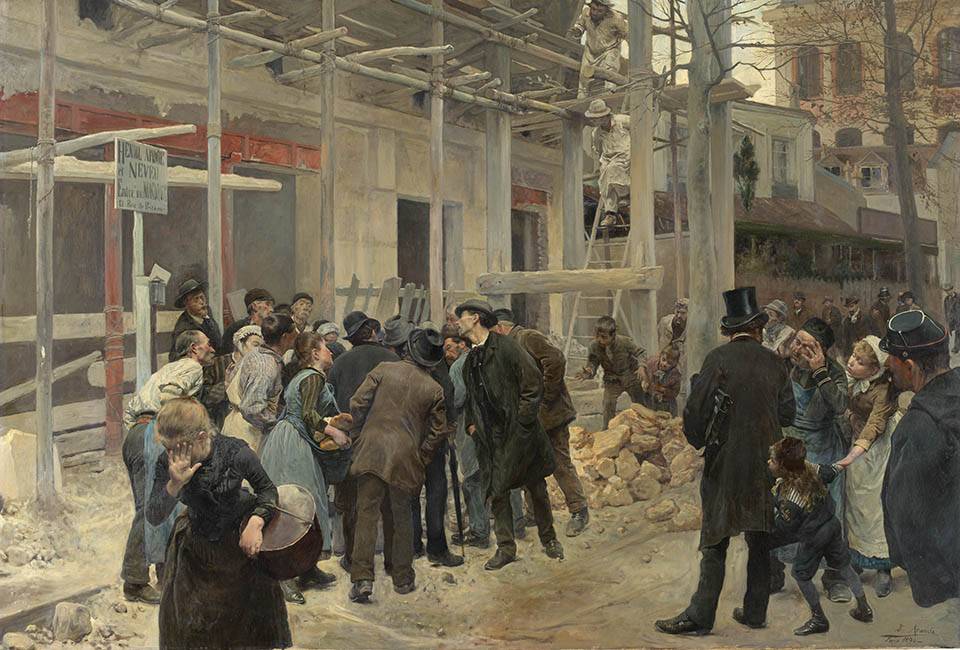
A Misfortune

José Jiménez Aranda

1890

Oil on canvas, 106 x 150 cm

Private collection

Insufficient safeguarding of workers meant that workplace accidents were common in traditional labour activities such as fishing, as depicted by Joaquín Sorolla in And they still say Fish is expensive! This was also the case with the new activities relating to public projects arising from increased construction, shown in A tragic Event by José Jiménez Aranda. In contrast to the drama of the few earlier examples we now encounter an objective approach which in the case of Jiménez Aranda’s scene even omits the injured worker in order to focus on the different reactions of the passers-by and the urban space in which the lamentable event has taken place.

Accidents were not properly covered until 1900 when the employer’s responsibility and the right to compensation was established. Soon after, the Provincial Government of Vizcaya organised a competition on this theme. A notable entry was Aurelio Arteta’s An Accident, which expressed the epic of work in a heroic tone frequently encountered in literature of this period.

The dramatic nature of workplace accidents, their seemingly chance, unexpected nature and their capacity to arouse the reader’s empathy and compassion made them one of the most favoured subjects in the illustrated magazines that became extremely popular in Spain from the last decade of the 19th century. The need to offer visual records of these events led to the use of different types of drawn images. Some were based on objective documents such as photographs or sketches made in situ. Others, such as those extensively produced by Vicente Cutanda, were imaginative recreations of the event, albeit based on the intention to achieve a naturalistic objectivity.

In a more direct manner and one closer to reality, photography provided images of different disasters, including ships exploding, such as the steamship “Cabo Machichaco” in Santander, captured by Pablo Isidro Duomarco and Pascual Urtasun, fires, collapsing buildings and derailments. Following the introduction of photogravure into the illustrated press, this technique became more widely used.

Prostitution

Prostitution
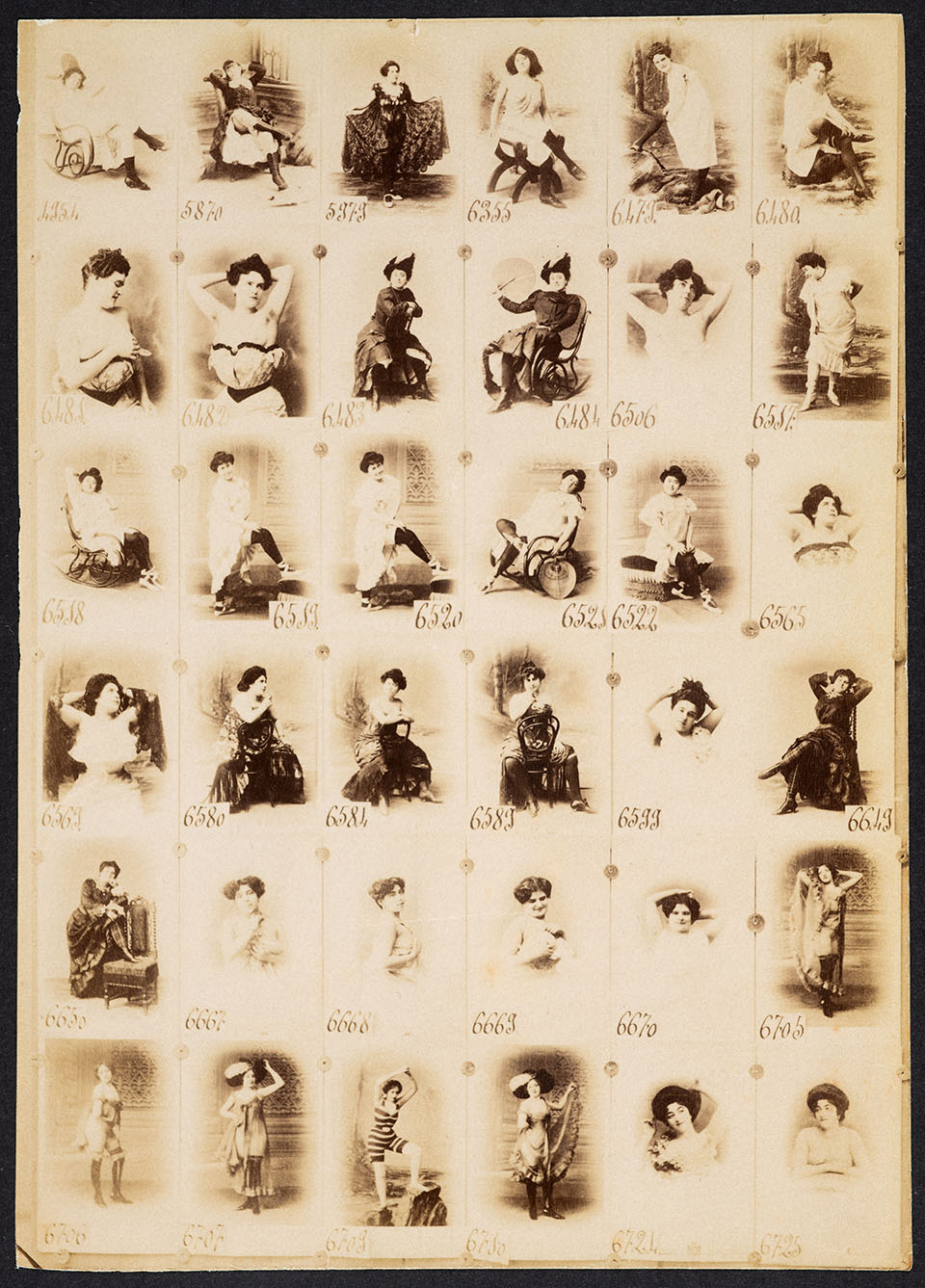
Erotic Photography Samples

Antoni Esplugas i Puig

Albumen paper, 170 x 120 mm

1890

Barcelona, Colección Domènech-Ballester

Particularly popular with novelists, this subject was widely depicted by painters. It became associated with the portrayal of social injustice and exploitation, as in the work of Joaquín Sorolla and Antonio Fillol, and later with the weariness and existential anguish of prostitutes, as conveyed by Gonzalo Bilbao, Ignacio Zuloaga and Julio Romero de Torres, who aimed to surpass the naturalism of earlier depictions through a more intense expressivity. The most innovative artists, who were working in Paris, such as Hermen Anglada-Camarasa and Pablo Picasso, focused on prostitution through more urban scenes, both on the street and in cafés and cabaret performances. Prostitution was tolerated within the closed space of the brothel and also in the public space, disguised as entertainment, as its eradication was considered impossible although it was viewed completely negatively by society.

Marginalised individuals were frequently to be encountered in the world of prostitution, as well as others of non-European ethnic origins, such as the woman in Anglada-Camarasa’s painting.

The attraction which the world of prostitution held for many artists was frequently expressed in the form of graphic work. This artistic discipline offered enormous potential for achieving the desired effects, evident in Joaquim Sunyer’s etchings and Pablo Picasso’s drawings. Like the French artists, these painters also focused on the most sordid aspects of this milieu. In contrast, Juan Gris’s drawings, made for reproduction as illustrations, employed a clarity of line quite different to that of Sunyer and Picasso. The 1st of May on the Kursaal explicitly juxtaposes the world of high-class prostitution with the context of the struggle for workers’ rights.

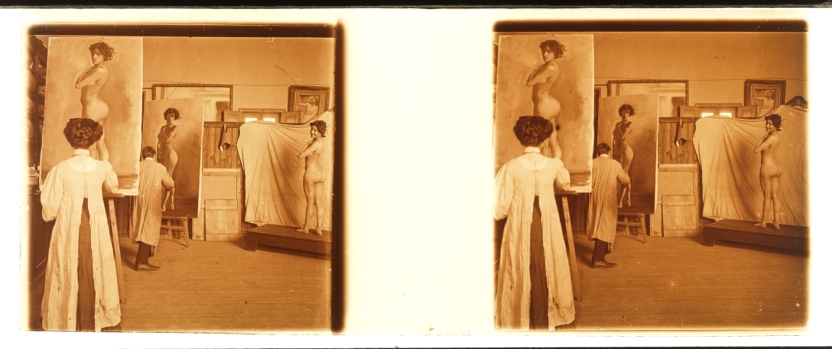
Photography of nudes frequently concealed the true nature of such images through the use of classical Greek poses, as in the images by Pere Casas Abarca, or “artistic” poses, such as the two groups of autochromes and stereoscopic prints displayed here. The catalogue samples of Antoni Esplugas’s photographs of women in erotic poses are particularly interesting.

Emigration

Emigration
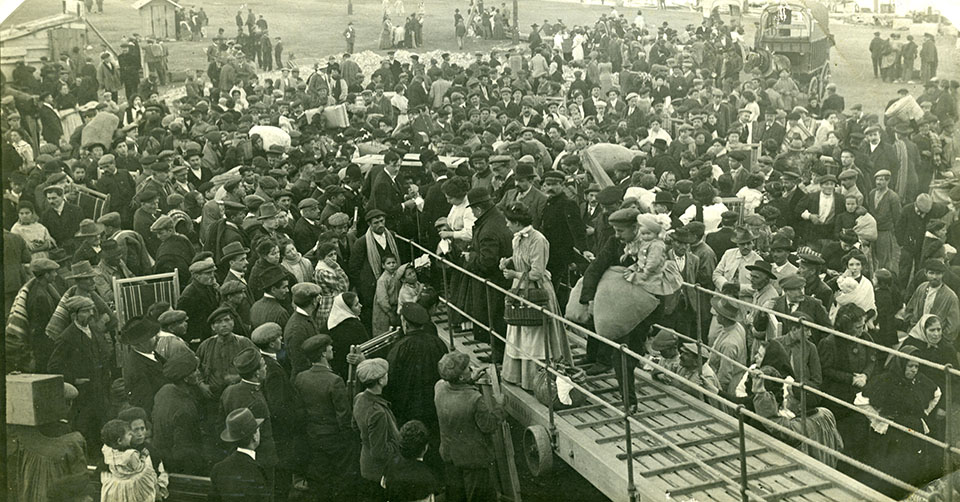
Embarkation of emigrants to South America at the port of Barcelona

Frederic Ballell Maymí

Period copy on gelatin silver bromide, 94 x 179 mm

1910

Barcelona, Arxiu Fotogràfic de Barcelona, Ajuntament de Barcelona, S0-2-42

In the last decade of the 19th century up to 400,000 Spaniards emigrated from the Peninsula to Latin America, principally Cuba and Argentina. Painters’ new focus on this issue took the form of larger works with monumental figures. A popular subject was that of emigrants embarking, also seen in photographs, as this was an episode that combined the sadness of saying farewell to relatives and uncertainty regarding the future. The presence of landing craft and ferries alongside the big transatlantic steamers offered a realistic depiction of the start of the voyage. Emigrants’ identity records, featuring their photographic portraits, reflect their initial experience of their destination country. The figure of the successful returned emigrant and those repatriated after the events of 1898 also attracted artists’ attention.

Alongside these circumstances the exodus from the countryside to the city in search of work gave rise to social uprooting and a radical change of lifestyle. In this case the railway, which linked the principal Spanish cities, was the means of transport employed.

Poverty and ethnic and social marginalisation. Colonialism

Poverty and ethnic and social marginalisation. Colonialism
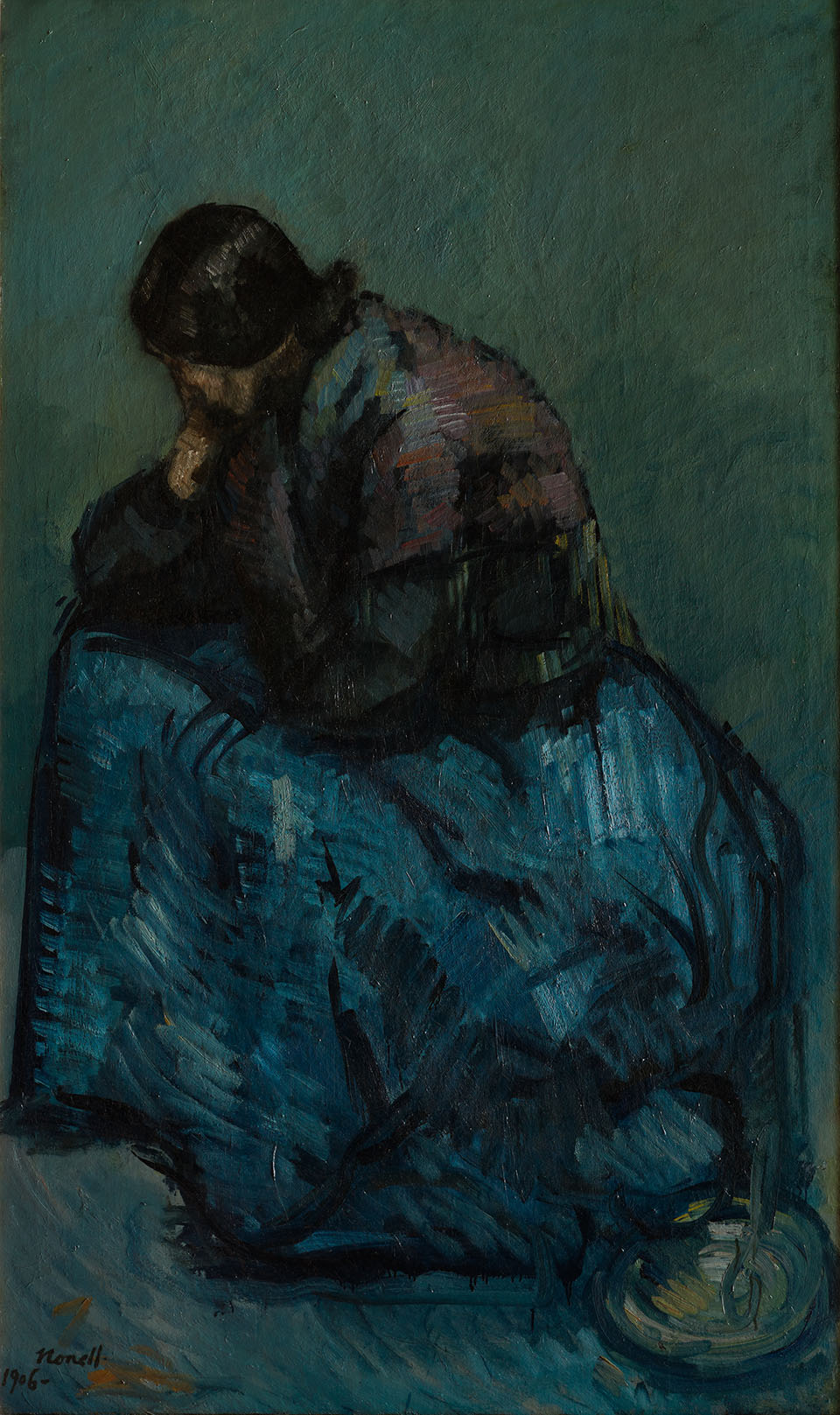
Gypsy

Isidre Nonell

Oil on canvas, 101 x 81 cm

1901

Colección Casacuberta Marsans

One of the consequences of the rapid social transformation brought about by industrialisation was the appearance of zones of poverty in the urban periphery. While charitable initiatives were launched along with social protection these proved insufficient. Unemployment, the death of the principal wage earner in a family, alcoholism and illness immediately led to poverty. Artists depicted the different episodes in this sequence: orphanhood, pawning possessions, eviction and impoverishment.

Congenital diseases, which Degenerationist thought of the period associated with hereditary vices, inspired important works of art. They include the examples by Joaquín Sorolla and José Gutiérrez Solana, the latter responding to the former in a different tone.

The subject of fascinated contemplation during the Romantic period, the Spanish Romani people, popularly known as gitanos [gypsies], aroused enormous interest among artists in the last decade of the 19th century. Most emphasised their unique exoticism but Isidre Nonell focused on their poverty. In the Spanish overseas territories artists such as the Filipino Domingo Teotico depicted the marginalisation of local ethnic groups.

Groups marginalised by physical deformity, such as those from the Valle de Bohí suffering from diseases resulting from endogamy, particularly interested Isidre Nonell. In his etchings Ricardo Baroja depicted the struggle for life, which also lay at the heart of his brother Pío’s novels. Ricard Canals’s depiction of a prison visit and the caricature of capitalism squeezing its victim also depict aspects of social reality. In contrast, The frugal Meal by Picasso conveys a mood of self-absorption in its depiction of a spiritualised poverty which is characteristic of the artist’s Blue period.

Like painters but more assiduously, photographers focused on homes for the destitute, soup kitchens, the independent lives of poor children on the streets and their stays in summer camps, as well as prisoners. Marginalised ethnic groups such as the Romani and, in the overseas colonies, the black population of Cuba and the indigenous peoples of the Philippines and Equatorial Guinea, were the subject of detailed photographic scrutiny which left a record of their racial characteristics and otherness.

Strikes and protests

Strikes and protests
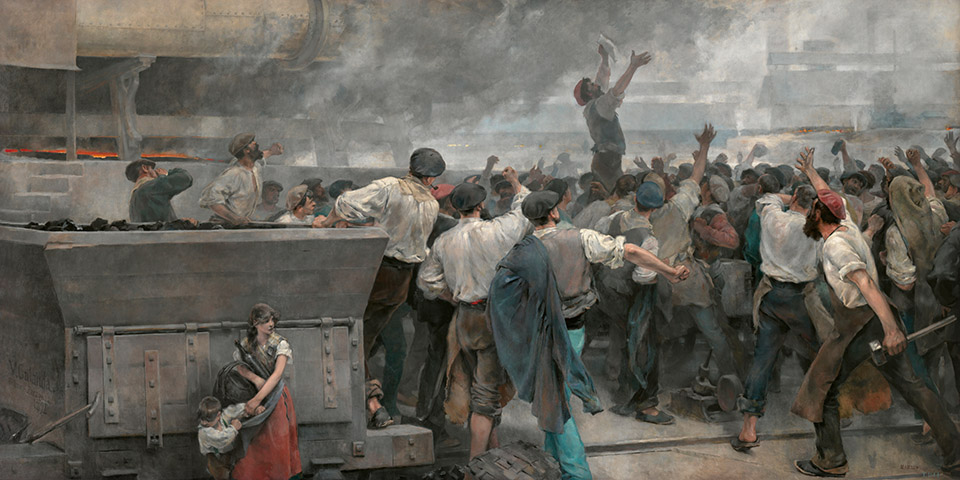
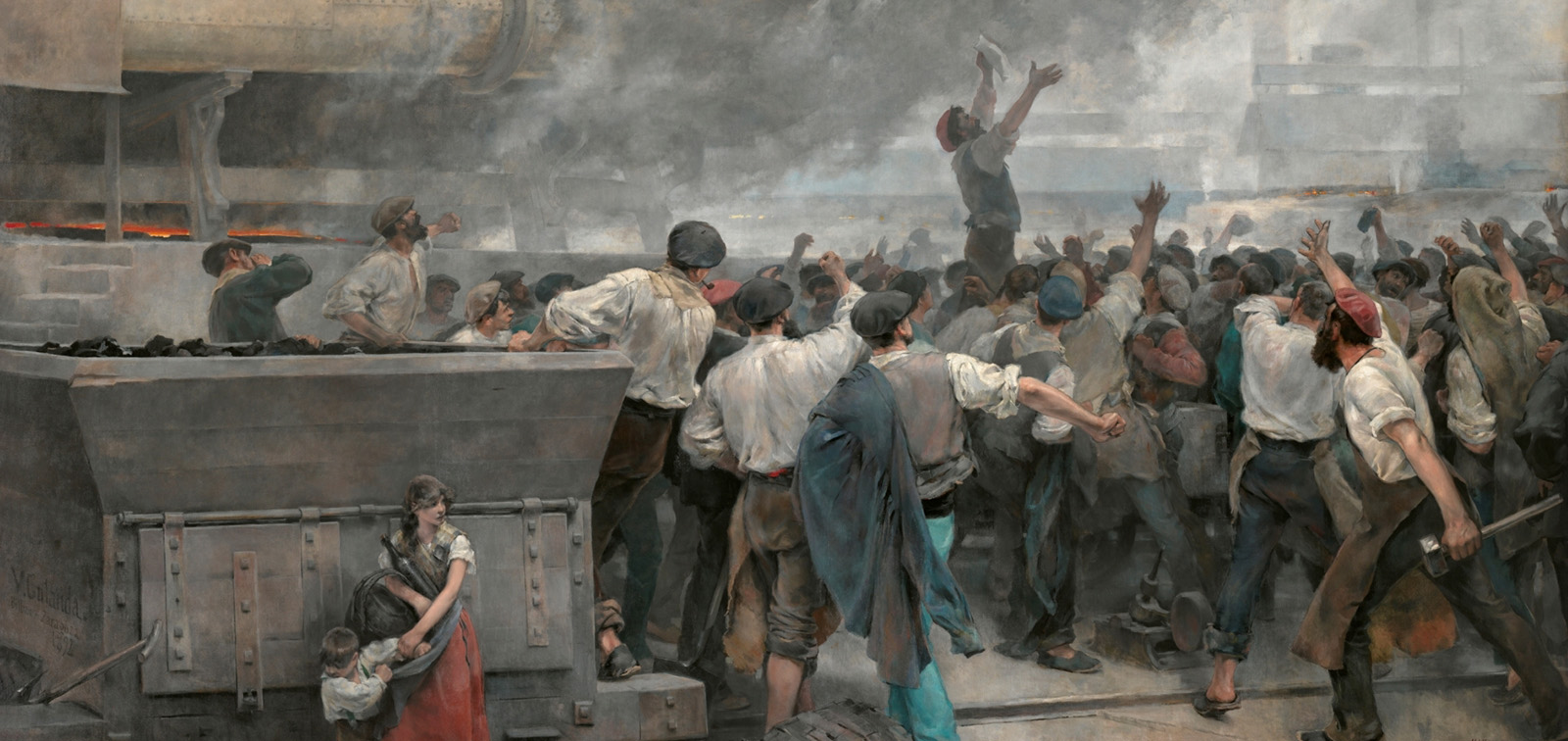
Workers on Strike in Vizcaya

Vicente Cutanda

Oil on canvas, 275 x 550 cm

1892

Madrid, Museo Nacional del Prado, P-7793

The increasing organisation of the working class with the aim of defending its labour rights led to major strikes in the most industrialised parts of Spain. These were depicted in works by Vicente Cutanda and José Uría who, like painters in other countries, emphasised the radicalism of the conflicts and the heroic epic of the worker. As a result, repression and death appear as possible consequences of the strikes. Artists heightened the drama of the event portrayed by setting the scene in the actual spaces of the workshop or factory, which they studied objectively in order to make their depictions as realistic as possible. Other painters, such as Lluís Graner, showed secret meetings as well as clashes with the forces of order, as did Antonio Fillol.

Among the different social movements, Anarchism aroused concern and interest due to the virulent nature of its actions and the extent of the acceptance of its ideas, which were well received by some intellectuals and artists. Nonetheless, this ideology was frequently condemned for its subversive aims.

The interest aroused by anarchist activities led some painters to focus on them. Santiago Rusiñol drew portraits of the anarchists involved in the bomb attack on the Liceo in Barcelona, revealing an interest in recording their facial features. The movement’s supposed activities, such as those attributed to the “Black Hand” in Andalusia, and the punishments meted out to them were subsequently depicted by Xavier Gosé, while Ricard Opisso recorded their public rallies. The desire to illustrate the special editions which Republican and workers’ publications devoted to the First of May from 1890 onwards led to the commissioning of artists who had depicted subjects of workers and labour, such as Vicente Cutanda. Associated with Republicanism at this period, Joaquín Sorolla designed the masthead of the newspaper El Pueblo, founded by his friend Vicente Blasco Ibáñez.

Rallies, demonstrations, barricades (during the so-called “Tragic Week”), strikes and attacks reached a large public through photography, which offered the most accurate images. In the case of one photograph by Luis Marín we even see the corpse of the perpetrator of the assassination of José Canalejas.

Education

Education
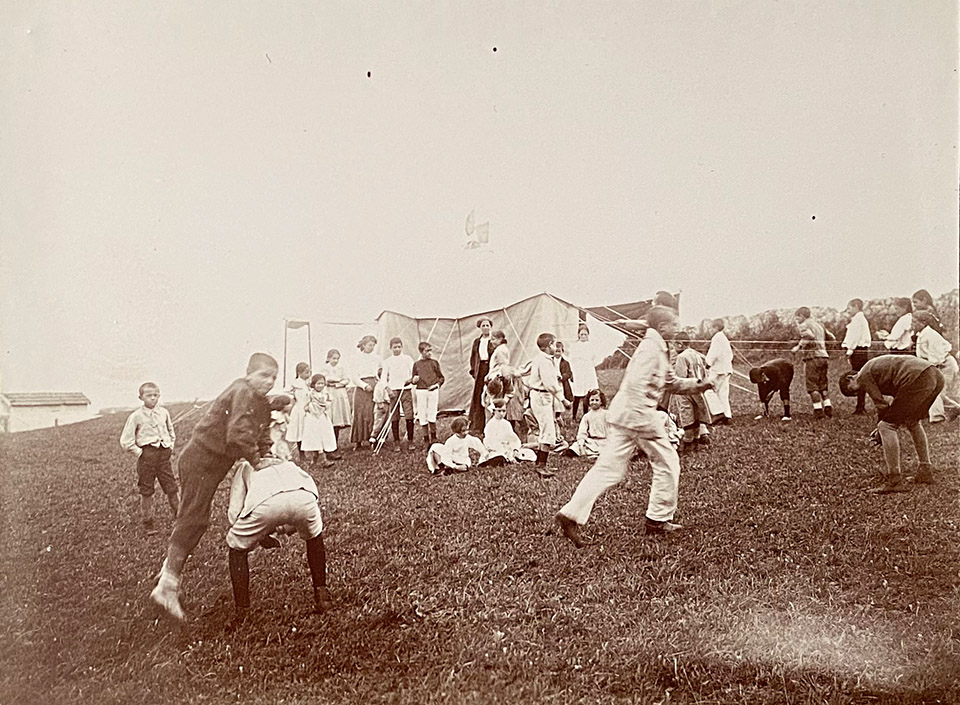
Children in the colony of San Vicente de la Barquera, Cantabria

Authorship unknown

Paper in gelatin, 140 x 186 mm

1910

Madrid, Fundación Francisco Giner de los Ríos [Institución Libre de Enseñanza], MG/154

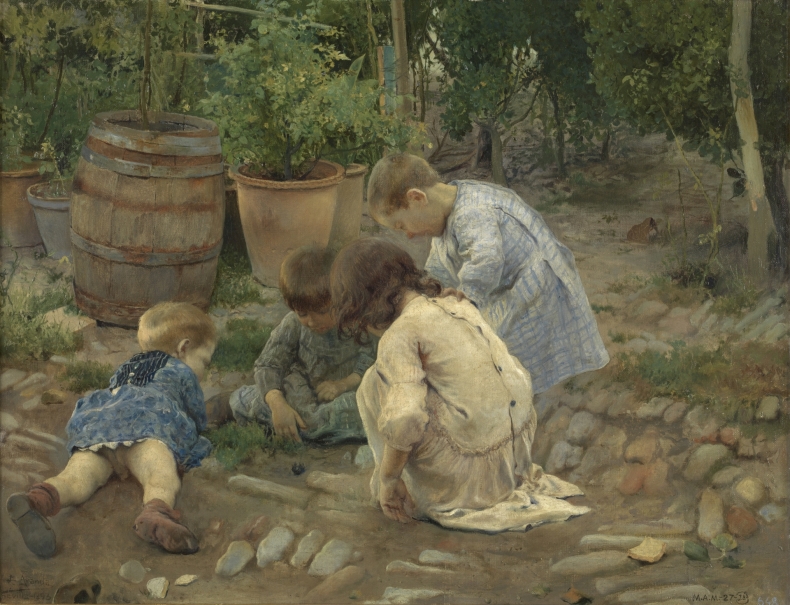
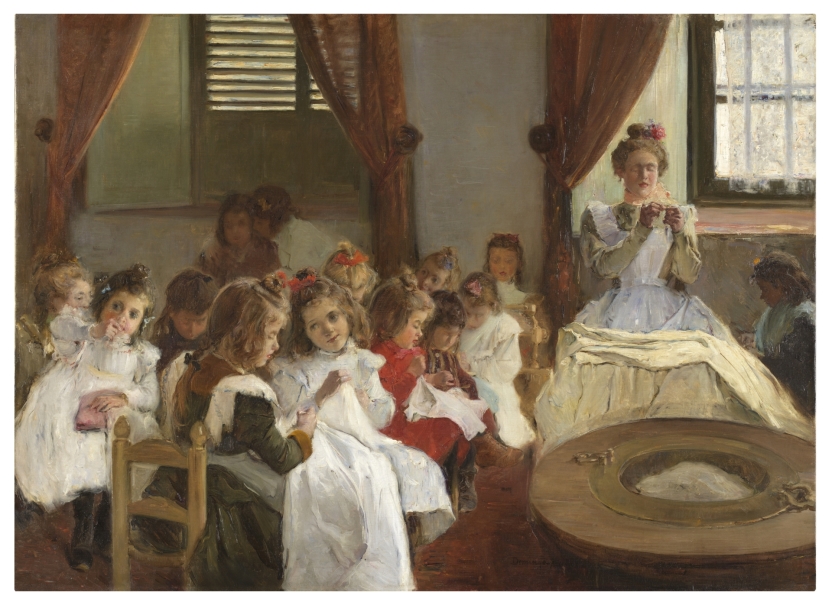
Around 1885, 71% of the Spanish population was illiterate. The Constitution of 1876 had stipulated that education was to be based on Catholic doctrine at a time when State education was not sufficiently available. The Church largely assumed this responsibility through numerous religious foundations, in addition to caring for orphans on the initiative of some members of the clergy. While children learned through play, depicted in José Jiménez Aranda’s painting, and in contact with nature, as promoted by the Institución Libre de Enseñanza, education was essentially based on learning by rote, as depicted by Ignacio Pinazo. Women were also educated to a limited extent, including art training.

One sector of primary education, particularly in Andalusia, was entrusted to the traditional Escuelas de amiga (schools run by women), where working women could leave their children. These schools are the subject of paintings by Domingo Muñoz and Julio Romero de Torres, the latter from an innovative viewpoint.

In Spain and its overseas territories education essentially depended on the State and on various religious Orders. School was frequently an institution characterised by a repressive drive for uniformity in a cheerless environment, evoked by Ricardo Baroja’s etching, from which children only escaped through play.

The most valuable educational approaches arose from private initiatives. In 1870 Fernando de Castro founded the Asociación para la Enseñanza de la Mujer, which was pioneering in its modern treatment of female education. Associated with it was the Institución Libre de Enseñanza, founded in 1876, which promoted an integrated type of education inspired by British and German models, as well as contact with nature through its school colonies or camps. The latter were central to the Escola del Bosc, set up in the Montjuïc Park in Barcelona and captured in Frederic Ballell’s photographs. This new way of understanding education, directly related to hygienist trends, contributed to changing some aspects of the official education system over the following decades. Other types of non-official teaching existed, offered in studios and academies where women were increasingly present.

Death

Death
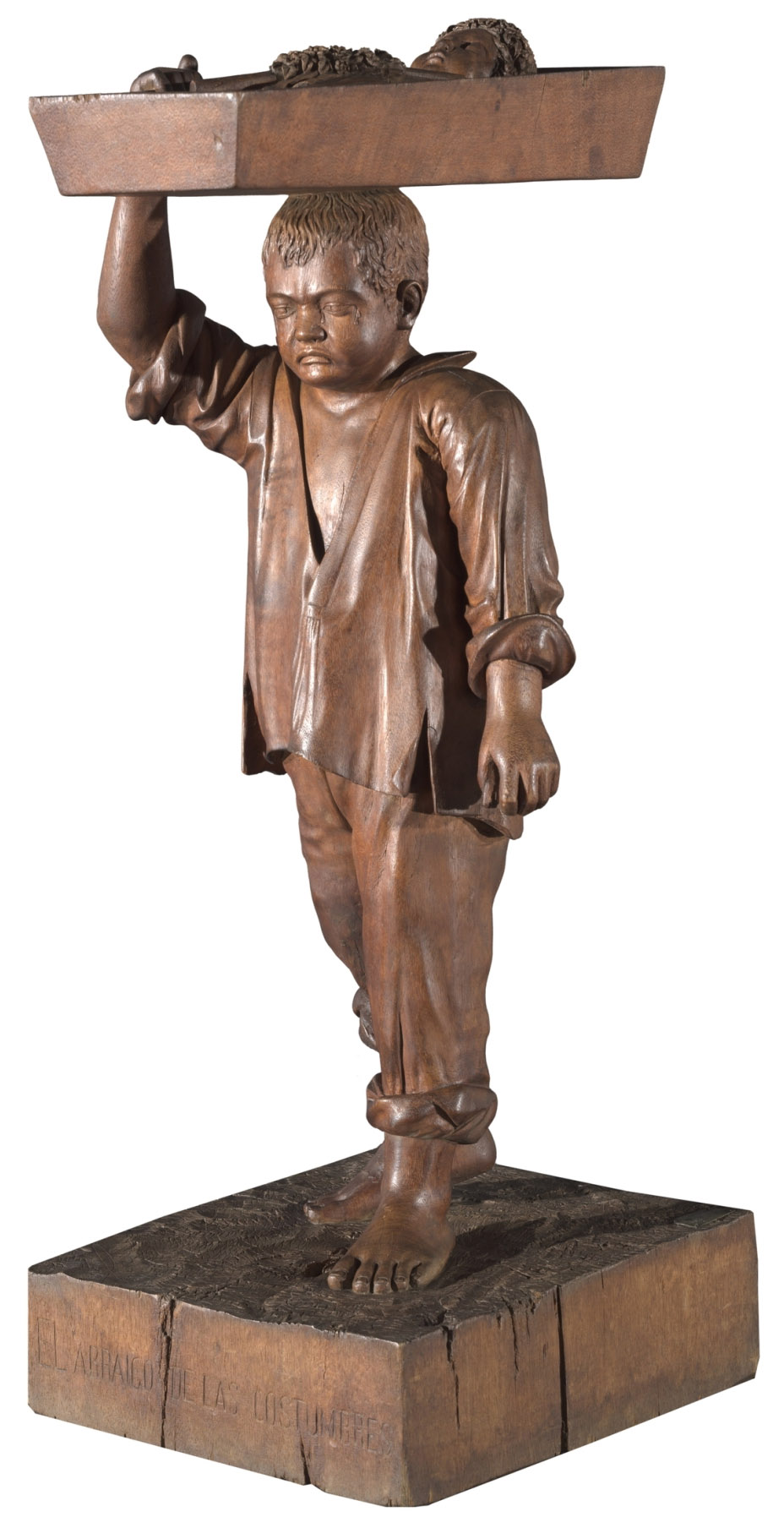
Deep-rooted Customs

Ciriaco Gaudínez y Javier (1884-1919/20)

Baticulin wood and brass, 82 x 29 x 34 cm

c. 1887

Madrid, Museo Nacional del Prado (depositado en Madrid, Museo Nacional de Antropología), E-968

A key theme in Spanish painting and artistic movements prior to the 19th century, death is depicted in images of this period with much more contained emotion. Examples of the most restrained naturalism, two works by Ramon Casas reveal the objective neutrality with which this subject was approached, even in the case of an execution – Execution by Garrotting – and the suicide of a friend of the artist –The Burial of Casellas.

Despite advances in medicine, infant mortality continued to be higher in Spain than in other European countries and even more so in the overseas territories. The sculpture by the Filipino artist Ciriaco Gaudínez references local customs and circumstances in its depiction of a young girl’s death.

Condolence Visit by Regoyos exemplifies the artist’s early quest for innovation deriving from his contact with Belgian Symbolism, combined with a characteristic distortion of the figures. The result is a new vision in Spain of the customs associated with death.

In the context of the fin-de-siècle, the appeal of death as a subject was transmitted through all forms of artistic creation. The fascination with burials and their funerary cortèges is evident in the drawing by Ramon Pichot and the pastel by Pablo Picasso. Mourning and prayer in cemeteries also attracted artists, particularly Darío de Regoyos who depicted these acts in various intaglio prints and lithographs. The origins of Regoyos’s marked expressivity lies in his close contact with the innovative nature of Belgian Symbolism but his obsession with Spanish rituals allowed him to offer a profound and original vision of his native country through a theme central to its culture.

Given their nature as public events, executions by garrotting were captured through the medium of photography, which also focused on more private aspects of funeral rites such as wakes, notably recorded in the images taken by Joaquín Pintos. Posthumous portraits were also common, particularly of children, which functioned as mementoes for family members.

Cinema and social change

From the outset, cinema became a remarkably potent medium for representing reality. With moving film the naturalist intent already evident in painting and photography reached a culminating point that attracted all sectors of society. The earliest films, first shown in 1895, presented a documentary and in some cases humorous vision which appealed to audiences through the concepts of amusement and satisfying curiosity. These films were included as part of “variety shows”. Spanish audiences saw films made in France and elsewhere, while other similar ones were very soon made nationally, for example Leaving the 12 o’clock mass at El Pilar, Zaragoza. Some focused on exceptional news events such as fires or on little known aspects of reality, such as mental health clinics. Film proved valuable for showing technical, scientific and medical procedures, including dissections. It was also used to reconstruct events, among them the assassination of José Canalejas.

Artworks

1
Victims of the bullfight

Darío de Regoyos (1857-1913)

Engraved linear background, scraper, pen and brush with black ink, bodycolour wash and touches of black chalk (grattage), 310 x 450 mm

c. 1894-99

Mollet del Vallés (Barcelona), Museu Abelló, Fundació Municipal d’Art, n.º 685

2
Victims of a Fiesta, Spain (Victimes d’une fête, Espagne)

Darío de Regoyos (1857-1913)

Pastel and oil on canvas, 90 x 120 cm

1894

Colección Unicaja (depositado en Oviedo, Museo de Bellas Artes de Asturias), n.º 12064

3
Preparing Raisins (Transporting Grapes. Jávea)

Joaquín Sorolla (1863-1923)

Oil on canvas, 125 x 200 cm

1900

Oviedo, Museo de Bellas Artes de Asturias, n.º 1812

5
Basque agricultural labourer

Darío de Regoyos (1857-1913)

Artes gráficas Federico Álvarez (act. h. 1897)

Crayon chromolithograph, red and blue ink on paper, 374 x 249 mm

1897

Colección Juan San Nicolás

6
Dead horse

Francisco Iturrino (1864-1924)

Etching on Arches paper, 195 x 250 mm

c. 1898

Madrid, Biblioteca Nacional de España, INVENT/46773

7
Peasants working the land

Arturo Truan Vaamonde (1868-1937)

Albumen print, 75 x 105 mm

c. 1892

Madrid, Colección Mario Fernández Albarés

8
Tying sheaves

Julio García de la Puente (1868-1955)

Photogravure, 115 x 165 mm

1902-4

Santander, Centro de Documentación de la Imagen de Santander (CDIS), Ayuntamiento de Santander, Fondo del Centro de Estudios Montañeses (CEM), reg. 18967


9
August labours

Fernando Cevallos de León (1887-1955)

Gelatin silver print (developing-out-paper), 125 x 175 mm

1910-20

Santander, Centro de Documentación de la Imagen de Santander (CDIS), Ayuntamiento de Santander, Colección Francisco Javier Gómez Martínez, reg. 18585

10
Weighing cork in the Sierra de Cádiz

Francisco Hernández-Rubio (1859-1950)

Gelatin silver flexible negative (digitally developed image), 90 x 120 mm. Exhibition print

1908

Madrid, Colección Mario Fernández Albarés

11
The grape harvest

Francisco Garay Panizo (1884-1949)

Platinotype, 157 x 223 mm

c. 1910

Madrid, Museo Sorolla, [inv. 82758]

12
The fountain at Buñol

Attributed to Antonio García Peris (1841-1918)

Albumen print, 252 x 303 mm

1891-95

Madrid, Museo Sorolla, [inv. 82768]

13
Milking a cow

Julio García de la Puente (1868-1955)

Gelatin silver glass negative (digitally developed image), 130 x 180 mm. Exhibition print

1900-15

Santander, Centro de Documentación de la Imagen de Santander (CDIS), Ayuntamiento de Santander, Fondo del Centro de Estudios Montañeses (CEM), reg. 11875

16
The “Cho” or Cabin Boy

Adolfo Guiard (1860-1916)

Oil on canvas, 62 x 41 cm

1887

Bilbao, Museo de Bellas Artes de Bilbao, aportación de la Diputación Foral de Bizkaia en 1923, n.º 82/32

17
The Return of the Fishing Fleet

Joaquín Sorolla (1863-1923)

Oil on canvas, 265 x 403.5 cm

1894

París, Musée d’Orsay, n.º RF 948

18
Mariners in the Port of Gijón

Nicanor Piñole (1878-1978)

Oil on canvas, 113 x 166 cm

1906

Madrid, Museo Nacional Centro de Arte Reina Sofía, AS01076 (depositado en Gijón, Museo Nicanor Piñole, n.º dep. 2023/03)

19
Fisherman (Sea Wolf)

Mateo Inurria (1867-1924)

Bronze, 52 x 33 x 50 cm

model of 1903; casting after 1916/17

Madrid, Colección Banco de España, E_25

20
The Sea Bream

Juan Martínez Abades (1862-1920)

Body colour wash and graphite on paper, 282 x 444 mm

1894

Madrid, Fundación Colección ABC

21
Maritime labours. After washing the decks

Ventura Álvarez Sala (1869-1919)

Body colour wash on paper, 380 x 270 mm

1900

Madrid, Fundación Colección ABC

22
Fisherman from La Escala

Josep Esquirol Pérez (1874-1931)

Gelatin silver glass negative (digitally developed image), 130 x 180 mm. Exhibition print

c. 1910

La Escala (Gerona), Arxiu Històric de L’Escala, n.º ESQ1599

23
Fishing port in La Escala

Josep Esquirol Pérez (1874-1931)

Gelatin silver glass negative (digitally developed image), 130 x 180 mm. Exhibition print

c. 1910

La Escala (Gerona), Arxiu Històric de L’Escala, n.º ESQ1617

24
Fishing boats setting out for the catch, Santander

Attributed to Pablo Isidro Duomarco (1870-1949)

Gelatin silver print (developing-out-paper), 115 x 180 mm

1895

Santander, Centro de Documentación de la Imagen de Santander (CDIS), Ayuntamiento de Santander, Colección Víctor del Campo Cruz, reg. 8722

25
The port of San Sebastián

Unknown photographer

Gelatin silver print, 109 x 80 mm

1901

Madrid, Real Academia de Bellas Artes de San Fernando, Biblioteca, FOT-2022

26
Arcades in the port of San Sebastián

Unknown photographer

Gelatin silver print, 81 x 109 mm

1901

Madrid, Real Academia de Bellas Artes de San Fernando, Biblioteca, FOT-2077

27
Boy leading oxen to drag the boats on shore

Attributed to Antonio García Peris (1841-1918)

Albumen print, 114 x 159 mm

1890-1900

Madrid, Museo Sorolla, [inv. 83460]

28
Fishermen

Unknown photographer

Albumen print, 141 x 129 mm

c. 1890

Madrid, Museo Sorolla, [inv. 83456]

29
Two fishing boats moored in a port

Unknown photographer

Gelatin silver print, 92 x 110 mm

c. 1900

Madrid, Museo Sorolla, [inv. 83548]

30
The return of the fishing fleet

Unknown photographer

Gelatin silver print (developing-out-paper), 89 x 138 mm

c. 1910

Madrid, Museo Sorolla, [inv. 83540]

31
Farrier

Santiago Rusiñol (1861-1931)

Oil on canvas, 100 x 67 cm

1889

Private collection

32
Textile Factory

Santiago Rusiñol (1861-1931)

Oil on canvas, 112 x 175 cm

1889

Barcelona, Foment del Treball Nacional

33
Foundry Workers

Juan Luna Novicio (1857-1899)

Oil on canvas, 40.5 x 61 cm

c. 1893

Bilbao, Museo de Bellas Artes de Bilbao, legado de don Laureano de Jado en 1927, n.º 69/158

In the Trough
34
In the Trough

Pablo Gargallo (1881-1934)

Bronze, 103.5 x 114 x 26 cm

1898

Zaragoza, Museo Pablo Gargallo, Ayuntamiento de Zaragoza, n.º inv. 159

35
The Cathedral of Iron in Gallarta (Les mines de fer)

Darío de Regoyos (1857-1913)

Oil on canvas, 56 x 89 cm

c. 1900

Madrid, private collection

36
Iron Ore Deposits

Darío de Regoyos (1857-1913)

Oil on panel, 35.2 x 55.1 cm

c. 1900

Bilbao, Museo de Bellas Artes de Bilbao, donación de colección particular en 2019, n.º 19/19

37
Blaster and Smelter (Barrinaire i fonedor)

Miquel Blay (1866-1936)

Bronze, 116 x 86 x 38 cm

1986 (later bronze cast from a plaster of 1903)

Olot (Gerona), Museu de la Garrotxa, n.º MCG2511

38
Ferros d’art Juli i Llorens Vallmitjana

Miquel Utrillo (1862-1934). Utrillo & Rialp S.C. (act. 1895-1902)

Crayon and brush chromolithograph on paper, 866 x 472 mm

1897

Barcelona, Marc Martí Colección, n.º 035-U

39
M. Fuster. Fabricación de silicatos

Ramon Casas (1866-1932). Utrillo & Rialp S.C. (act. 1895-1902)

Crayon chromolithograph on paper, 473 x 1197 mm

1898

Barcelona, Marc Martí Colección, n.º 006-T

40
Men laying tarmac in the Puerta del Sol

Ricardo Baroja (1871-1953)

Etching, aquatint and burnisher on wove paper, 217 x 276

1900

Madrid, Biblioteca Nacional de España, INVENT/14446

41
Break from work

Manuel Benedito (1875-1963)

Body colour wash on paper, 530 x 290 mm

c. 1908

Madrid, Fundación MAXAM

42
Tobacco factory

Unknown photographer

Photomechanical reproduction, 98 x 151 mm

c. 1890

Gijón (Asturias), Muséu del Pueblu d’Asturies, FF44682

43
Cuba, interior of a sugar factory

José Gómez de la Carrera († 1908)

Gelatin silver print, 194 x 242 mm

1885-1900

Madrid, Colección Mario Fernández Albarés

44
Construction of the commemorative column for the 4th centenary of the discovery of America in Palos de la Frontera, La Rábida, Huelva

Francisco Hernández-Rubio (1859-1950)

Gelatin silver glass negative (digitally developed image), 90 x 120 mm. Exhibition print

1892

Madrid, Colección Mario Fernández Albarés

45
Interior of the Santa Bárbara explosives factory in Lugones, Asturias

Edmundo Lacazette Areces (1859-1914)

Modern print from a gelatin silver glass negative, 238 x 304

c. 1885

Gijón (Asturias), Muséu del Pueblu d’Asturies, FF053208

46
Demetrio Casañé blanket factory

Luis Rodríguez Alonso (1884-1929)

Aristotype, 120 x 170 mm

1908

Palencia, Colección Félix Pollos. Archivo Histórico Provincial de Palencia

47
Production workshop, La Asturiana ceramics factory, Gijón

Julio Peinado (1869-1940)

Gelatin silver print (developing-out-paper), 120 x 170 mm

1911

Gijón (Asturias), Colección Archivo Alejandro Alvargonzález Díaz, ALV0023

48
Glassblowing workshop, La Industria glass factory, Gijón

Julio Peinado (1869-1940)

Gelatin silver print (developing-out-paper), 120 x 170 mm

1911

Gijón (Asturias), Colección Archivo Alejandro Alvargonzález Díaz, ALV003

49
Interior of La Magdalena bakers, Gijón

Julio Peinado (1869-1940)

Gelatin silver print (developing-out-paper), 120 x 170 mm

1911

Gijón (Asturias), Colección Archivo Alejandro Alvargonzález Díaz, ALV 0008

50
Workshop in the Cuesta y Compañía bicycle factory, Gijón

Julio Peinado (1869-1940)

Gelatin silver print (developing-out-paper), 120 x 170 mm

1911

Gijón (Asturias), Colección Archivo Alejandro Alvargonzález Díaz, ALV0016

51
Repairs to the Reina Victoria Eugenia

Francisco Fernández Trujillo (1896-1972)

Gelatin silver print (developing-out-paper), 217 x 158 mm

1917

Madrid, Colección Mario Fernández Albarés

52
Repairs to the Vulcain

Francisco Fernández Trujillo (1896-1972)

Gelatin silver print (developing-out-paper), 158 x 217 mm

1917

Madrid, Colección Mario Fernández Albarés

53
Repairs to the Antonio López

Francisco Fernández Trujillo (1896-1972)

Gelatin silver print (developing-out-paper), 158 x 217 mm

1918

Madrid, Colección Mario Fernández Albarés

54
Child Worker

Joan Planella (1849-1910)

Oil on canvas, 179.5 x 140 cm

c. 1882

Private collection

56
Women Gilders

Manuel Cusí (1857-1919)

Oil on canvas, 73.5 x 59 cm

c. 1891

Barcelona, Museu Nacional d’Art de Catalunya, adquisición en la Primera Exposición General de Bellas Artes de Barcelona, 1891, MNAC 024658

57
The Tow Rope

Anselmo Guinea (1855-1906)

Oil on canvas, 52 x 75.5 cm

1892

Familia Urbano Ispizua

58
Filipino Woman

Lorenzo Rocha y de Icaza (1837-1898)

Oil on canvas, 221 x 101.5 cm

1895

Córdoba, Museo de Bellas Artes de Córdoba, n.º inv. CE1761P

59
Catalan Fisherman and Woman

Juli González (1876-1942)

Oil on cardboard, 750 x 480 mm

c. 1910-14

Barcelona, Museu Nacional d’Art de Catalunya, donación de Roberta González, hija del artista en 1972; ingreso en 1973, MNAC 113509

60
Collecting seaweed

Tomás Campuzano y Aguirre (1857-1934)

Etching and roulette on wove paper, 79 x 120 mm

1894

Madrid, Biblioteca Ateneo de Madrid, Z-510

61
Women selling sardines in Fuenterrabía

Darío de Regoyos (1857-1913)

Artes gráficas Federico Álvarez (act. h. 1897)

1897

Crayon lithograph with scraper, blue ink, ink stone on paper, 232 x 300 mm

Colección Juan San Nicolás

62
Manteca P. F. Esbensen

Antoni Utrillo (1867-1944). Utrillo & Rialp S.C. (act. 1895-1902)

Brush chromolithograph on paper, 1093 x 774 mm

1898-1902

Barcelona, Museu Nacional d’Art de Catalunya, adquisición de la colección Plandiura, 1903, MNAC 399-C

63
Rue des Abbesses

Joaquim Sunyer (1874-1956)

Etching and aquatint, colour printing on laid paper, 431 x 322 mm

c. 1901

Colección Juan San Nicolás

64
Mango seller, Manila

Francisco Pertierra (1844-?)

Albumen print, 215 x 140 mm

1886-91

Gijón (Asturias), Muséu del Pueblu d’Asturies, R 34.945

65
Asturian peasants

Unknown photographer

Gelatin silver print, 78 x 112 mm

c. 1903-4

Madrid, Museo Sorolla, [inv. 82860]

66
Asturian peasants

Unknown photographer

Gelatin silver print, 81 x 112 mm

c. 1903-4

Madrid, Museo Sorolla, [inv. 82863]

67
Washerwomen in Villena, Alicante

Manuel Cantos Company (1869-1935)

Gelatin silver print, 240 x 315 mm (soporte secundario / secondary support, 312 x 387)

c. 1900

Patrimonio Nacional. Colecciones Reales, Real Biblioteca, inv. n.º 10193626

68
Exterior domestic scene

Jorge Bosch Díaz (1884-1978)

Gelatin silver glass negative (digitally developed image), 90 x 120 mm. Exhibition print

1900-15

Madrid, Colección Mario Fernández Albarés

69
Women ironing

José Ortiz Echagüe (1886-1980)

Carbon print, 117 x 163 mm

1905-9

Pamplona, Museo Universidad de Navarra, AN-0078

70
Breaking the fibres, carding and spinning

Julio García de la Puente (1868-1955)

Gelatin silver glass negative (digitally developed image), 130 x 180 mm. Exhibition print

c. 1901

Santander, Centro de Documentación de la Imagen de Santander (CDIS), Ayuntamiento de Santander, Fondo del Centro de Estudios Montañeses (CEM), reg. 11861

71
Dressmakers’ gathering, Elizondo

Félix Mena Martín (1861-1935)

Gelatin silver glass negative (digitally developed image), 180 x 240 mm. Exhibition print

c. 1900

Elizondo (Navarra), Colección familia Mena

72
Women sewing in a gallery

Casto de la Mora y Arena (1881-1936)

Gelatin silver glass negative (digitally developed image), 50 x 50 mm a stereoscopic pair). Exhibition print

c. 1901

Santander, Centro de Documentación de la Imagen de Santander (CDIS), Ayuntamiento de Santander, Fondo Ángel de la Mora, reg. 8277

73
Ceramics painters in the Ruiz de Luna studio, Talavera de la Reina

Juan Ruiz de Luna Rojas (1863-1945)

Gelatin silver print, 173 x 126 mm

c. 1915

Talavera de la Reina (Toledo), Museo Ruiz de Luna, DO/2023/11/28

74
Unloading cargo in the port of Santander

Francisco Hernández-Rubio (1859-1950)

Gelatin silver glass negative (digitally developed image), 90 x 120 mm. Exhibition print

1899-1902

Madrid, Colección Mario Fernández Albarés

75
Women workers in La Algodonera textile factory, Gijón

Julio Peinado (1869-1940)

Gelatin silver print (developing-out-paper), 147 x 157 mm

1911

Gijón (Asturias), Colección Archivo Alejandro Alvargonzález Díaz, ALV0024

76
Young female workers in a textile factory

Unknown photographer

Gelatin silver print, 78 x 110 mm

c. 1900

Madrid, Colección Mario Fernández Albarés

77
Fish canning factory, La Escala

Josep Esquirol Pérez (1874-1931)

Gelatin silver glass negative (digitally developed image), 130 x 180 mm. Exhibition print

1900-15

La Escala (Gerona), Arxiu Històric de L’Escala, ESQ0071

78
Cigarette makers in the tobacco factory at Gijón

Julio Peinado (1869-1940)

Gelatin silver prints, 164 x 224 mm

c. 1907

Gijón (Asturias), Muséu del Pueblu d’Asturies, FF025559

79
Cigarette makers in the tobacco factory at Gijón

Julio Peinado (1869-1940)

Gelatin silver print, 164 x 224 mm 

c. 1907

Gijón (Asturias), Muséu del Pueblu d’Asturies, FF025560

83
To the Friend School

Julio Romero de Torres (1874-1933)

Oil on canvas, 168 x 95 cm

1906

Oviedo, Museo de Bellas Artes de Asturias, Colección Pedro Masaveu

84
In the Drawing Class

Elvira Santiso (1872-1961)

Oil on canvas, 118 x 170 cm

1906

Santiago de Compostela, Real Sociedad Económica de Amigos del País de la Ciudad de Santiago

85
Instructing the ignorant

Augusto Junquera (1869-1942)

Oil on canvas, 198 x 234 cm

1909/1910

Oviedo, Colección Unicaja, inv. 12065

86
Going into school

Ricardo Baroja (1871-1953)

Etching and aquatint on wove paper, 378 x 278 mm  

c. 1906

Córdoba, Museo de Bellas Artes de Córdoba, n.º CE0392G

87
Children playing

Xavier Gosé (1876-1915)

Conté crayon and graphite on thin card, 215 x 245 mm

c. 1906

Lérida, Colección Morera. Museu d’Art Modern i Contemporani de Lleida, donación de de Josepa y Teresa Borràs Gosé, 1987, MAMCL 0861

88
The prince’s education (Éducation de prince)

Juan Gris (1887-1927)

India ink, charcoal and body colour wash on paper, 312 x 312 mm

1909

Private collection

89
Students of the Association for the Teaching of Women

Fotografía Franco-Española. M. Gutiérrez y Hermano

Platinotype, 167 x 217 mm

1898-99

Madrid, Asociación para la Enseñanza de la Mujer - Fundación Fernando de Castro, FG-2/1

90
Teaching staff of the Association for the Teaching of Women

Rafael Blanco Juste (1872-1915)

Gelatin silver print, 115 x 165 mm

1900

Madrid, Asociación para la Enseñanza de la Mujer - Fundación Fernando de Castro, FP-2/1

91
Group of children before the entrance arch of the Independent Teaching Institute

Unknown photographer

Gelatin silver print (developing-out-paper), 85 x 111 mm

c. 1915

Madrid, Fundación Francisco Giner de los Ríos [Institución Libre de Enseñanza], MG/484

92
Children at the San Vicente de la Barquera summer colony, Cantabria

Unknown photographer

Gelatin silver print, 140 x 186 mm

1910

Madrid, Fundación Francisco Giner de los Ríos [Institución Libre de Enseñanza], MG/154

93
Outdoor class, Escola del Bosc, Montjuïc Park

Frederic Ballell Maymí (1864-1951)

Gelatin silver print (developing-out-paper), 80 x 110 mm

1914

Barcelona, Arxiu Fotogràfic de Barcelona. Ajuntament de Barcelona, S0-12-54

94
The educationalist Rosa Sensat teaching outdoors, Escola del Bosc, Montjuïc Park

Frederic Ballell Maymí (1864-1951)

Modern print from a gelatin silver glass negative, 130 x 180 mm

1914

Barcelona, Arxiu Fotogràfic de Barcelona. Ajuntament de Barcelona, C5-5-21

95
Outdoor class at the International Institute

Manuel Moreno García (1865-1925)

Gelatin silver glass negative (digitally developed image), 240 x 300 mm. Exhibition print

c. 1911

Madrid, Instituto del Patrimonio Cultural de España, Ministerio de Cultura, 04069-C

96
Group portrait of schoolgirls, Philippines

Unknown photographer

Collodion aristotype, 175 x 234 mm

1880-1900

Madrid, Colección Mario Fernández Albarés

97
Claretian missionaries with a group of pupils in Santa Isabel, modern-day Malabo (Equatorial Guinea)

Unknown photographer

Albumen print, 138 x 201 mm

1890-1900

Madrid, Colección Mario Fernández Albarés

98
Young women sewing at the school in Unzué, Navarre

Alberto Oficialdegui (1872-1941)

Gelatin silver glass negative (digitally developed image), 180 x 130 mm. Exhibition print

1912

Pamplona, Archivo Real y General de Navarra, FOT-OFICIALDEGUI-018

99
Boys’ Home, Porta-Coeli, Madrid

Unknown photographer

Gelatin silver print (photographic reproduction), 90 x 120 mm. Exhibition print

1916

Madrid, Colección Sánchez Vigil

102
Examination of Conscience

Ramon Casas (1866-1932)

Oil on canvas, 183 x 131 cm

1890

Colección Casacuberta Marsans

104
The Cathedral of the Poor

Joaquim Mir (1873-1940)

Oil on canvas, 209.3 x 253 cm

1898

Colección Carmen Thyssen-Bornemisza, en depósito gratuito en Barcelona, MNAC, desde 2004, MNAC 212858-000

107
Good Friday in Castille (Vendredi Saint en Castille)

Darío de Regoyos (1857-1913)

Oil on canvas, 81 x 65.5 cm

1904

Bilbao, Museo de Bellas Artes de Bilbao, adquirido en 1962, n.º 82/130

108
Procession in Toledo

José Gutiérrez Solana (1886-1945)

Oil on canvas, 60 x 81 cm

1905

Colección Casacuberta Marsans

109
The daughters of Mary (Servantes de Marie)

Darío de Regoyos (1857-1913)

Pastel on paper attached to canvas on wood, 43 x 49 cm

1891

Private collection

110
A procession setting out

Evaristo Valle (1873-1951)

Pencil, wash and body colour wash on thin card, 330 x 460 mm

c. 1905

Gijón (Asturias), Fundación Museo Evaristo Valle, n.º 117-FEVA


111
Church interior

Ricardo Baroja (1871-1953)

Etching on laid paper, 278 x 217 mm (huella y papel / plate and sheet)

c. 1906

Madrid, Biblioteca Nacional de España, INVENT/14469

112
Village tranquility

Inocencio Medina Vera (1876-1918)

Body colour wash and graphite on thin card and cardboard, 305 x 3364 mm

1907

Madrid, Fundación Colección ABC

113
Corpus Christi procession on calle Trinidad in Gijón

Unknown photographer

Gelatin silver print, 168 x 119 mm

1895

Gijón, Colección Archivo Alejandro Alvargonzález Díaz, ALV0012

114
The Virgin of Grace and Hope of San Roque, Seville

Juan Barrera Gómez (1864-1941)

Gelatin silver print (developing-out-paper), 81 x 108 mm

1914

Madrid, Museo Sorolla, [inv. 82796]

115
The Virgin of Grace and Hope of San Roque, Seville

Juan Barrera Gómez (1864-1941)

Gelatin silver print (developing-out-paper), 79 x 108 mm

1914

Madrid, Museo Sorolla, [inv. 82806]

116
The Virgin of Grace and Hope of San Roque, Seville

Juan Barrera Gómez (1864-1941)

Gelatin silver print (developing-out-paper), 81 x 109 mm

1914

Madrid, Museo Sorolla, [inv. 82807]

117
Good Friday procession in Madrid. Processional images of the Christ of Medinaceli and the Virgin of Solitude

Unknown photographer

Gelatin silver stereoscopic glass negative (digitally developed image), 44 x 106 mm. Exhibition print

1900-10

Madrid, Colección Mario Fernández Albarés

118
Good Friday procession in Madrid. Processional images of the Christ of Medinaceli and the Virgin of Solitude

Unknown photographer

Gelatin silver stereoscopic glass negative (digitally developed image), 44 x 106 mm. Exhibition print

1900-10

Madrid, Colección Mario Fernández Albarés

120
Inauguration of the train from Solares to Liérganes, Cantabria

Ricardo Santaló (act. 1900-17)

Gelatin silver print (developing-out-paper), 89 x 117 mm

1909

Madrid, Archivo ABC, Q-7298760

121
Sermon in the village

José Ortiz Echagüe (1886-1980)

Direct carbon print on Fresson paper, 487 x 448 mm

1903

Pamplona, Museo Universidad de Navarra, n.º OE-658

125
Ramon Canudas, unwell

Santiago Rusiñol (1861-1931)

Oil on canvas, 81 x 65 cm

1892

Sitges (Barcelona), Museu del Cau Ferrat, Colección Santiago Rusiñol, n.º inv. 30856


126
Mad Woman!

José Jiménez Aranda (1837-1903)

Oil on panel, 46.5 x 37 cm

1894

Colección Fundación María Cristina Masaveu Peterson, n.º inv. CFMCMP-235

127
Science and Charity

Pablo Picasso (1881-1973)

Oil on canvas, 197 x 249.5 cm

1897

Barcelona, Museu Picasso Barcelona, MBP 110.046

128
Research

Joaquín Sorolla (1863-1923)

Oil on canvas, 122 x 151 cm

1897

Madrid, Museo Sorolla, [inv. 295]

130
Degenerates (preliminary study)

Carles Mani (1867-1911)

Plaster, 40 x 60 x 65 cm

1907

Barcelona, obra cedida en comodato por la Fundación Junta Constructora del Temple Expiatori de la Sagrada Família, CMG000048

131
Study for the poster “Syphillis”

Ramon Casas (1866-1932)

Charcoal and pastel on paper, 460 x 280 mm

1900

Barcelona, Museu Nacional d’Art de Catalunya, adquirido en 1985, MNAC 108770-D

132
José Gómez, known as “Gallito”, recovering from the wounds inflicted in a bullfight in Barcelona

Frederic Ballell Maymí (1864-1951)

Gelatin silver print, hand-coloured, 120 x 177 mm

1914

Barcelona, Arxiu fotogràfic de Barcelona, Ajuntament de Barcelona, S0-13-66

133
Portrait of a young man, Manila

Francisco Pertierra (1844-?)

Albumen print, 143 x 101 mm

1886-88

Gijón (Asturias), Muséu del Pueblu d’Asturies, FF012898

134
Dermatological patients

Unknown photographer

Gelatin silver glass negative (digitally developed image), 180 x 130 mm. Exhibition print

c. 1900

Madrid, Colección Mario Fernández Albarés

135
Dermatological patients

Unknown photographer

Gelatin silver glass negative (digitally developed image), 180 x 130 mm. Exhibition print

c. 1900

Madrid, Colección Mario Fernández Albarés

136
Dermatological patients

Unknown photographer

Gelatin silver glass negative (digitally developed image), 180 x 130 mm. Exhibition print

c. 1900

Madrid, Colección Mario Fernández Albarés

137
Woman with a mastectomy

Unknown photographer

Collodion aristotype, 157 x 115 mm

c. 1910

Barcelona, Colección Domènech-Ballester

138
Mental health patients being taken to the hospital at Ciempozuelos

Unknown photographer

Gelatin silver print, 90 x 119 mm

1906

Madrid, Archivo ABC, Q-7387552

139
Doctor Madrazo and his team during an operation

Lucas Escolá (1857-1930)

Albumen print, 180 x 240 mm

1896

Santander, Centro de Documentación de la Imagen de Santander (CDIS), Ayuntamiento de Santander, Fondo Enrique Diego-Madrazo, n.º 81

140
La Princesa Hospital

Alfonso Sánchez García (1880-1953)

Gelatin silver print on baryta paper, modern copy, 185 x 243 mm

1912

Madrid, Museo de la Real Academia de Bellas Artes de San Fernando, F-0270


141
Field hospital during the Morocco campaign

Francisco Goñi y Soler (1873-1936)

Gelatin silver glass negative (digitally developed image), 90 x 120 mm. Exhibition print

c. 1910

Guadalajara, Archivo Histórico Provincial de Guadalajara, ES.19130AHP

142
Temporary hospital of the Maritime Section in La Ciutadella Park. Men’s pavilion, Barcelona

Frederic Ballell Maymí (1864-1951)

Gelatin silver print (developing-out-paper), 71 x 113 mm

1914

Barcelona, Arxiu Fotogràfic de Barcelona, Ajuntament de Barcelona, S0-14-37

143
Smallpox vaccination in Barcelona

José Arija (act. 1890-1915)

Gelatin silver print, 160 x 213 mm

1912

Madrid, Archivo ABC, Q-6612164

144
Dr Joan Rull’s gynaecology class

A. y E. F. dits Napoleon

“Platinogravure”, 320 x 435 mm

1889-90

Barcelona, Colección Vicenç Artigas

145
Santiago Ramón y Cajal giving a dissection class

Alfonso Sánchez García (1880-1953)

Gelatin silver print (developing-out-paper), 150 x 210 mm

c. 1915

Alcalá de Henares (Madrid), Archivo General de la Administración, Archivo Fotográfico Alfonso, IDD (03)124.001

146
Condolence Visit (Visite de condoléance)

Darío de Regoyos (1857-1913)

Oil on canvas, 90 x 120 cm

1886

La Coruña, Colección de Arte Fundación María José Jove

148
Execution by Garrotting

Ramon Casas (1886-1932)

Oil on canvas, 127 x 166 cm

1894

Madrid, Museo Nacional Centro de Arte Reina Sofía (depositado por el Estado), AS11076


149
The Burial of Casellas

Ramon Casas (1886-1932)

Oil on canvas, 36.5 x 48.5 cm

1910

Private collection

150
Mourning or Praying (In the funeral)

Darío de Regoyos (1857-1913)

Etching and aquatint, three plates, colour printing on paper, 185 x 134 mm

c. 1897

Colección Juan San Nicolás

151
Basque-French cemetery

Darío de Regoyos (1857-1913)

Artes gráficas Federico Álvarez (act. h. 1897)

Pen lithograph and brush on paper, 300 x 235 mm

1897

Colección Juan San Nicolás

152
A burial

Ramon Pichot (1871-1925)

Conté crayon and pulverised ink on paper, 380 x 280 mm

c. 1898

Sitges (Barcelona), Museu del Cau Ferrat, Colección Santiago Rusiñol, n.º inv. 32616


153
Burial in the countryside

Pablo Picasso (1881-1973)

Pastel on paper, 240 x 306 mm

1900

Barcelona, Museu Picasso Barcelona, MPB 110.223

154
Execution in the square at Belén, Jerez de la Frontera, Cadiz

Unknown photographer

Aristotype, 80 x 111 mm

1900

Madrid, Colección Mario Fernández Albarés

155
Execution in the square at Belén, Jerez de la Frontera, Cadiz

Unknown photographer

Aristotype, 80 x 111 mm

1900

Madrid, Colección Mario Fernández Albarés

156
Execution in the square at Belén, Jerez de la Frontera, Cadiz

Unknown photographer

Aristotype, 80 x 111 mm

1900

Madrid, Colección Mario Fernández Albarés

157
Execution of Isidre Mompart Prat in Barcelona

Antoni Esplugas i Puig (1852-1919)

Gelatin silver print, 180 x 240 mm

1892

Madrid, Colección Mario Fernández Albarés

158
Dead child in Elizondo

Félix Mena Martín (1861-1935)

Gelatin silver glass negative (digitally developed image), 180 x 240 mm. Exhibition print

c. 1902

Elizondo (Navarra), Colección Familia Mena

159
Posthumous portrait of Pablo Ramón Velasco Torre

Unknown photographer

Aristotype, 247 x 190 mm

1898

Santander, Centro de Documentación de la Imagen de Santander (CDIS), Ayuntamiento de Santander, Fondo Manuel Velasco Torre, reg. 19577

161
Victoria Pena Aguete

Francisco Zagala Pérez (1842-1908)

Albumen print, 100 x 147 mm

1897

Pontevedra, Museo de Pontevedra, FOT 22-20

162
Wake in a village in Pontevedra

Joaquín Pintos Amado (1881-1967)

Gelatin silver glass negative (digitally developed image), 180 x 240 mm. Exhibition print

1905

Pontevedra, Museo de Pontevedra, CP-5-18

163
Wake of a Trappist brother

Attributed to the padre Emiliano Alonso García (1876-1946)

Gelatin silver glass negative (digitally developed image), 180 x 240 mm. Exhibition print

1906

Palencia, Abadía Cisterciense de San Isidro de Dueñas, Archivo Histórico Provincial de Palencia, sign. 142 (caja 5)

164
A tragic Event

José Jiménez Aranda (1837-1903)

Oil on canvas, 106 x 150 cm

1890

Private collection

166
Accident in a Factory in Vizcaya

Aurelio Arteta (1879-1940)

Oil on canvas, 110 x 140 cm

1902

Bizkaiko Foru Aldundia-Diputación Foral de Bizkaia

167
Train derailment and fire. Teruel. The El Jiloca catastrophe

Mariano Pedrero López (1865-1927)

Body colour wash on thin card, 420 x 600 mm

1904

Madrid, Museo de la Real Academia de Bellas Artes de San Fernando, n.º inv. L-034

168
Rescue or Firemen breaking down a door

Vicente Cutanda (1850-1925)

Body colour wash on thin card, 527 x 339 mm

1904

Madrid, Museo de la Real Academia de Bellas Artes de San Fernando, n.º inv. L-634

169
The burning steamship Cabo Machichaco moored at the Maliaño dock in Santander

Pablo Isidro Duomarco (1870-1949)

Albumen print, 77 x 110 mm

1893

Santander, Colección José Antonio Torcida

170
The steamship Cabo Machichaco fifteen minutes before the explosion

Pablo Isidro Duomarco (1870-1949)

Albumen print, 78 x 106 mm 

1893

Santander, Colección José Antonio Torcida

171
Calle Méndez Núñez in Santander after the fire caused by the explosion of the steamship Cabo Machichaco

Unknown photographer

Gelatin silver print (developing-out-paper), 87 x 140 mm

1893

Santander, Centro de Documentación de la Imagen de Santander (CDIS), Ayuntamiento de Santander, Colección Víctor del Campo Cruz, reg. 5739

172
Damage caused by the second explosion of the steamship Cabo Machichaco

Pascual Urtasun (1820-1899)

Gelatin silver print (developing-out-paper), 80 x 113 mm

1894

Santander, Centro de Documentación de la Imagen de Santander (CDIS), Ayuntamiento de Santander, Colección Víctor del Campo Cruz, reg. 8231

173
Fire at the chair factory on calle de Prada, Seville

Juan Barrera Gómez (1864-1941)

Gelatin silver print, 120 x 168 mm

1905

Madrid, Archivo ABC, Q-5681156

174
Fire in a factory on calle Méndez Álvaro, Madrid

Unknown photographer

Gelatin silver print (developing-out-paper), 101 x 148 mm

1909

Madrid, Archivo ABC, Q-7284798

175
Dead workers in the cementery of San Lorenzo, Madrid

Ramón Alba (h. 1870-1919)

Gelatin silver print, 232 x 197 mm

1909

Madrid, Archivo ABC, Q-7301304

176
Collapsed roof of a foundry in Valencia

Vicente Barberá Masip (1870-1935)

Gelatin silver print (developing-out-paper), 118 x 167 mm

1910

Madrid, Archivo ABC, Q-7467795

177
Derailment of a goods train in Mieres, Asturias

Villa (act. h. 1900-25)

Gelatin silver print (retouched photograph), 178 x 239 mm

1906

Madrid, Archivo ABC, Q-7374611

178
White Slave Trade

Joaquín Sorolla (1863-1923)

Oil on canvas, 166.5 x 194 cm

1895

Madrid, Museo Sorolla, [inv. 320]

180
Waiting (Margot)

Pablo Picasso (1881-1973)

Oil on cardboard, 685 x 560 mm

1901

Barcelona, Museu Picasso Barcelona, MPB 4.271

181
Lady wearing an Aigrette (La dame à l’aigrette)

Hermen Anglada-Camarasa (1871-1959)

Oil on canvas, 81.5 x 104 cm

c. 1902

Colección Masaveu, n.º inv. CM-137

182
The slave (study)

Gonzalo Bilbao (1860-1938)

Body colour wash on cardboard, 637 x 525 mm

c. 1904

Madrid, Museo Nacional del Prado, D-10102


183
The Slave

Gonzalo Bilbao (1860-1938)

Oil on canvas, 217 x 203 cm

1904

Trieste (Italia), Civico Museo Revoltella-Galleria d’Arte Moderna, inv. 222

184
Prostitutes

Julio Romero de Torres (1874-1930)

Oil on canvas, 167.5 x 198.5 cm

c. 1906

Las Palmas de Gran Canaria (Las Palmas), Fondos Artísticos de la Fundación La Caja de Canarias, n.º 1082

185
The Procuress

Ignacio Zuloaga (1870-1945)

1906

Oil on canvas, 151.5 x 180.5 cm

Madrid, Museo Nacional Centro de Arte Reina Sofía, DO00001

(* This work be included later on in the exhibition)

186
Rue de la Lune

Joaquim Sunyer (1874-1956)

Etching on paper, 212 x 150 mm

c. 1900

Colección Juan San Nicolás

187
Tavern fauna

Pablo Picasso (1881-1973)

Pen and brush with black ink, red ink wash and blue pastel on paper, 132 x 202 mm

1900-01

Sitges (Barcelona), Museu del Cau Ferrat, Colección Santiago Rusiñol, n.º inv. 30702

188
Nude study II

Joaquim Sunyer (1874-1956)

Etching, printed in red, black and grey-brown inks on paper, 220 x 260 mm

c. 1907

Colección Juan San Nicolás

189
The 1st of May on the Kursaal

Juan Gris (1887-1927)

India ink and body colour wash on paper, 365 x 320 mm

1907

Private collection

190
Confusion

Juan Gris (1887-1927)

Black crayon on paper, 380 x 310 mm

1909

Private collection

191
Confusion

Juan Gris (1887-1927)

India ink, blue crayon and body colour wash on paper, 400 x 310 mm

1909

Private collection

192
Catalogue samples of erotic photographs

Antoni Esplugas i Puig (1852-1929)

Albumen print, 170 x 120 mm

c. 1890

Barcelona, Colección Domènech-Ballester

193
Catalogue samples of erotic photographs

Antoni Esplugas i Puig (1852-1929)

Albumen print, 170 x 120 mm

c. 1890

Barcelona, Colección Domènech-Ballester

194
Catalogue samples of erotic photographs

Antoni Esplugas i Puig (1852-1929)

Albumen print, 170 x 120 mm

c. 1890

Barcelona, Colección Domènech-Ballester

195
Catalogue samples of erotic photographs

Antoni Esplugas i Puig (1852-1929)

Albumen print, 170 x 120 mm

c. 1890

Barcelona, Colección Domènech-Ballester

196
Erotic scene with a couple

Antoni Esplugas i Puig (1852-1929)

Albumen print, 140 x 100 mm

1880-90

Barcelona, Colección Jordi Barón Rubí

197
Young woman before a mirror

Antoni Esplugas i Puig (1852-1929)

Albumen print, 210 x 130 mm

1880-90

Barcelona, Colección Jordi Barón Rubí

198
Naked young woman wearing stockings

Antoni Esplugas i Puig (1852-1929)

Albumen print, 160 x 110 mm

1880-90

Barcelona, Colección Jordi Barón Rubí

199
Young woman in an exterior

Unknown photographer

Gelatin silver stereoscopic glass negative (digitally developed image), 60 x 130 mm. Exhibition copy

c. 1900-10

Madrid, Colección Mario Fernández Albarés

200
Joven en ropa interior

Autoría desconocida

Negativo estereoscópico de vidrio al gelatinobromuro (imagen positivada digitalmente) 60 x 130 mm

Copia de exposición

h. 1900

Madrid, Colección Mario Fernández Albarés

201
Model in an armchair

Unknown photographer

Silver gelatin on stereoscopic glass plate, 60 x 130 mm. Exhibition print

c. 1900-10

Madrid, Colección Mario Fernández Albarés

202
Model crouching down

Unknown photographer

Silver gelatin on stereoscopic glass plate, 60 x 130 mm. Exhibition print Madrid, Colección c. 1900-10

Mario Fernández Albarés

203
Getting ready to go on stage

Unknown photographer

Silver gelatin on stereoscopic glass plate, 44 x 106 mm

c. 1910

Barcelona, Colección Domènech-Ballester

204
Saucy corset!

Unknown photographer

Silver gelatin on stereoscopic glass plate, 44 x 106 mm

c. 1910

Barcelona, Colección Domènech-Ballester

205
Women in a brothel

Unknown photographer

Silver gelatin on stereoscopic glass plate, 44 x 106 mm

c. 1910

Barcelona, Colección Domènech-Ballester

206
Who wants to try something nice…

Unknown photographer

Silver gelatin on stereoscopic glass plate, 44 x 106 mm

c. 1910

Barcelona, Colección Domènech-Ballester

207
Only looking!

Unknown photographer

Silver gelatin on stereoscopic glass plate, 44 x 106 mm

c. 1910

Barcelona, Colección Domènech-Ballester

208
Interior of a brothel in Barcelona

Unknown photographer

Silver gelatin on stereoscopic glass plate, 44 x 106 mm

c. 1915

Barcelona, Colección Domènech-Ballester

209
Woman putting on her stockings

Unknown photographer

Gelatin silver print, 30 x 24 mm

c. 1900

Madrid, Colección Cuesta-Sánchez

210
The morning toilette

Unknown photographer

Gelatin silver print, 30 x 24 mm

c. 1900

Madrid, Colección Cuesta-Sánchez

211
Flirtatiousness

Unknown photographer

Gelatin silver print, 30 x 24 mm

c. 1900

Madrid, Colección Cuesta-Sánchez

212
Classical music

Unknown photographer

Gelatin silver print, 30 x 24 mm

c. 1900

Madrid, Colección Cuesta-Sánchez

213
The dance

Pere Casas Abarca (1875-1958)

Gelatin silver print, 78 x 107 mm

c. 1903

Barcelona, Colección Jordi Barón Rubí

214
Choosing

Pere Casas Abarca (1875-1958)

Gelatin silver print, 85 x 130 mm

c. 1903

Barcelona, Colección Jordi Barón Rubí

215
Cocotte looking into a gramophone

Luis Federico Guirao Girada (1848-1912)

Gelatin silver stereoscopic glass negative (digitally developed images), 80 x 90 mm (a stereoscopic pair). Exhibition print

c. 1890

Murcia, Colección María Manzanera

216
Luisa naked

Unknown photographer

Gelatin silver glass negative (digitally developed image), 90 x 120 mm. Exhibition print

c. 1903

Badajoz, Fundación Caja Badajoz-Unicaja. Fondo Maltide Muro

217
Artistic nude I

Unknown photographer

Stereoscopic autochrome, 44 x 106 mm

c. 1910

Madrid, Colección Mario Fernández Albarés

218
Artistic nude II

Unknown photographer

Stereoscopic autochrome, 44 x 106 mm

c. 1910

Madrid, Colección Mario Fernández Albarés

219
Artistic nude V

Unknown photographer

Stereoscopic autochrome, 44 x 106 mm

c. 1910

Madrid, Colección Mario Fernández Albarés

220
Artistic nude III

Unknown photographer

Stereoscopic autochrome, 44 x 106 mm

c. 1910

Madrid, Colección Mario Fernández Albarés

221
Artistic nude VI

Unknown photographer

Stereoscopic autochrome, 44 x 106 mm

c. 1910

Madrid, Colección Mario Fernández Albarés

222
Artistic nude VIII

Unknown photographer

Stereoscopic autochrome, 44 x 106 mm

c. 1910

Madrid, Colección Mario Fernández Albarés

223
Artistic nude VII

Unknown photographer

Stereoscopic autochrome, 44 x 106 mm

c. 1910

Madrid, Colección Mario Fernández Albarés

224
Artistic nude IV

Unknown photographer

Stereoscopic autochrome, 44 x 106 mm

c. 1910

Madrid, Colección Mario Fernández Albarés

225
Off to seek one’s fortune

José Jiménez Aranda (1837-1903)

Oil on canvas, 106 x 150 cm

1895

Barcelona, J.M.S.O.C.

226
The Migrants

Joan Llimona (1860-1926)

Oil on canvas, 200 x 155 cm

1887

Private collection

228
Repatriate from Cuba on the quayside

Isidre Nonell (1872-1911)

Greasy ink and resin on paper attached to cardboard, 292 x 258 mm

1898

Barcelona, Museu Nacional d´Art de Catalunya, adquirido en 1960, MNAC 67405-D


229
Back to Argentina

Maximino Peña Muñoz (1863-1940)

Body colour wash on thin card, 450 x 310 mm

1900-1914

Madrid, Museo de la Real Academia de Bellas Artes de San Fernando, n.º inv. L-797


230
Spanish volunteers embarking for Cuba in the Río de la Plata

Chute & Brooks

Gelatin silver print, 174 x 235 mm

1895

Madrid, Patrimonio Nacional. Colecciones Reales. Archivo General de Palacio

231
Migrants on the deck of the steamship Heliópolis

R. de Torres (act. 1900-25)

Gelatin silver print (retouched photograph), 126 x 164 mm

1907

Madrid, Archivo ABC, Q-7316799

232
Migrants embarking for South America in the port of Barcelona

Frederic Ballell Maymí (1864-1951)

Gelatin silver print (developing-out-paper), 94 x 179 mm

1910

Barcelona, Arxiu Fotogràfic de Barcelona, Ajuntament de Barcelona, S0-2-42


233
Identification records of migrants to Argentina. Steamship Pampa

Unknown photographer

Gelatin silver print (developing-out-paper) on laid paper document, 54 x 169 mm

c. 1915

Madrid, Colección Mario Fernández Albarés

234
Identification records of migrants to Argentina. Steamship Liger

Unknown photographer

Gelatin silver print (developing-out-paper) on laid paper document, 80 x 55 mm

c. 1915

Madrid, Colección Mario Fernández Albarés

235
Identification records of migrants to Argentina. Steamship Ceylán

Unknown photographer

Gelatin silver print (developing-out-paper) on laid paper document, 90 x 76 mm

c. 1915

Madrid, Colección Mario Fernández Albarés

236
Identification records of migrants to Argentina. Steamship Amiral Latouche Treville (A)

Unknown photographer

Gelatin silver print (developing-out-paper) on laid paper document, 100 x 63 mm

c. 1915

Madrid, Colección Mario Fernández Albarés

237
Identification records of migrants to Argentina. Steamship Amiral Latouche Treville (B)

Unknown photographer

Gelatin silver print (developing-out-paper), 120 x 160 mm

c. 1915

Madrid, Colección Mario Fernández Albarés

238
Identification records of migrants to Argentina. Steamship Salamanca

Unknown photographer

Gelatin silver print (developing-out-paper) on laid paper document, 80 x 143 mm

c. 1915

Madrid, Colección Mario Fernández Albarés

240
The Pawnshop

Santiago Rusiñol (1861-1931)

Oil on canvas, 97.8 x 130.2 cm

1889

Sitges (Barcelona), Museu del Cau Ferrat, Colección Santiago Rusiñol, n.º inv. 30772

241
The Onset of Winter

Miquel Blay (1866-1936)

Bronze, 66 x 38 x 30cm

1892

Madrid, Museo de Historia de Madrid (depositado en el Archivo de la Villa), n.º 96227

242
Sad Inheritance!

Joaquín Sorolla (1863-1923)

Oil on canvas, 212 x 288 cm

1899

Valencia, Colección Fundación Bancaja

243
At the Church Door (Waiting for Soup)

Isidre Nonell (1872-1911)

Oil on canvas, 51 x 65.5 cm

1899

Montserrat (Barcelona), Museo de Montserrat, donación J. Sala Ardiz, 1980, N.R. 200.485


244
Mother and Daughter

María Luisa Puiggener (1867-h. 1921)

Oil on canvas, 105 x 77 cm

c. 1901

Private collection

246
Dwarf Dancer (Danseuse naine)

Pablo Picasso (1881-1973)

Oil on cardboard, 1020 x 600 mm

1901

Barcelona, Museu Picasso Barcelona, MPB 4274

247
Gypsy Woman

Isidre Nonell (1872-1911)

Oil on canvas, 101 x 81 cm

1901

Colección Casacuberta Marsans

248
The Humble

Pablo Gargallo (1881-1938)

Wood, 45.7 x 78.5 x 8.2 cm

1904

Zara

249
Sexual Predator

Antonio Fillol (1870-1930)

Oil on canvas, 190 x 280 cm

1906

Madrid, Museo Nacional del Prado, P-8452

Study of a Gypsy Woman
250
Study of a Gypsy Woman

Isidre Nonell (1872-1911)

Oil on canvas, 186 x 110 cm

1906

Colección Masaveu, n.º inv. CM-214

251
The Outcasts

José Gutiérrez Solana (1886-1945)

Oil on canvas, 125.7 x 199.4 cm

1908

Detroit, Detroit Institute of Arts Gift of Dr. and Mrs. George Kamperman, 43.465


252
Mentally impaired woman from Bohí

Isidre Nonell (1872-1911)

Pen, ink and pulverised paint on paper, 305 x 220 mm

1896-97

Barcelona, Museu Nacional d’Art de Catalunya, adquirido en 1969, MNAC 107762-D


253
Prison visit

Ricard Canals (1876-1931)

Pencil and charcoal, 305 x 215 mm

1895

Montserrat (Barcelona), Museu de Montserrat, donación Enric Gil i Aliart, 2010, N.R. 202.020


254
Walkers. Search

Ricardo Baroja (1871-1953)

Etching on laid paper, 135 x 225 mm (huella/plate); 225 x 297 mm (papel/sheet)

c. 1900-5

Madrid, Biblioteca Nacional de España, INVENT/14471

255
Early risers or Street children by the tarmac cauldrons

Ricardo Baroja (1871-1953)

Etching and aquatint on laid paper, 139 x 215 mm (huella/plate); 241 x 325 mm (papel/sheet)

1900

Madrid, Biblioteca Nacional de España, INVENT/47690

256
The frugal meal

Pablo Picasso (1881-1971)

Etching on Arches laid paper, 613 x 440 mm

1904

Madrid, Museo Nacional Thyssen-Bornemisza, n.º inv. (704) 1973.32

257
Caricature of capitalism

Veritas (act. 1900-25)

Conté crayon preparation. Pen and black ink on thin card, 319 x 244 mm

1900-25

Madrid, Colección Mario Fernández Albarés

258
Poor mothers with their children arriving to eat at the Nuestra Señora de los Ángeles poorhouse in Malaga

Modern photography

Gelatin silver print, 120 x 170 mm

1904

Patrimonio Nacional. Colecciones Reales, Archivo General de Palacio, inv. n.º 10169182

259
Distributing food to the poor in the shop-poorhouse in the Puente de Toledo quarter, Madrid

Julio Duque (h. 1870-1936)

Gelatin silver print, 178 x 244 mm

1916

Madrid, Archivo ABC, Q-5999123

260
Street children assembled at a disinfection site, Madrid

Unknown photographer

Gelatin silver print, 170 x 227 mm

1901-10

Madrid, Museo de Historia de Madrid, n.º inv. 21.569

261
Street children after being washed and given uniforms, Madrid

Unknown photographer

Gelatin silver print, 170 x 227 mm

1901-10

Madrid, Museo de Historia de Madrid, n.º inv. 21.570

262
Wreckers jumping into the sea from the quayside, Santander

Unknown photographer

Gelatin silver print (developing-out-paper), 90 x 140 mm (imagen/image, 55 x 120 mm)

c. 1915

Santander, Colección José Antonio Torcida

263
Young mother with her child

Antoni Esplugas i Puig (1852-1919)

Albumen print, 140 x 100 mm

c. 1890

Barcelona, Colección Jordi Barón Rubí

264
Police booking photographs. Elderly woman

Unknown photographer

Gelatin silver glass negative (digitally developed image), 90 x 120 mm. Exhibition print

c. 1912-30

Santander, Centro de Documentación de la Imagen de Santander (CDIS). Ayuntamiento de Santander. Colección proyecto “Presos con causa”, reg. 13962

265
Police booking photographs. Young gypsy woman with child

Unknown photographer

Gelatin silver glass negative (digitally developed image), 90 x 120 mm. Exhibition print

c. 1912-30

Santander, Centro de Documentación de la Imagen de Santander. Ayuntamiento de Santander. Colección proyecto “Presos con causa”, reg. 13963

266
Police booking photographs. Young man

Unknown photographer

Gelatin silver glass negative (digitally developed image), 90 x 120 mm. Exhibition print

c. 1912-30

Santander, Centro de Documentación de la Imagen de Santander. Ayuntamiento de Santander. Colección proyecto “Presos con causa”, reg. 13964

267
Police booking photographs. Young black man

Unknown photographer

Gelatin silver glass negative (digitally developed image), 90 x 120 mm. Exhibition print

c. 1912-30

Santander, Centro de Documentación de la Imagen de Santander. Ayuntamiento de Santander. Colección proyecto “Presos con causa”, reg. 13967

268
Gypsies in Santurce

Gerardo Gutiérrez de la Monja (1855-1945)

Gelatin silver glass negative (digitally developed image), 60 x 130 mm. Exhibition print

after 1905

Bilbao, Colección Carlos Olazabal

269
Black Cubans spreading out sugar cane pulp (Cuba)

Unknown photographer

Albumen print, 171 x 227 mm

c. 1885

Gijón (Asturias), Muséu del Pueblu d’Asturies, FF18215

270
Group of indigenous people in the Philippines in front of a hut

J. Laurent y Cía. (act. 1874-1900)

Albumen print, 270 x 380 mm

1887

Madrid, Museo Nacional de Antropología, n.º FD6740

271
Group of Pamue people from the Ysembu tribe, near the Utamboni river (Equatorial Guinea)

Unknown photographer

Silver gelatin on stereoscopic glass plate, 45 x 110 mm

1912

Patrimonio Nacional. Colecciones Reales. Archivo General de Palacio, inv. n.º 10168086

273
Preparations for the 1st of May in a Factory in Vizcaya

Vicente Cutanda (1850-1925)

Oil on canvas, 49.5 x 150 cm

1894

Bilbao, Museo de Bellas Artes de Bilbao, aportación del Ayuntamiento de Bilbao en 1913, n.º 82/2508

277
The Anarchist’s Family on the Day of Execution

Eduardo Chicharro (1873-1949)

Oil on canvas, 114 x 148 cm

1899

Madrid, Patrimonio Histórico Artístico de la Universidad Complutense de Madrid, CUC000692

278
The Anarchist’s Family on the Day of Execution

Manuel Benedito (1875-1963)

Oil on canvas, 115 x 148 cm

1899

Madrid, Patrimonio Histórico Artístico de la Universidad Complutense de Madrid, CUC000687

279
The Anarchist’s Family on the Day of Execution

Fernando Álvarez de Sotomayor (1875-1960)

Oil on canvas, 114 x 148 cm

1899

Madrid, Patrimonio Histórico Artístico de la Universidad Complutense de Madrid, CUC000688

281
The Revolution’s Son (After the Affray)

Antonio Fillol (1870-1930)

Oil on canvas, 111 x 186 cm

1904

Valencia, Museo de Bellas Artes de València, n.º 1267

282
Portraits of anarchists imprisoned for the bomb attack on the Teatro del Liceo

Santiago Rusiñol (1861-1931)

Carbon crayon on paper, 199 x 269 mm

1893

Sitges (Barcelona), Museu del Cau Ferrat, Colección Santiago Rusiñol, núms. inv. 30777-30780

283
El Pueblo. Diario republicano de Valencia

After a painting by Joaquín Sorolla (1863-1923). R. Pérez (act. h. 1900)

Brush chromolithograph on paper, 1280 x 1870 mm

1900

Barcelona, Museu Nacional d’Art de Catalunya, adquisición de la colección Plandiura, 1903, MNAC 386-C

284
Anarchist rally

Ricard Opisso (1882-1966)

Charcoal and pastel on paper, 350 x 540 mm

1903

Montserrat (Barcelona), Museu de Montserrat, donación de Montserrat Carreras Jané, 2006, N.R. 201.630

285
“Et ceux-là, les graciera-t-on aussi&nbsp;?” (Y estos, ¿serán también indultados?). En L’Assiette au Beurre, n.o 99, 1903 / “Et ceux-là, les graciera-t-on aussi&nbsp;?” (And these, will they also be pardoned&nbsp;?). In L’Assiette au Beurre, no. 99

Xavier Gosé (1876-1915). Imprimerie de Vaugirard (act. 1897-h. 1939)

Chromolithograph, 315 x 490 mm

1903

Madrid, Museo Nacional del Prado

286
The struggle for life. In El Socialista, no. 947, 1 May 1904

After a drawing by Vicente Cutanda (1850-1925). Imprenta de Inocente Calleja (act. 1871-1910)

Phototype on continuous paper, 178 x 235 mm (cliché/plate); 455 x 323 mm (hoja/sheet)

Madrid, Fundación Pablo Iglesias, P 2824

287
1st of May demonstration in Madrid passing along calle Alcalá

Francisco Goñi y Soler (1873-1936)

Gelatin silver print, 90 x 120 mm

1906

Madrid, Archivo ABC, Q-10745407

288
Pablo Iglesias in a rally of the Conjunción Republicano Socialista in Madrid

Ramón Cifuentes (1875-1910)

Gelatin silver print (retouched photograph), 221 x 196 mm

1910

Madrid, Archivo ABC, Q-7298850

289
Building a barricade during “Tragic Week” in Barcelona

Frederic Ballell Maymí (1864-1951)

Gelatin silver print (developing-out-paper), 90 x 120 mm

1909

Barcelona, Arxiu fotogràfic de Barcelona, Ajuntament de Barcelona, S0-6-2

290
Demonstration in support of the liberation of those imprisoned in connection with “Tragic Week” in Barcelona

Joaquim Llorens (sin datos/without data)

Gelatin silver print (developing-out-paper), 83 x 110 mm

1910

Barcelona, Arxiu fotogràfic de Barcelona, Ajuntament de Barcelona, S0-84-49

291
The Sant Antoni Market during a strike by its vendors

Frederic Ballell Maymí (1864-1951)

Gelatin silver print (developing-out-paper), 84 x 110 mm

1916

Barcelona, Arxiu fotogràfic de Barcelona. Ajuntament de Barcelona, S0-22-19

292
Terrorist attack on Alfonso XIII and Victoria Eugenie of Battenberg on the calle Mayor

Madrid

Fernández y González

Gelatin silver print, 122 x 172 mm (soporte secundario / secondary support, 195 x 246 mm)

1906

Madrid, Colección Mario Fernández Albarés

293
Terrorist attack during the wedding of Alfonso XIII and Victoria Eugenie of Battenberg

Eugenio Mesonero Romanos y Barrón (1889-1952)

Gelatin silver print (retouched photograph), 167 x 222 mm

1906

Madrid, Museo de Historia de Madrid, inv. 6834

294
Pardina, Canaleja’s assassin, in the morgue

Luis Ramón Marín (1884-1944)

Gelatin silver glass negative (digitally developed image), 120 x 90 mm. Exhibition print

1912

Madrid, Fundación Pablo Iglesias

Resources for the visit

Digital brochure Art and Social Change in Spain (1885-1910)
 

Print on demand

Print artworks available in our catalogue in high quality and your preferred size and finish.

Image archive

Request artworks available in our catalogue in digital format.

Up