Friends of Jesus
1900. Oil on canvas.Room 061A
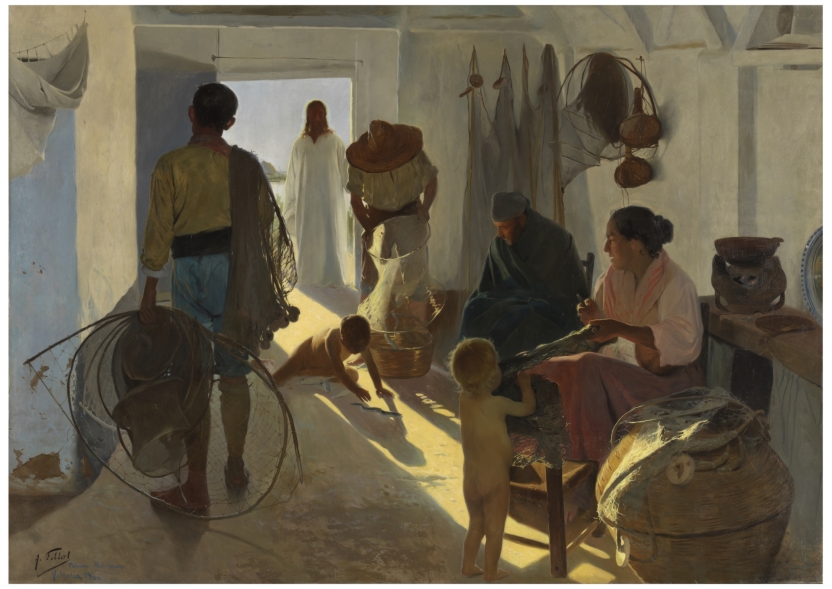
Painted in the Albufera of Valencia in 1900, this work depicts the interior of a barraca—a traditional rural dwelling—whose simplicity reveals the poverty of its inhabitants. Inside, a woman is seen mending fishing nets, accompanied by a naked child, while a second child, seated on the ground, attempts to catch an eel. The latter is watched by an elderly man, seated and wrapped in a blanket. On the left, a fisherman burdened with his tools heads toward the door, while another figure in the background empties the meager catch of the day from his creel. The apparent ordinariness of this everyday scene is disrupted by the presence of the spectral figure of Christ at the entrance of the humble home—an apparition seemingly unnoticed by the fisherman who faces away from it. The light emanating from the doorway organizes the composition and ultimately becomes its protagonist, even though its dramatic effects and stark contrasts drew criticism from some contemporary viewers.
The critical responses published during the 1901 National exhibition of Fine Arts where Fillol submitted this painting, provide valuable insights into its symbolic character. Though these reviews have received little scholarly attention, many of them attempted to interpret the painting’s meaning and to uncover the painter’s intentions. Luis Pardo, for example, noted its “strange symbolisms” and suspected an anticlerical critique, suggesting that the supposed “friendship” (a reference to the painting’s title) lacked sincerity. Valencian writer Rodrigo Soriano, a close acquaintance of the artist who had visited Fillol’s studio while the painting was in progress, also highlighted its symbolic codes and elaborated on its true message—likely conveyed to him directly by the artist:"Egalitarian doctrines are now the driving force in the world. Revolutionaries, far more Christian and humane than hypocritical Catholics and Jesuits, strive to achieve human fraternity. Jesus—not the Jesus of altars and Jesuit intrigues, but the human Jesus, the companion of his fellow men—was a friend to the poor, their comfort and guide, their champion and leader. Inspired by these noble ideas, Fillol has painted an admirable work.”
In the republican newspaper “El País”, another critic similarly read the painting as a critique of the clergy and even of broader social structures, stating that Christ had come to “observe how little attention is paid to His doctrines by those who make their living from them: prelates, friars, and statesmen.”
It is clear, then, that Fillol conceived this work with critical intent, as he had done in earlier paintings with social themes. In this case, he employs a religious image—rich in symbolic references—not only through the composition, which is illuminated from the background where Christ stands, but also through the selection of figures, which represent the various stages of life, from childhood to old age, and include a strong evocation of maternity. The woman not only tends to the children, but also to the hearth, visually suggested by the fire behind her. The interpretation of the elderly man’s attitude is more ambiguous: some critics believed he represented a feverish, and therefore ill, figure. Soriano clarified that his symptoms were caused by prolonged labor in the swampy regions of the Albufera—an interpretation that further reinforces the painting’s message by underscoring the precarious living conditions of the fishing community.
Recent scholarship has emphasized the painting’s connection with the ideals of Vicente Blasco Ibáñez—though this link was never acknowledged by contemporary critics, even those close to Fillol—and with Fritz von Uhde’s "Grace Before the Meal" (1885, Alte und Neue Nationalgalerie, Berlin). It is quite plausible that Fillol knew Uhde’s work through a printed reproduction, given its widespread circulation at the time. It should also be noted that the 1901 Exposición Nacional de Bellas Artes featured several artists who addressed religious themes in unconventional ways, often not directly drawn from the Gospels. Many demonstrated familiarity with foreign painting, which had already explored similar themes—such as Joaquín Bárbara’s The "Supper at Emmaus" (c. 1900, Museo de Jaén, on deposit from the Museo del Prado), which closely echoes the composition of Léon Lhermitte’s "Supper at Emmaus" (1892, Museum of Fine Arts, Boston).
Martínez Plaza, Pedro José, 'Antonio Fillol. Los amigos de Jesús'. Arte y transformaciones sociales en España (1885-1910), Madrid, Museo Nacional del Prado, 2024, p.200-201 nº.106