Defending the Hut
1895. Oil on canvas.On display elsewhere
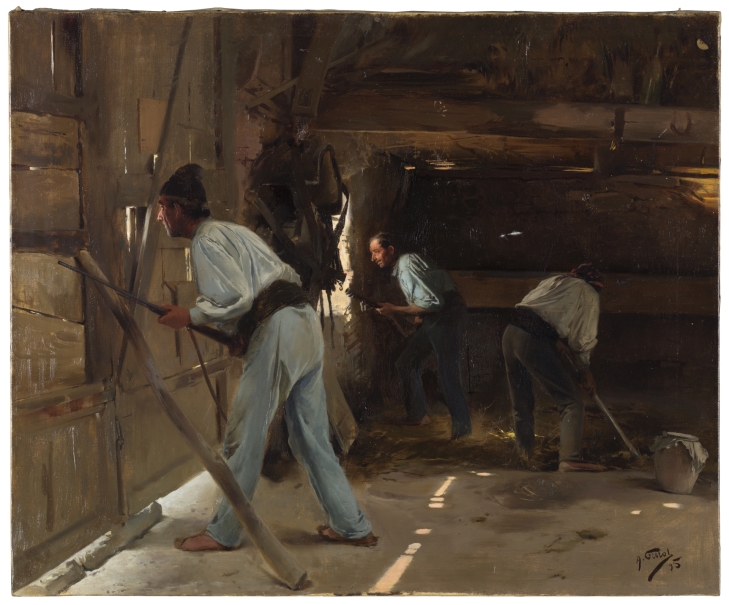
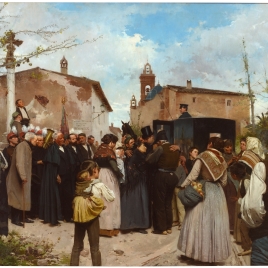
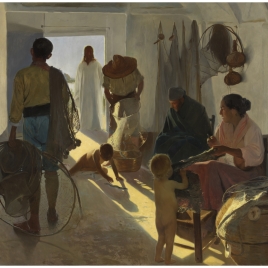
Oil painting likely conceived around the same time as “La gloria del pueblo” (P5563), although it was not submitted to the National Exhibition of 1895. This is a highly unusual work within the context of Valencian painting at the time, and in it Fillol advances a vision of the peasant that breaks decisively with prevailing clichés and idealizations. The farmworker is no longer the wry, cheerful figure so often exploited by costumbrista painting, but rather a man harassed and at times anguished by his condition—circumstances that occasionally push him to the brink, where he may resort to extreme violence in defense of the land he works.
The canvas depicts the interior of a hut or stable, where several armed huertanos lie in wait, rifles in hand. From cracks and openings in the wooden structure, they observe what is happening outside. Their faces are gaunt and weathered, their bodies lean but robust—shaped by a life of hard labor and scarcity. The figures are rendered with a realism that conveys the tension of the moment. The scene unfolds within a closed, confined space, but the intense daylight that enters through the many crevices and beneath the rustic doorway is so powerful that it illuminates the interior, sharpening the contrast between interior and exterior realities.
Were it not for the later publication date of Vicente Blasco Ibáñez’s “La barraca” (1898), one might suppose that the painting was inspired by the episode in which Uncle Barret’s home is seized. The description in the novel matches the painting so closely that it may, in fact, have been the other way around—or perhaps both Fillol and Blasco drew on the kinds of real, often violent conflicts that were common during this period. In the 1925 prologue to “La barraca”, Blasco Ibáñez recalls being influenced by a confrontation between laborers and landowners and the deep impression left on him in childhood by the sight of abandoned fields and stories of tragic rural struggles. The devastating drought that affected Valencia between 1875 and 1879 led to tenant uprisings, as many were unable to pay rent. Both Fillol and Blasco reflect the complex and conflict-ridden reality surrounding land ownership. It is very likely that Blasco was familiar with Fillol’s painting and that it inspired the literary scene he would later write.
Although the work’s principal subject is logically interpreted as the defense of the land, this reading is not entirely conclusive. The painting’s title may have been either “The Defense of the Hut” or “Escondiendo el tesoro” (Hiding the Treasure). The building itself is not, in fact, a traditional choza, but rather a more solid construction, as seen in the right-hand wall from which one of the men takes aim. Moreover, a third peasant in the scene is not holding a weapon, but instead digging or working the earth with a hoe. The subtitle introduces further ambiguity about the true motive behind the defense; it is equally plausible that these huertanos are keeping watch while one of them hides something of value.
The detailed rendering of this dilapidated interior—part stable, part storage space—perfectly captures the aged and weathered quality of such rural buildings, where dust accumulates with time. The shafts of light piercing through the countless cracks in the roof and doors enhance the contrast and contribute to the photographic objectivity and neutrality of Fillol’s gaze.
Pérez Rojas, F. Javier; Alcaide Delgado, José Luis, Antonio Fillol Granell (1890-1930): Naturalismo radical y modernismo, Valencia, Ajuntament de València, 2015, p.46-48