The satyr
1906. Oil on canvas.Room C
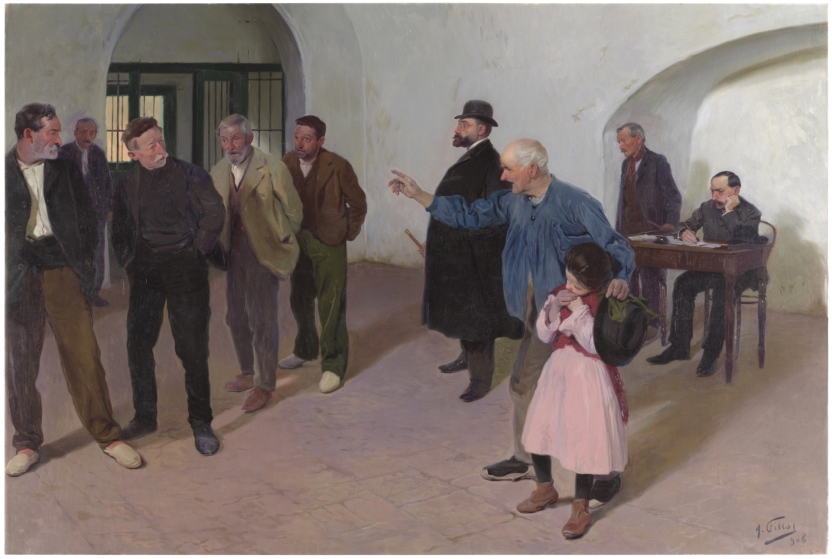
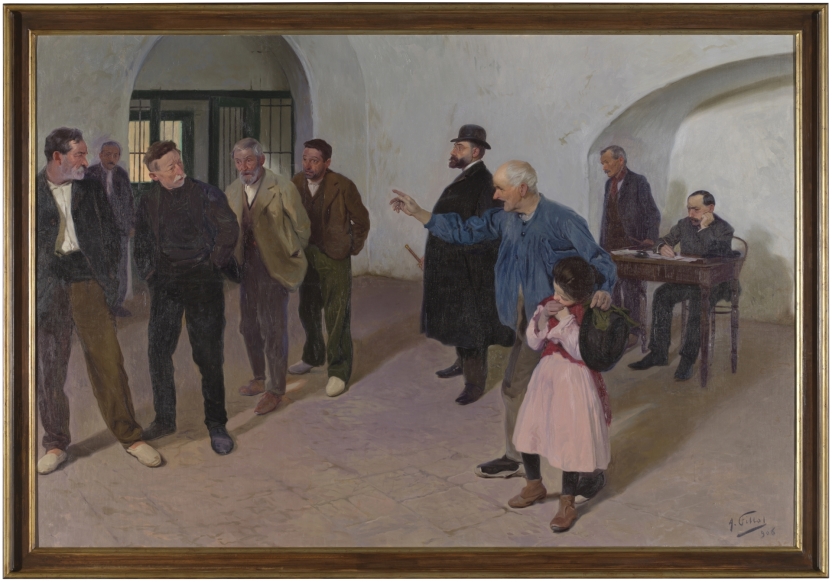
Set inside the prison at the Torres de Quart in Valencia, in a scene whose conceptualization represents the artist’s most ambitious exercise in formal synthesis, two human groups are architecturally divided, forming a visual angle. Fillol depicts them with a dry, restrained brushstroke, avoiding all forms of sensationalism while asserting a striking robustness in his drawing. In the group to the right, the figure of the venerable old man stands out as he raises an accusatory finger while shielding the young girl—now a victim—whose pensive gesture withdraws into the protection offered by her grandfather. Fillol, with great elegance, conceals her face. Behind him, indifferent court officials, unmoved by the episode, observe impassively as the perpetrator is identified. The second group consists of several detainees, among whom is the man identified as the child’s rapist, second from the left.
Although this was not the first incident of artistic censorship in early 20th-century Spain, the controversy surrounding this painting stands as one of the most significant to occur at the nation’s official painting and sculpture exhibitions of the period. Most notably, unlike the majority of earlier cases in 19th-century Spanish art culture—which typically concerned the boundaries of representing the female nude—here it was the rawness of the subject matter itself that was deemed unacceptable. The Valencian painter was accused of immorality for his choice of theme.
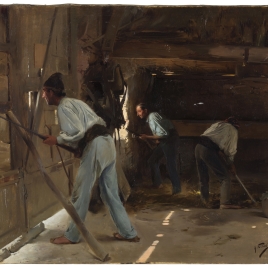
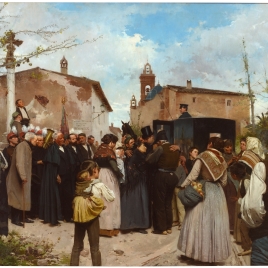
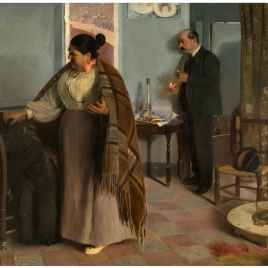
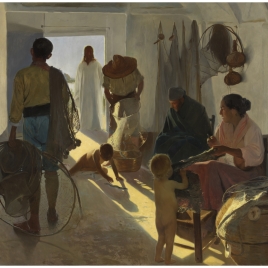
The minutes of the jury sessions for the Exposición Nacional de Bellas Artes record that, unanimously, the decision was made to reject the four paintings “on the grounds that they do not conform to the respect and decency owed to the public, nor do they correspond to the higher ideals that should inspire our art—an art that, being beautiful, must aspire to nobler ends, especially in the context of an official public manifestation of national culture.”
With this work, Fillol continued his denunciation of injustice through a radically naturalist lens, aligning himself with the sensibilities and innovations of contemporary literature.
G.Navarro, Carlos, 'Antonio Fillol. El sátiro'. Arte y transformaciones sociales en España (1885-1910), Madrid, Museo Nacional del Prado, 2024, p.350-352 nº.250