The glory of the people
1895. Oil on canvas.On display elsewhere
The canvas was awarded a second medal at the National Exhibition of 1895, when the painting was executed. Fillol at the age of twenty-five took part in this competition for the first time, as had other artists of his generation such as Manuel Benedito, José Pinazo Martínez, Julio Romero de Torres, Isidro Nonell and Ricardo Baroja, among others. It is somewhat surprising that it hadn’t happened earlier, but in his first showing he came to take a chance in the Catalan capital. Fillol´s award was certainly not insignificant considering that the same second-class recognition had been given to Pinazo Camarlench. He brought a portrait of a soldier, which the most advanced critics considered a masterpiece and the best canvas of the exhibition. Cecilio Pla brought his work Lazo de union (Bond of Union), which was one of his most ambitious works, and Santiago Rusiñol brought Santo Sepulcro (Holy Sepulchre). Thus, the young Fillol took second place to older artists who already enjoyed considerable prestige.
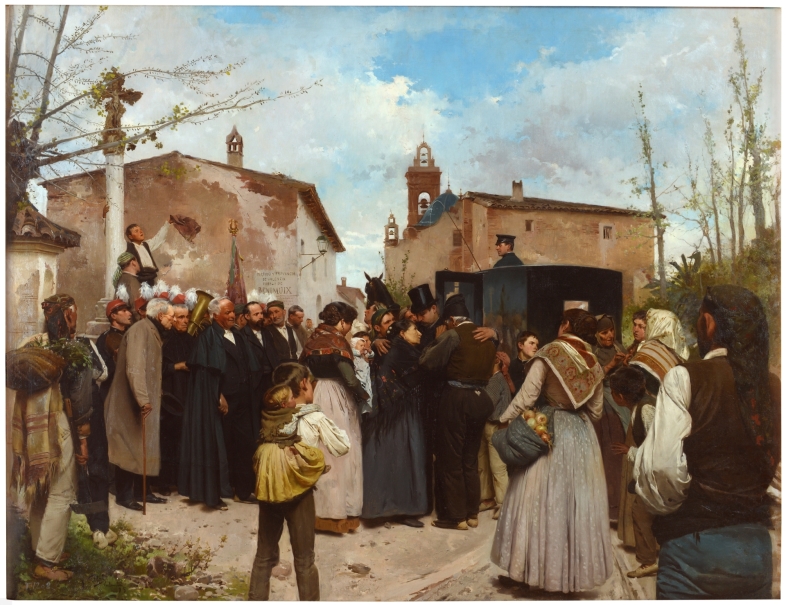
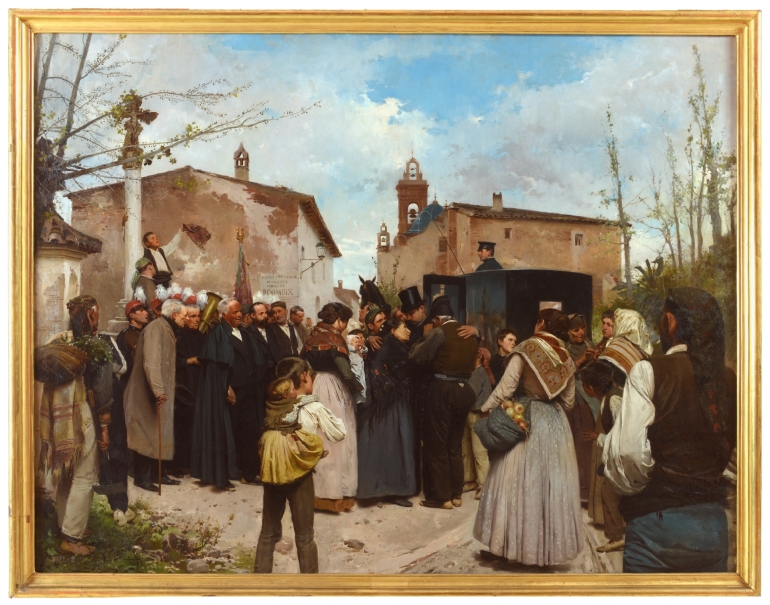
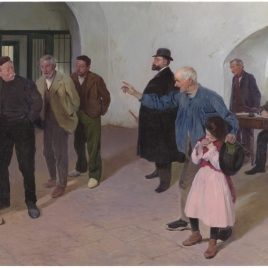
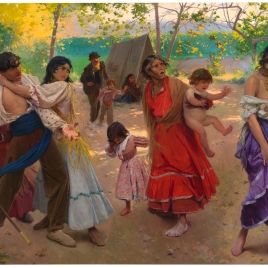
Fillol´s naturalism and fidelity of his reproduction of the outside world fully triumph in this work. The subject of the canvas is the reception or farewell given in a small village to a man of the country. He has become a celebrated person, perhaps a political victor, and he has just arrived in a black carriage which stands in front of the waiting entourage. He is elegantly dressed in black, his head covered with a shiny hat, symbolising his transformation as a man of the city and emphasising his difference from the locals in his belonging to a privileged world. The man embraces his excited parents who maintain their customary ways, their son´s ascension having made little change to their lives and clothing. The father´s trousers are baggy and somewhat dishevelled, and his knotted headscarf underline his belonging to the rural world. The mother wears a black shawl with fringes and embroidered with flowers, which in this case differs from the scarves of the other women, which are much simpler and cheaper. The woman behind her may be a sister or a relative who is going to introduce her son to the newcomer. On the left of the painting characters who must be the village authorities or most senior representatives appear together. They wear cloaks, except for the old man on the left, who wears a mackintosh and carries a walking stick. Behind them appear a brass band in full dress and wearing caps adorned with plumes. On the far left of the painting, two young locals stand on the steps of the cross. They are looking down on the reception from a higher point and one of them seems to be cheering. As in the canvas To That One, the artist positions himself in a distant plane to capture the image in perspective. There are isolated figures between the viewer and the main group, such as the man with this back to the composition, whose body is cut off. In front of him there are two women with their backs turned, one of them carrying a basket or small bundle of onions. The children are browsing and observing. The boy in the foreground with a little girl on his back stands out among them. Once again, as in the canvas To That One, Fillol gives greater prominence and presence to the secondary characters than to the protagonist. For him the latter serves really only as the binding of the scene that really interests him, the gathering of local officials and public for his reception and the space in which the event takes place.
The location of the scene is the entrance to the village, as can be seen in the fusion with the landscape that is most evident in the greenery on the right. The bare branches, with hardly any leaves, tell of autumn or winter. The local on the left of the painting, who is returning from work, walks through an area of grass and scrubland on a ground with no cobblestones. All of these details are related to a specific location, the entrance to the village, where the retinue has travelled to receive what they consider to be the glory and pride of the locality. Perhaps a politician who will end up asking for the support of the villagers in exchange for promises and benefits at a time when caciquism was the common practice. If it were a scene set in the north of Spain, it could be interpreted as the honouring of a Spanish emigrant who became rich in Latin America. However, the meaning is different in Valencia. The day is in line with the season and the sky is overcast with grey clouds that prelude the possibility of rain. The clearings between the clouds give more light to the scene, a nuanced light without contrasts that hardly casts any shadows. The shadow beneath the skirt of the woman with the basket is the most pronounced. The architecture of the houses in this farming village is as faithfully rendered as the rest of the scene: large dwellings with thick walls and asymmetrical windows. The party wall of the house on the left of the painting is stained and peeling, faithfully depicting the effects of the passage of time and abandonment, but also of the permanence of traditional life in a peaceful place where the man who has recently arrived from the city is the only exotic and contrasting element.
Fillol is an artist deeply identified with the popular sphere, a painter of traditional life who evolves at the pace of his time. He is not an artist interested in depicting modern life, but when he approaches it, he sees it from a social point of view. The modern existence which Fillol depicts involves a political and ideological consideration.