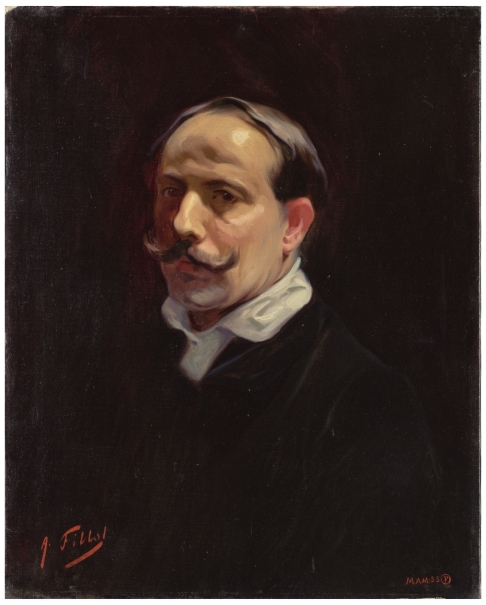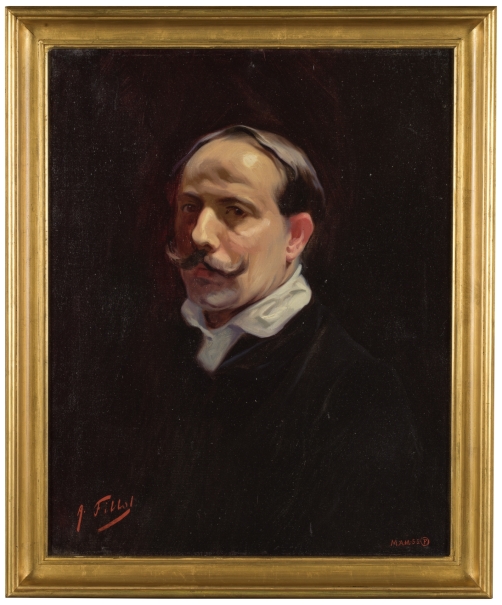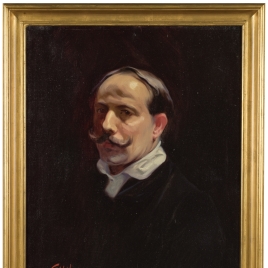
Self-portrait
1915. Oil on canvas.Not on display
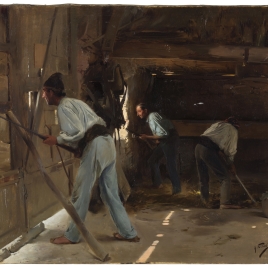
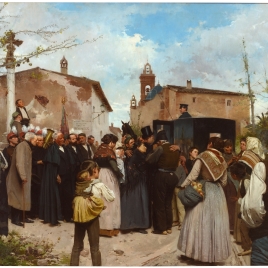
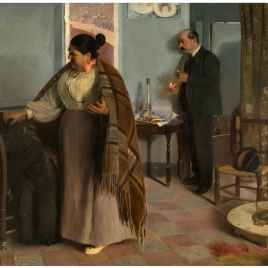
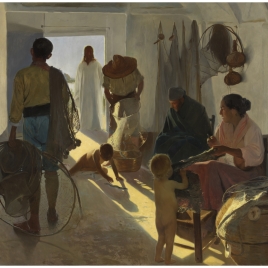
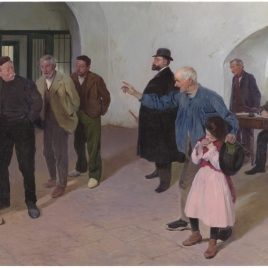
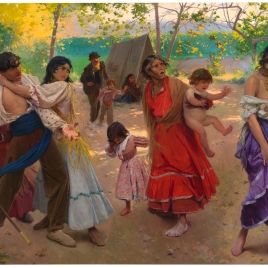
Fillol´s production is best known for its costumbrista and regionalist approach. He has produced a large and varied gallery of folkloric types, habits, and scenes. In these visions he moved on from the initial naturalism to a more decorative and sometimes characterising art.
The painter must have painted this self-portrait around 1915, when he was forty-five years old; in fact, the work was bequeathed in 1917. It is interesting to note the number of self-portraits bequests to museums, perhaps largely motivated by the painters´ desire to immortalise their image. Several of these bequests seem to stem from this motif, some dignifying the figure more than others, seeking the most flattering angle, and showing a confident and decisive personality. As in other works by the artist, the soft, diluted brushstroke is dominant in this self-portrait.
The face emerges from the half-light, while the dark background that prevents us from seeing the scarf and jacket or smock he is wearing at that moment, thereby barely hinting at them. The purpose of using this type of background – or another lighter but also neutral one – is not to distract attention from other objects but to concentrate the view on the face, which ends at the bottom on the pure white of the shirt. Fillol, who was 45 at the time, must have lost some of his hair early on, as we can see a clear forehead and the typical comb over that covers the thinning areas. The imperial-style moustache flourished as a fashion that some young modernists adopted and subsequently ceased when they reached maturity. The light shining from the left side of the painting, glinting on the forehead and cheekbone, shows a sturdy, vigorous physiognomy, a broad neck, full lips and a powerful nose. Only the fact that he is painting detracts from his energy, which he transfers to his work, immersed as he is in the painting process. In this process, it is not only the soft, melting brushstroke that prevails, but also thicker, more autonomous touches. The painter, a very worthy cultivator of impressionist modernism, knew that the field of portraiture and self-portraiture was not the most conducive for displaying his agile brushstroke. Other exceptionally gifted colleagues, with the sole exception of Ignacio Pinazo, had already proved this to be the case (Pérez Rojas, F. J.; Alcaide, J. L. in: Antonio Fillol Granell (1870–1930). Naturalismo radical y modernismo, 2015, pp. 172–173).
Pérez Rojas, F. J. en Díez, J. L., Artistas pintados: retratos de pintores y escultores del siglo XIX en el Museo del Prado, Madrid, Ministerio de Educación y Cultura, 1997, p.182