After the Strike
Ca. 1895. Oil on canvas.On display elsewhere
This painting represents the pinnacle of José Uría’s engagement with social realist themes. It was inspired by the strike carried out in the spring of 1892 by the workers of the Talleres de la Compañía del Norte in Valladolid, an event that had a significant public impact. Uría himself was likely not an eyewitness, as he did not move to Valladolid until January 1893, when he took up a teaching position at the School of Fine Arts. However, he may have received firsthand accounts from acquaintances residing there, such as his former classmate Ángel Díaz, then secretary of the School.
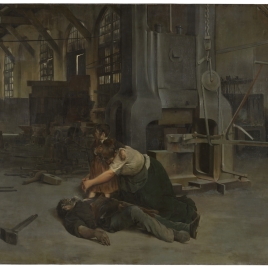
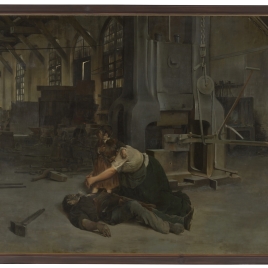
The subject matter relates closely to that of “A Workers’ Strike in Biscay” by Vicente Cutanda (Museo Nacional del Prado, P7793), which had been awarded a First-Class Medal at the 1892 Exhibition. Cutanda also submitted a work titled “Epilogue” (P6647) to the 1895 Exhibition, showing steelworkers carrying a severely injured colleague. Uría’s painting, which received a Second-Class Medal, is more dramatic in tone. At the very intersection of the two main diagonals that structure the composition lies a dead worker, flanked by his wife and daughter, surrounded by a large empty space. The carefully studied composition was among the aspects most praised in the report issued by the Royal Academy of Fine Arts of San Fernando, which recommended the painting for state acquisition.
The scene unfolds within the factory interior, rendered with remarkable precision in the depiction of machinery—a subject Uría would revisit in “Workshops of the Northern Railway” (Madrid, private collection). Light enters from both ends of the diagonals and through large windows whose sequential rhythm lends the work a sense of dynamic movement. The nuanced treatment of light reveals the influence of Velázquez, whose works Uría had studied and copied at the Museo del Prado. Like the Sevillian master, Uría favors a restrained palette dominated by greys. Some critics lamented what they perceived as a lack of definition in the background; however, the softened brushwork in the far distance is the result of an atmospheric perspective study that expands the factory space and amplifies the emotional impact of the central figures, rendering them more isolated. On the right, Uría includes a contingent of the civil guard which in fact monitored the area during the real strike.
The restrained tone of the work, praised by the critic Narciso Sentenach, struck the academic jury as excessive. Although the painting was ultimately recommended for acquisition, it was described as “lacking in feeling”—an assessment that failed to recognize how its very expressive neutrality rendered the painting more eloquent and modern. Among the critics, some perceived the work as sympathetic to the cause of workers´ emancipation and even socialism, while others interpreted it in the opposite light, viewing the painting as “a vivid depiction of the disastrous ends to which certain subversive preachings may lead; that lifeless worker stretched out on the gallery floor of the factory says more against socialism and anarchism than a dozen speeches.”
Uría’s intention was undoubtedly not propagandistic—he was by no means a promoter of socialist ideals. Rather, like many painters of his generation, he was committed to offering as objective a representation as possible of the new social and labor realities emerging at the close of the 19th century.
Barón, Javier, 'José Uría y Uría. Después de una huelga'. Arte y transformaciones sociales en España (1885-1910), Madrid, Museo Nacional del Prado, 2024, p.381 nº.277